
Gathering a list of free PMP exam questions and answers is an effective study strategy for the PMP exam. The materials helped form the basis of the practice questions I used while preparing. When studying for the PMP, don’t rely on the PMBOK Guide alone. It isn’t designed to help you pass the exam. This is one reason many candidates struggle with the test. Good luck, and if you find these PMP exam questions helpful, please share them with others.
Key takeaways
- Practice with 200 free questions. The quiz below has 200 original PMP questions with an explanation for every answer, in your browser and with no sign-up.
- Know the new exam format. Since July 9, 2026, the PMP exam has 180 questions in 240 minutes, with two 10-minute breaks. Of these, 170 are scored and 10 are unscored pretest questions.
- Study by domain weight. Process makes up 41% of the exam, People 33% and Business Environment 26%. About 60% of questions use agile or hybrid approaches.
- Rehearse the full exam. Use the 180-question simulator to build stamina. PMI does not publish a passing score, so use your score as a guide and review every mistake.
Try our free PMP practice quiz below
Try our free PMP practice quiz below. This PMP quiz works in your browser with no sign-up, and it draws on 200 original questions written for the new exam that PMI launched on July 9, 2026. Take a quick quiz, practice one domain, or sit the full 180-question exam simulation with two breaks, just like test day. Every answer comes with a short explanation. To see how the questions map to the exam, read how the PMP exam is structured.
Practice with 200 free PMP exam questions
Take a quick quiz, practice one exam domain, sit a timed 180-question exam simulation, or review the questions you missed.
Set aside about 4 hours and 20 minutes. The exam has 3 sections of 60 questions. Within a section you can flag questions and go back to any of them. After sections 1 and 2 you can take a 10-minute break with the clock paused. A finished section is locked.
The questions you miss are saved in this browser so you can practice them again.
See what the 200 questions above cover
| Exam task and what it covers | Questions |
|---|---|
| Domain I: People | 66 |
| 1.1Develop a common visionProduct vision and product goal, shared success criteria, linking work to business outcomes, onboarding new members, a change of sponsor | 7 |
| 1.2Manage conflictsPersonal and technical disagreements, conflict resolution approaches, cultural friction in distributed teams, matrix resource conflicts, competing priorities | 9 |
| 1.3Lead the project teamServant leadership, self-organization, team development stages, delegation, sustainable pace, rewards, skill building, responsible use of AI tools | 10 |
| 1.4Engage stakeholdersIdentifying and analyzing stakeholders, the power/interest grid, resistant stakeholders, regulators, end users, hidden concerns | 9 |
| 1.5Align stakeholder expectationsCharter and success criteria, feature priorities, conflicting requirements, acceptance criteria, assumptions, sprint reviews | 7 |
| 1.6Manage stakeholder expectationsForecasts and trade-offs, milestone slips, gold plating, expectations about AI gains, response times, backlog transparency | 8 |
| 1.7Help ensure knowledge transferExperts leaving, handover to operations, lessons learned during the project, communities of practice, tacit knowledge, AI-generated code | 7 |
| 1.8Plan and manage communicationCommunication channels, information needs, communication methods, information radiators, time zones, confidential data, honest reporting | 9 |
| Domain II: Process | 82 |
| 2.1Develop an integrated project management plan and plan deliveryTailoring predictive, agile and hybrid approaches, integrating subsidiary plans, baselines, rolling wave planning, release planning | 9 |
| 2.2Develop and manage project scopeThe WBS and the 100 percent rule, scope validation, traceability, exclusions, backlog refinement, story splitting, hybrid scope control | 9 |
| 2.3Help ensure value-based deliveryOutcomes versus output, MVPs, benefits measurement, cost of delay, MoSCoW, incremental delivery, A/B tests, value-based cost cuts | 8 |
| 2.4Plan and manage resourcesNegotiating for resources, leveling and smoothing, multitasking, RACI charts, cross-functional teams, resource calendars, materials | 8 |
| 2.5Plan and manage procurementContract types, contract change control, bidder fairness, claims, seller selection, statements of work, AI terms, termination | 8 |
| 2.6Plan and manage financeEAC, ETC, TCPI and VAC, cost baseline and budget, contingency and management reserves, agile funding, funding limits | 8 |
| 2.7Plan and optimize quality of products/deliverablesPrevention over inspection, definition of done, cost of quality, Pareto and control charts, technical debt, continuous integration, grade | 8 |
| 2.8Plan and manage schedulePERT estimates, float, critical path, crashing and fast tracking, velocity forecasts, lags, near-critical paths, sprint timeboxes | 9 |
| 2.9Evaluate project statusCPI and SPI, burndown and cumulative flow, variance thresholds, honest status reporting, earned value rules, Monte Carlo, velocity | 9 |
| 2.10Manage project closureClosure activities, early termination, transition criteria, contract closure, benefits ownership, final acceptance | 6 |
| Domain III: Business Environment | 52 |
| 3.1Define and establish project governanceDecision thresholds, phase gates, approval authority, tailoring governance for agile, AI and data decisions, PMO types | 7 |
| 3.2Plan and manage project complianceNew regulations, sustainability reporting, mandatory inspections, compliance evidence in agile, gifts from bidders, accessibility | 6 |
| 3.3Manage and control changesChange requests and impact analysis, change in agile, rejected changes, configuration management, emergency changes, change freezes | 7 |
| 3.4Remove impediments and manage issuesRemoving blockers, escalation, recurring issues and root causes, the issue log, cross-team dependencies, workarounds | 7 |
| 3.5Plan and manage riskResponse strategies, spikes, expected monetary value, secondary risk, risk appetite, opportunities, urgency, missed triggers | 8 |
| 3.6Continuous improvementRetrospectives, value stream mapping, applying lessons in the next phase, benchmarking, WIP limits, using lessons learned | 6 |
| 3.7Support organizational changeChange readiness, managers’ roles in agile, sustaining change, visible sponsorship, change fatigue, change champions | 6 |
| 3.8Evaluate external business environment changesTariffs, competitors, investor sustainability expectations, new AI services, PESTLE analysis | 5 |
| Total, across 3 domains and 26 tasks | 200 |
Domains, weights and tasks follow PMI’s PMP Examination Content Outline for the exam launched on July 9, 2026. All questions are original.
What Is the PMP Certification?
The PMP (Project Management Professional) certification is one of the most globally recognized and respected credentials in the field of project management. Awarded by the Project Management Institute (PMI), it validates an individual’s ability to lead and manage projects effectively across a wide range of industries and methodologies. As the project management landscape continues to evolve, the PMP exam has been updated to reflect the growing importance of Agile and Adaptive approaches alongside traditional predictive frameworks.
This practice exam has been designed with that evolution in mind. The interactive quiz on this page includes 200 original questions covering predictive, agile and hybrid approaches, plus a timed 180-question exam simulator. Specifically, this practice exam is designed to help candidates:
- Understand and apply Agile and Adaptive methodologies within the PMP framework.
- Test their knowledge and readiness for the updated PMP certification exam.
- Identify areas of improvement to focus their study efforts more effectively.
Why Practice Questions Are Essential for PMP Exam Success
Many candidates underestimate the gap between understanding project management concepts and being able to apply them under PMP exam conditions. The PMP exam is not a straightforward knowledge test. PMI deliberately crafts questions to be complex, nuanced, and scenario-driven — often presenting multiple answers that appear correct at first glance. Passing requires the ability to identify the best answer in context, not just the technically accurate one.
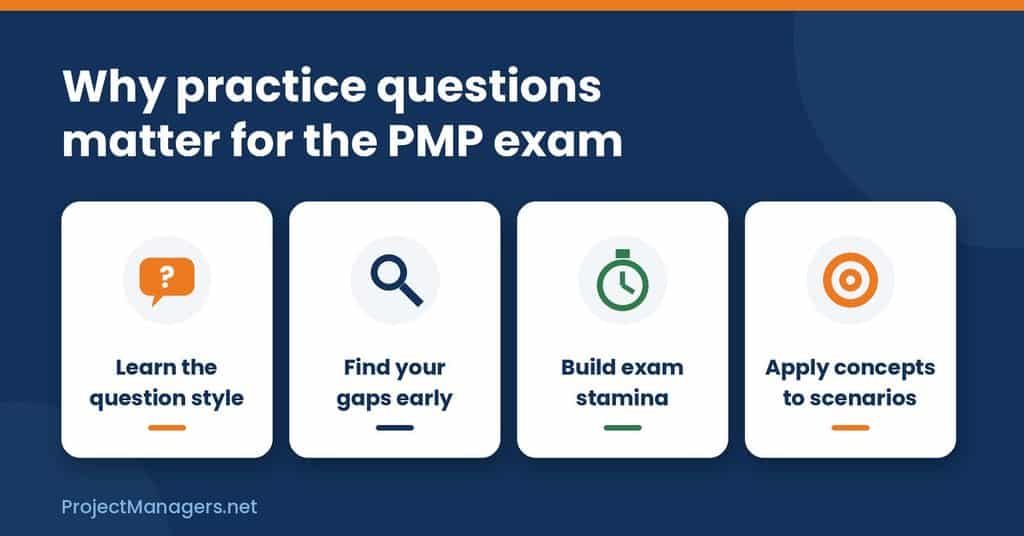
Practicing with a large bank of exam-style questions addresses this challenge in several important ways:
- Familiarity with PMI’s Question Style: The PMP exam uses a very specific style of questioning that rewards situational thinking over rote memorization. Regular practice helps candidates internalize this style and develop the instincts needed to navigate ambiguous scenarios confidently.
- Identifying Knowledge Gaps Early: Working through practice questions quickly surfaces the areas where your understanding is weakest — giving you targeted, actionable direction for your remaining study time rather than requiring you to review everything equally.
- Building Exam Stamina: The PMP exam is demanding and time-intensive. Regularly completing full sets of practice questions builds the mental endurance needed to maintain focus and accuracy across the full duration of the exam.
- Reinforcing Concept Application: Reading about a concept and applying it to a realistic scenario are two very different cognitive tasks. Practice questions bridge this gap by forcing you to apply what you know in context — which is exactly what the real exam demands.
How the PMP Exam Is Structured
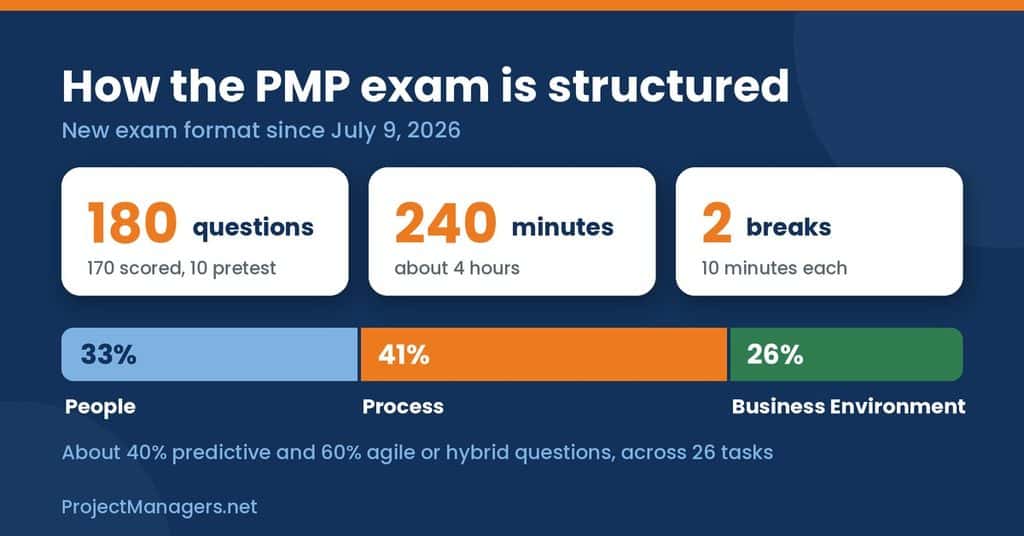
Understanding the structure of the PMP exam is an important part of effective preparation. The current exam consists of 180 questions to be completed within a total time limit, with two scheduled breaks provided. Questions are drawn from three primary domains that reflect the full scope of a project manager’s responsibilities:
- People: This domain focuses on the skills and activities associated with effectively leading a project team. It covers topics such as team building, conflict resolution, stakeholder engagement, and servant leadership — areas that have become increasingly prominent in the updated exam.
- Process: The Process domain addresses the technical aspects of project management, including planning, executing, monitoring, and controlling project work. It spans both predictive and agile approaches, requiring candidates to demonstrate fluency across methodologies.
- Business Environment: This domain examines the relationship between projects and the broader organizational strategy. It covers topics such as benefits realization, organizational change, compliance, and the alignment of project outcomes with business objectives.
Since July 9, 2026, the PMP exam follows a new Examination Content Outline aligned with the PMBOK Guide 8th Edition. It has 180 questions (170 scored and 10 unscored pretest questions) in 240 minutes, with two 10-minute breaks. The questions cover three domains: People (33%), Process (41%) and Business Environment (26%), across 26 tasks. About 40% of questions use predictive approaches and 60% use agile or hybrid approaches. Question types include multiple choice, multiple response, case studies, matching, hotspot and drag and drop. New topics include AI, sustainability and project finance.
What to Expect from Agile and Adaptive Questions
One of the most significant changes to the PMP exam in recent years is the expanded emphasis on Agile and Adaptive methodologies. Candidates who are primarily familiar with traditional waterfall-based project management will find this portion of the exam particularly challenging without dedicated preparation.
Agile and Adaptive questions on the PMP exam typically focus on:
- Scrum Framework Fundamentals: Sprints, ceremonies, roles such as Scrum Master and Product Owner, and the mechanics of iterative delivery.
- Servant Leadership: Agile project management places a strong emphasis on the project manager as a facilitator and enabler rather than a directive authority. Questions in this area test your understanding of how to lead without commanding.
- Responding to Change: Agile is built on the premise that requirements will evolve. Exam questions frequently test your ability to respond to change constructively while keeping the team focused and the project on track.
- Hybrid Approaches: Many real-world projects blend predictive and agile elements. The exam reflects this reality by including scenarios that require candidates to draw on both methodologies and select the most appropriate approach for a given situation.
- Business Environment grew from 8% to 26% of the exam.
Tips for Using These Practice Questions Effectively
Getting the most out of a practice question bank requires more than simply working through the questions and checking your answers. Here are strategies that will maximize the value of your preparation:
- Review Every Answer — Not Just the Wrong Ones: Understanding why a correct answer is right is just as important as understanding why a wrong answer is wrong. PMI’s reasoning often reveals important nuances about how the exam expects you to think.
- Simulate Real Exam Conditions: Set a timer, minimize distractions, and complete full sets of questions in one sitting wherever possible. The closer your practice conditions mirror the real exam, the more effectively you will be prepared for it. Use the full exam simulation in the quiz above.
- Focus on the “Best” Answer, Not Just the “Correct” One: PMP questions frequently present multiple technically defensible answers. Train yourself to identify which answer PMI would consider the best response given the specific context of the scenario.
- Track Your Performance by Domain: Monitor which of the three exam domains (People, Process and Business Environment) you score lowest in.
- Use Multiple Study Resources: Complement these practice questions with a reputable PMP exam prep course, the PMI Examination Content Outline (ECO), and the Agile Practice Guide. No single resource covers everything the exam tests.
- Eligibility (optional): Qualifying experience now counts from the last 10 years. From December 1, 2026, live training hours must come from a PMI Authorized Training Partner or an eligible academic program.
Conclusion
Preparing for the PMP exam is a serious undertaking, but with the right approach and the right resources, it is entirely achievable. Practice questions are not just a supplementary study tool — they are one of the most reliable predictors of exam readiness. The more scenarios you work through, the more naturally PMI’s style of reasoning will come to you when it matters most.
Remember to study across all three domains, give Agile and Adaptive methodologies the attention they deserve, and never rely on any single resource alone. Approach each practice question as an opportunity to sharpen your judgment, not just test your memory. The PMP certification is one of the most valuable credentials in project management. Put in the preparation it deserves, and success will follow.
Suggested articles:
- PMP Exam Prep: How to Pass the PMP Certification Exam
- Free PMP Exam Study Guide Tips
- 1000+ Free CAPM Exam Questions to Practice for the CAPM Test

Shane Drumm, holding certifications in PMP®, PMI-ACP®, CSM, and LPM, is the author behind numerous articles featured here. Hailing from County Cork, Ireland, his expertise lies in implementing Agile methodologies with geographically dispersed teams for software development projects. In his leisure, he dedicates time to web development and Ironman triathlon training. Find out more about Shane on shanedrumm.com and please reach out and connect with Shane on LinkedIn.