
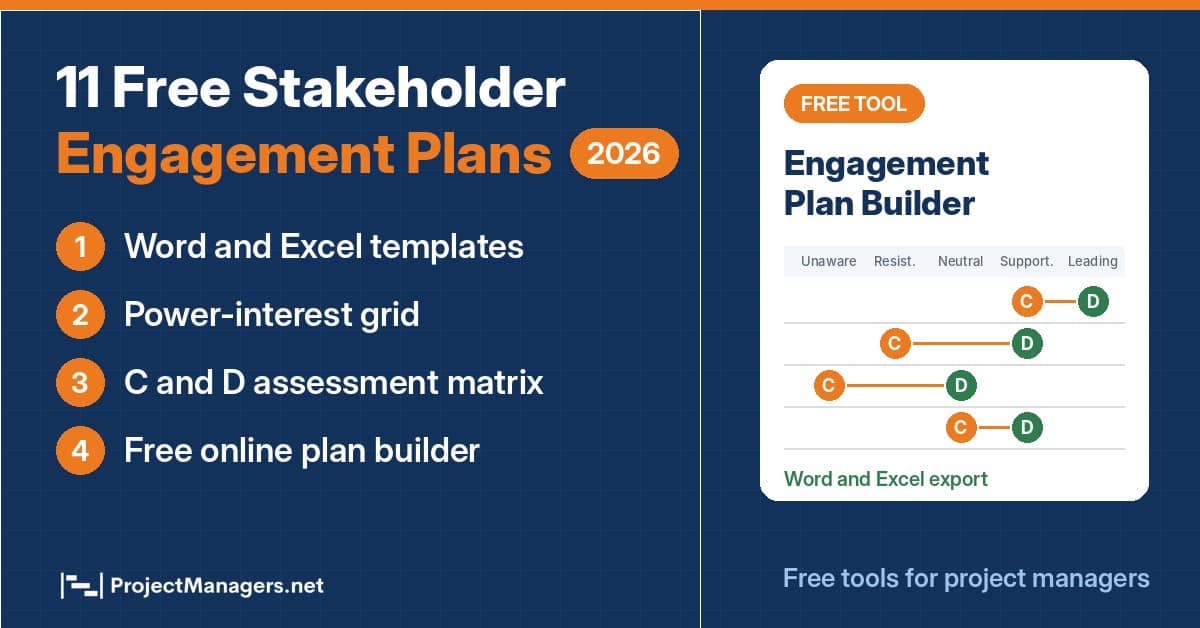
A stakeholder engagement plan tells the project manager who needs to be involved in the project, how much support each person or group gives today, how much support the project needs from them, and exactly how the team will close that gap. It names a contact for every stakeholder, a channel, a frequency and an owner, so engagement happens on purpose instead of by accident.
- What It Is: A stakeholder engagement plan lists every stakeholder, scores their power and interest, compares their current (C) and desired (D) engagement, and sets the channel, frequency and owner the project manager will use to close each gap.
- 11 Free Templates: Download our own Excel and Word templates, or pick from 9 other free options in Google Docs, Google Sheets, Excel and PDF, including the World Bank and NHS formats.
- Why It Matters: PMI found that 56% of the budget at risk on projects is at risk because of ineffective communication, and 55% of project managers call stakeholder communication the most critical success factor.
- Do It Right: Never plan to keep anyone Unaware or Resistant, give every gap a next action and an owner, and review the plan at every phase gate.
Every project has stakeholders, but the effort it takes to engage them varies a lot. A highway or hospital build can involve councils, regulators, residents and the media, while an internal software update may only need a sponsor, a few department heads and the end users. A good plan scales to fit the project.
What Is a Stakeholder Engagement Plan?
A stakeholder engagement plan is a project document that describes how the project manager and the project team will involve each stakeholder in decisions and keep their support from initiation to closing. For small projects, a project manager may not need a formal stakeholder engagement template. For large, complex projects with many stakeholders, a written plan is what keeps the project from being surprised by someone it forgot.
The plan builds on the stakeholder register and on any other management plans already in place, such as the communication plan and the risk management plan. Once the project manager drafts it, the sponsor or the steering committee approves it, and the project team updates it whenever a stakeholder changes role, power, interest or attitude.
The Project Management Body of Knowledge (PMBOK) treats this as core project management practice. The sixth edition made Plan Stakeholder Engagement a formal process with the stakeholder engagement plan as its output, and the eighth edition, published in November 2025, keeps Plan Stakeholder Engagement inside its Stakeholders performance domain. Depending on the project, the plan can be a one-page table or a detailed document with a grievance process and a budget.
11 Free Stakeholder Engagement Plan Templates
We checked every template below in November 2026. The first two are our own and are free to download with no sign-up. The rest come from other publishers, so their format and level of detail vary. Pick the one that matches the size of your project and the tool your team already uses.
| Template | Source | Format | Best for | Link |
|---|---|---|---|---|
| 1. Stakeholder Engagement Plan Template (Excel) | ProjectManagers.net | Excel | Power-interest scoring, automatic grid position, C and D matrix, gap and plan checks | Download |
| 2. Stakeholder Engagement Plan Template (Word) | ProjectManagers.net | Word | A written plan with register, grid, matrix, schedule and approval page | Download |
| 3. Project Stakeholder Engagement Plan Example | Google Docs | Google Docs, Word | A filled-in example to learn from | Get template |
| 4. Materials Funding Stakeholder Engagement Plan | Google Docs | Google Docs, Word | Funding and grant projects | Get template |
| 5. Project Stakeholder Engagement Plan | Google Sheets | Google Sheets, Excel | Teams that share one live tracker | Get template |
| 6. Basic Stakeholder Engagement Plan | Google Sheets | Google Sheets, Excel | Small projects that need a simple list | Get template |
| 7. Appvizer Stakeholder Engagement Plan Template | Appvizer | Excel (email required) | A ready-made spreadsheet if you do not mind a sign-up form | Get template |
| 8. NHS Stakeholder Engagement Strategy Template | NHS Elect | Health and public sector projects, with a power-interest grid and action plan | Get template | |
| 9. Sample Stakeholder Engagement Plan | World Bank | Large or high-risk projects that need a grievance mechanism and budget | Get template | |
| 10. Compass Stakeholder Engagement Plan Template | The Compass (AccountAbility T15) | Planning a single engagement event, from invitations to feedback | Get template | |
| 11. Stakeholder Engagement Plan Example | U.S. DFC (PT Domas Agrointi Prima) | Industrial and community projects, phased over the project life cycle | Get template |
Both files come with a worked example (an ERP system rollout) that you can overwrite. The Excel version scores power and interest, places each stakeholder on the grid, builds the C and D matrix and flags missing owners and actions.
Need a full set of project documents? See our 50+ project management templates.
Free Stakeholder Engagement Plan Builder
Prefer to work online? Add your stakeholders, score their power and interest, and set where they are today (C) and where the project needs them (D). The builder places each stakeholder on the power-interest grid, suggests a contact frequency, builds the engagement assessment matrix and checks your plan for gaps. It opens with a worked example, and you can export the finished plan to Word, Excel or CSV.
Loading the Stakeholder Engagement Plan Builder…
Why Stakeholder Engagement Matters to Project Managers
Projects rarely fail because one task ran late. They fail because the people who could approve, fund, use or block the project were not on board when it mattered. A stakeholder engagement plan makes that support something the project manager manages, measures and reports, like scope or budget.
The research backs this up:
of the budget at risk on projects is at risk because of ineffective communication: $75 million of every $135 million at risk per $1 billion spent. PMI, Pulse of the Profession 2013
of project managers say effective communication with all stakeholders is the most critical success factor in project management. PMI, The Essential Role of Communications
of respondents agree the executive sponsor role has grown in importance over the past five years. PMI, Executive Sponsor Engagement
projects and programs have an assigned executive sponsor, the stakeholder PMI calls the top driver of project success. PMI, Pulse of the Profession 2014
The PMI 2013 figures come from a survey of 1,093 project, program and portfolio managers. Treat them as a long-standing benchmark rather than this year's numbers.
Parts of a Stakeholder Engagement Plan
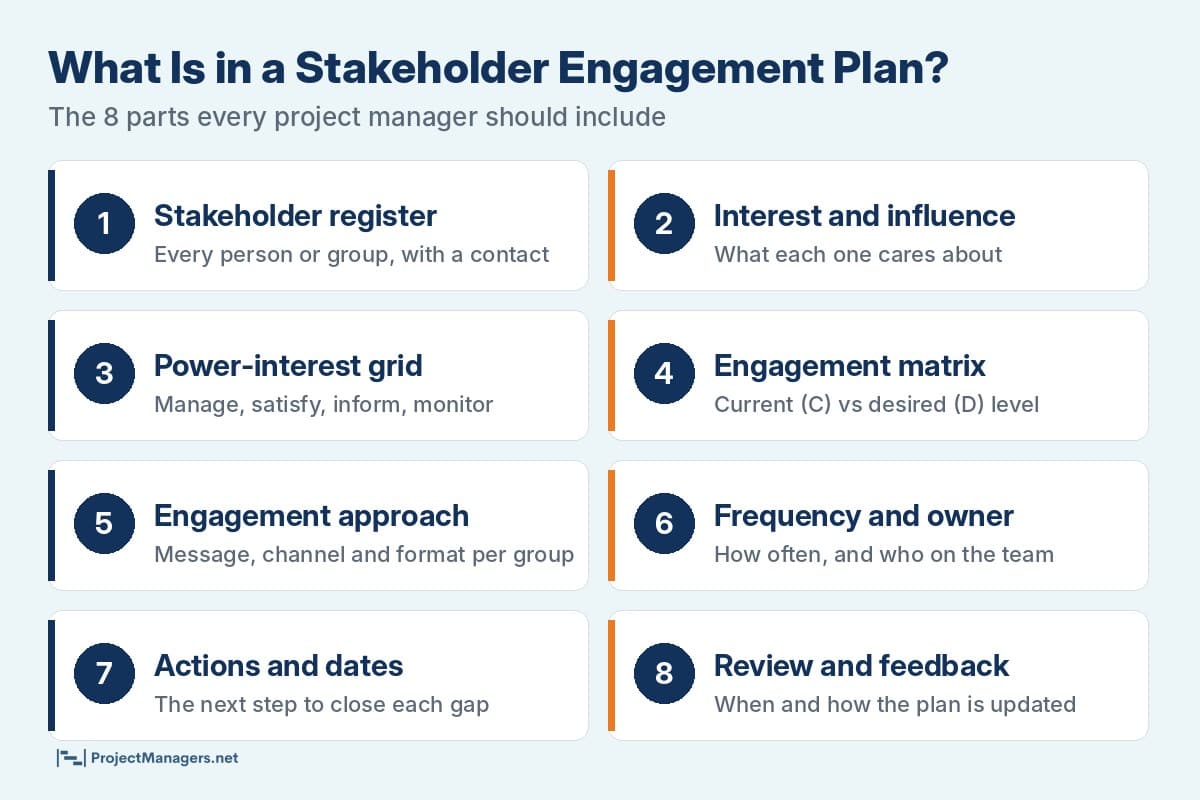
A complete plan gives the project manager a full picture of every stakeholder relationship and a clear way to manage it. These are the parts to include:
- Stakeholder List: Every person or group with an interest in the project, which PMBOK calls the Stakeholder Register. Be thorough: overlooking even a minor stakeholder can cost the project weeks later.
- Project Phase: Which stakeholders matter in which phase, so the project team engages the right people at the right time instead of everyone all the time.
- Contact Name: One named person for each stakeholder. This matters most for large organizations, such as government agencies or corporations, where many people could speak for the group.
- Influence Area: What each stakeholder cares about, how their interests overlap with the project goals, and what they can change. Real engagement starts with understanding what is in it for them.
- Power: Every stakeholder has some power to shape, delay or stop the project. Writing it down shows the project manager the cost of bypassing anyone. Purchasing decisions show how real that cost is: Adience’s research on B2B buyers notes that an average of 13 people influence a B2B purchase, and 26% of the 350 buyers surveyed named vendors trying to bypass procurement among the behaviors that frustrated them most.
- Engagement Approach: The specific strategies for communicating with stakeholders: the message, the channel, the format and the frequency. Daily emails, a weekly demo or a quarterly briefing all work, as long as the plan says which one and who sends it.
- Current and Desired Engagement: Where each stakeholder is today and where the project needs them, recorded in the engagement assessment matrix (more on this below).
- Actions, Owners and Review Dates: The next step to close each gap, the person on the project team who owns it, and when the plan will be reviewed.
Principles of Stakeholder Engagement
A few principles separate engagement that builds support from engagement that only fills calendars:
- Identify Stakeholders Widely: Use more than one method, such as a stakeholder map, an influence diagram, the salience model or the stakeholder cube, so nobody is missed. A stakeholder is anyone with a positive or negative interest in the project outcome.
- Analyze Power and Interest: Find the stakeholders who can approve or stop the project, and the ones who care a great deal even without formal power. This tells the project manager where to spend limited time.
- Tailor the Message: Give each group the information it needs, in its language. With stakeholders who are resistant, start by listening and answering their concerns rather than pushing more project updates at them.
- Engage Early and Often: Involve stakeholders from the first evaluation through to closing, not only at milestones. People commit to what they helped shape.
- Be Honest: Share bad news early and explain decisions, including the ones that did not go a stakeholder's way. Trust lost through surprises is slow to rebuild.
How to Develop a Stakeholder Engagement Plan in 6 Steps
Here is how a project manager can build the plan, in the same order our builder and templates follow:
- Identify and Classify Stakeholders: List everyone, then group them by their relationship to the project: upward (sponsor and leadership), downward (project team and suppliers), sideways (peer managers and contractors) and outward (customers, regulators, communities, competing projects).
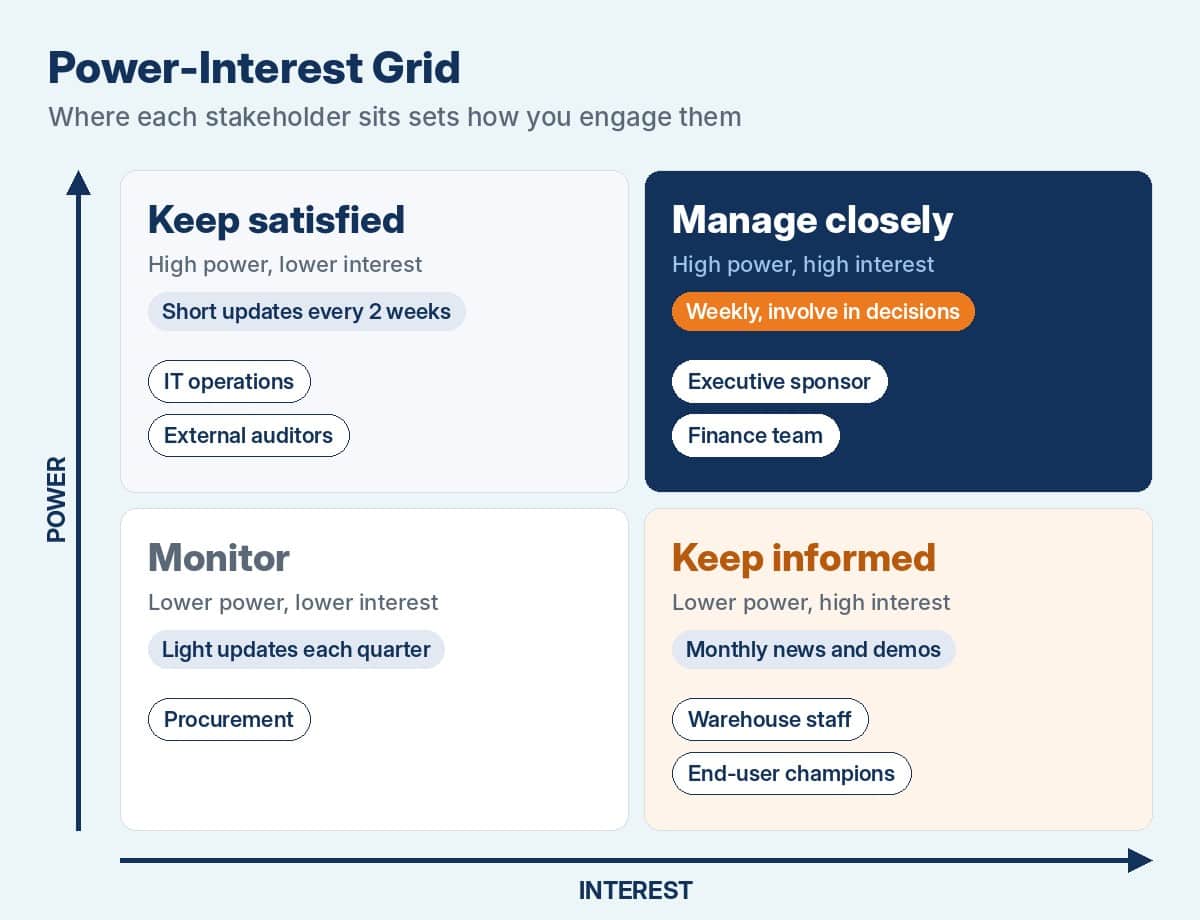
- Map Power and Interest: Score each stakeholder from 1 to 5 on power and on interest and place them on a power-interest grid. The quadrant gives you a default approach: manage closely, keep satisfied, keep informed or monitor.
- Describe Power and Interest in Words: Scores hide detail. Write one line on what each stakeholder can actually change (budget, approvals, adoption) and what they want from the project.
- Assess Current and Desired Engagement: Mark where each stakeholder is today (C) and where the project needs them (D) on the five-level engagement assessment matrix.
- Plan the Engagement: For every gap, choose the message, channel, frequency and owner, and write the next concrete action with a due date.
- Review and Update: Revisit the plan at every phase gate and whenever a stakeholder changes role or attitude. Update C as people move, and report the gaps in your status reports.
Stakeholder Engagement Assessment Matrix
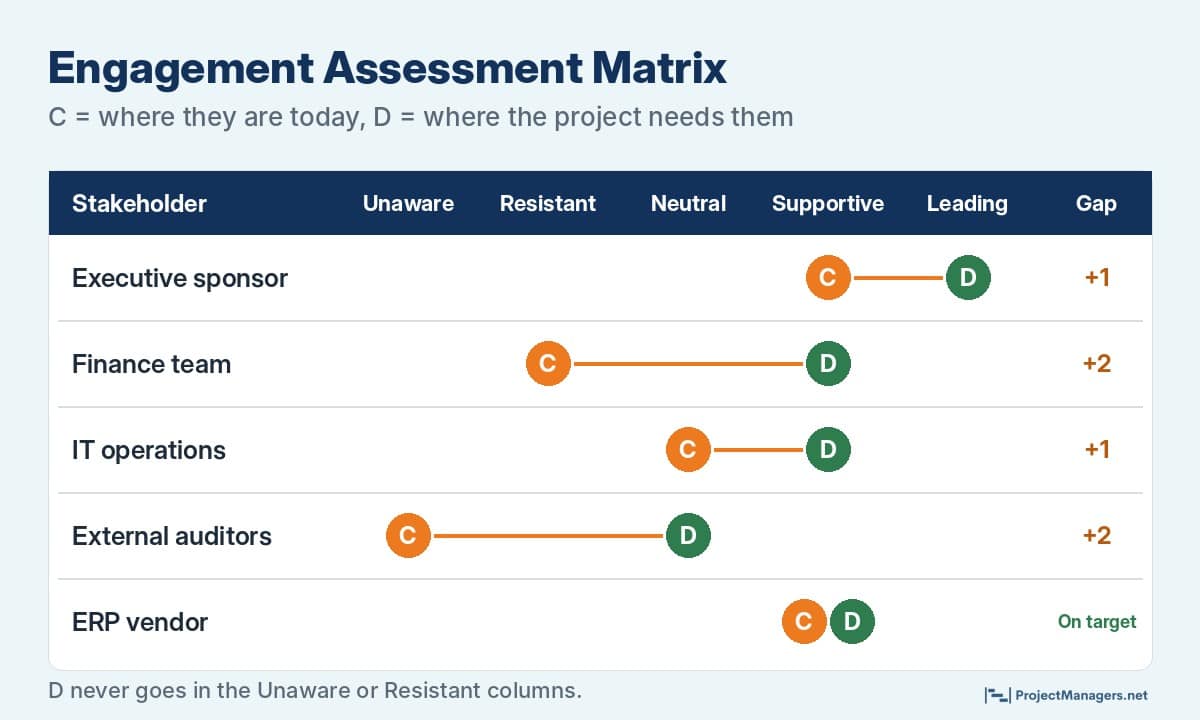
The stakeholder engagement assessment matrix is a simple project management tool that shows the gap between how engaged each stakeholder is and how engaged the project needs them to be. PMBOK uses it in several processes: planning communications, monitoring communications, planning stakeholder engagement and monitoring stakeholder engagement. During planning it records the desired level for each stakeholder. During monitoring it compares the actual level against that target.
Levels of Stakeholder Engagement
The matrix places every stakeholder in one of five levels:
- Unaware: They do not know about the project or how it affects them. They need basic information before any real engagement can start.
- Resistant: They know about the project and oppose it or the change it brings. Their concerns need careful, empathetic attention.
- Neutral: They know about the project but neither support nor resist it. Consistent engagement can turn them into supporters.
- Supportive: They know about the project and back it. Maintaining stakeholder engagement at this level means keeping them informed and thanking them for their help.
- Leading: They are fully engaged and actively work to make the project succeed. Often called change champions, they become powerful advocates when the project manager gives them the right information and a platform.
In the matrix, C marks the current level and D marks the desired level. A D never goes in the Unaware or Resistant columns, because no project manager should aim to keep a stakeholder uninformed or opposed. When C and D sit in the same column, that stakeholder is on target.
Benefits of a Stakeholder Engagement Assessment Matrix
The matrix pays off in both planning and day-to-day project management:
- More Project Support: It shows which stakeholders already back the project, so the project manager can keep that support and ask trusted supporters to help spread the message.
- Fewer Surprises: Stakeholders who are unaware or quietly resistant become visible early, and get their own engagement actions before passive resistance turns into a blocker.
- A Clear Progress Measure: Counting the gaps that are closing (or opening) gives the steering committee a simple engagement measure to track alongside schedule and budget.
Stakeholder Engagement Plan Examples
Here is how three different projects might fill in the same plan. The approach changes with the stakeholder, not with the template.
Finance team (end users)
C to DResistant to Supportive
Engagement approachWeekly hands-on demos run by the change lead, plus a feedback channel. Their concerns about month-end workload go into the risk register.
Local residents
C to DResistant to Neutral
Engagement approachA monthly open house and a project web page with the construction schedule, noise hours and a named community liaison.
Affected communities and vulnerable groups
C to DUnaware to Supportive
Engagement approachConsultations during preparation, public disclosure of project information and a grievance mechanism, as Environmental and Social Standard 10 requires.
How to Improve Stakeholder Engagement
A plan is a starting point. Project managers who keep refining their approach get better results than those who follow the first draft to the letter.
Demonstrate Care and Concern for Stakeholders
When the project manager shows real empathy, stakeholders are far more likely to trust that the project team is acting in good faith. Teams that brush off or argue with stakeholders who raise concerns often create opposition that is slow and expensive to resolve. Even when a suggestion cannot be adopted, acknowledging it respectfully stops negative opinion from spreading. Empathy is not just a soft skill here; it is a practical risk management tool.
Emphasize the Human Aspect
Not every stakeholder cares about financial returns. Many care about what the project means for people: jobs, community services, safety or the way their own work will change. When you present the project or ask for input, explain its benefits for people alongside its business case. Check that your project goals do not read as purely profit-driven, which can push away stakeholders with social or community interests.
Ensure Stakeholders Have a Voice
Stakeholders who believe they are heard are much more likely to support the project goals. Many arrive skeptical that their feedback will change anything, so show them what happened to it. Create regular moments for stakeholders to share concerns and ideas, then close the feedback loop by telling them how their input was used. This turns passive participants into active advocates.
Measure Engagement, Not Activity
Sending more emails is not the same as building support. Track how many C to D gaps are closing, which stakeholders still have no owner, and whether actions are done on time. Report these numbers in your project status reports so the sponsor sees engagement as part of project health.
Video About Stakeholder Engagement Tips
In this short video from Online PM Courses, Mike Clayton shares five practical tips that help project managers build stronger stakeholder relationships, keep their support and keep communication effective through the whole project.
Video by Online PM Courses (Mike Clayton) on YouTube.
Facts Worth Checking
A lot of stakeholder advice gets repeated without a source. Here is what the evidence says about six common claims.
| Claim | Verdict | What the data says | Source |
|---|---|---|---|
| “Poor communication puts more than half of project budget risk on the line.” | True | PMI found 56% of the budget at risk was at risk because of ineffective communication. The study is from 2013, so treat it as a long-standing finding, not a current figure. | PMI, 2013 |
| “PMBOK requires every project to have a formal stakeholder engagement plan.” | Partly true | PMBOK is a guide, not a rule book. It describes Plan Stakeholder Engagement as a process (still part of the Stakeholders domain in the 2025 eighth edition), and the plan can be informal on a small project. | PMBOK 8 overview |
| “Some stakeholders should stay unaware or resistant.” | False | In the engagement assessment matrix, the desired level (D) is never placed in the Unaware or Resistant columns. | Paymo guide |
| “World Bank projects must have a stakeholder engagement plan.” | True | Environmental and Social Standard 10 requires the borrower to develop and carry out a stakeholder engagement plan proportionate to the project's nature, scale, risks and impacts. | World Bank ESS10 |
| “Executive sponsors matter less than they used to.” | False | In PMI research, 76% of respondents said the executive sponsor role had grown in importance, and PMI called engaged sponsors the top driver of project success. | PMI, 2014 |
| “Engaging stakeholders at key milestones is enough.” | False | World Bank guidance treats engagement as a process that runs through the whole project cycle, from preparation to completion, not a set of one-off events. | World Bank tip sheet |
Conclusion
Stakeholder engagement planning gives the project manager a structure for building trust, managing expectations and keeping very different groups aligned. A good plan makes sure every stakeholder is identified, their power and interest are understood, and each one has a clear path from where they are today to where the project needs them.
Start with one of the templates above or the free builder, keep the plan short enough that your project team will actually use it, and review it at every phase gate. Investing a few hours in stakeholder engagement at the start is one of the cheapest ways to protect the project later.
Stakeholder Engagement Plan FAQs
What are stakeholder engagement examples?
A city council building a memorial for war veterans is a simple example. The project team consults veterans' families on the purpose and design, brings in a sculptor for professional input, and works with local media to tell the community about the launch. Each of these groups is a stakeholder with a different interest in the project, so each gets its own engagement approach.
What are stakeholder engagement strategies?
A stakeholder engagement strategy decides how often, and through which channels, the project communicates with each stakeholder group. Stakeholders are not equal: a sponsor may need weekly decisions while a support team needs a monthly update. The power-interest grid gives a sensible default (manage closely, keep satisfied, keep informed or monitor), which the project manager then adjusts for each stakeholder.
What should a stakeholder engagement plan include?
At a minimum: the stakeholder list with a named contact, each stakeholder's interest and influence, their power and interest scores, their current and desired engagement level, the message, channel and frequency, the owner on the project team, the next action with a due date, and when the plan will be reviewed.
What are the five steps to stakeholder engagement?
1. Engagement strategy: review past engagement and set goals for stakeholder involvement. 2. Stakeholder mapping: decide how to select and prioritize stakeholders and how to involve each group. 3. Preparation: set long-term objectives and give the process the budget and people it needs. 4. Engagement: run the process so every stakeholder can contribute fairly, and manage tensions as they come up. 5. Action: analyze the feedback, adjust project goals where needed, and plan the next round of involvement.
What is the difference between a stakeholder engagement plan and a communication plan?
The stakeholder engagement plan decides who needs to be involved, how much, and how to move them from their current to their desired level of engagement. The communication plan handles the mechanics of information: which reports and messages go to whom, in what format and on what schedule. The engagement plan sets the goals, and the communication plan is one of the main ways to reach them.
How often should you update a stakeholder engagement plan?
Review it at least at every phase gate and at a regular interval that suits the project, often monthly. Update it sooner when a new stakeholder appears, a key contact changes, or a stakeholder becomes resistant. Updating the current engagement level (C) after each review keeps the assessment matrix honest.
What is stakeholder engagement, and why is it important?
Stakeholder engagement is how a project works with, or informs, the people who have a stake in it. It starts with identifying, mapping and prioritizing stakeholders to find the best way to involve each one. It matters because it brings the needs of affected people into project decisions, which builds trust and confidence. Done well, it prevents conflict between groups, reduces uncertainty and lowers the risk that resistance derails the project.
What is the difference between smoothing and compromising?
Both are conflict resolution techniques. Smoothing stresses the points where the parties agree and plays down the disagreement, which gives a temporary fix that keeps the project moving. Compromising asks each side to give something up to reach a solution both can accept. Use smoothing for short-term relief, and compromising when a balanced outcome that partly satisfies everyone is both needed and possible.
Suggested articles:
- 80+ Stakeholder Identification Templates
- Understanding the Stakeholder Salience Model
- 67+ Stakeholder Register Templates
- 26 Free Stakeholder Analysis Templates
- Project Stakeholder Management Guide

Shane Drumm, holding certifications in PMP®, PMI-ACP®, CSM, and LPM, is the author behind numerous articles featured here. Hailing from County Cork, Ireland, his expertise lies in implementing Agile methodologies with geographically dispersed teams for software development projects. In his leisure, he dedicates time to web development and Ironman triathlon training. Find out more about Shane on shanedrumm.com and please reach out and connect with Shane on LinkedIn.