
This Job Description Template defines one project role in full once the project charter has been approved. It sets out the purpose of the role, its responsibilities and deliverables, the authority and tolerances it carries, how performance will be measured, and the skills, experience and behaviours it needs, and it calculates the time split across responsibilities and the weighted scores of shortlisted candidates for you. Fill it in below, free, with no sign-up. Your answers save automatically as you type. 50+ PM Templates.
- Custom version ($)
- Word template ($)
- How to use the templates
- What is inside
- What is a job description?
Loading the interactive form. If this message stays on screen, JavaScript is switched off or blocked in this browser.
Your answers are stored in this browser only and are not sent anywhere. Clearing your browsing data, or using a different device or a private window, will start a blank form.
What is inside the template
The job description follows the order in which a sponsor and HR agree a role, from what it is for, through what the person does and may decide, to how they will be judged, who can do it and on what terms:
- Role summary. The role title, reporting line, direct reports, time commitment, term, location, basis of appointment and pay band, with a short summary of the project the person is joining.
- Purpose of the role. Two or three sentences that say what success in the role looks like.
- Responsibilities and deliverables. The main responsibility areas with the share of time each one takes, converted into days per week for you, and the deliverables the person must produce, with the evidence and the date.
- Position in the project. Where the role sits in the project organisation, and the working relationships that matter most.
- Authority and accountability. What the person may decide alone, and the tolerances that trigger escalation, taken word for word from the charter.
- Performance measures. Measures with targets and evidence, and the review points where they are assessed.
- Person specification. Skills, experience, qualifications and behaviours, each marked essential or desirable, with how it will be assessed.
- Selection. Weighted selection criteria, a minimum score, and candidate ratings turned into a weighted score out of 10 and a ranking for you.
- Working arrangements and reward, and the approval block that records who approved the role and who was appointed.
What is a job description?
A job description defines one role in full: why it exists, what the person is responsible for and must deliver, what they may decide, how their performance will be judged, and the skills, experience and behaviours the role needs. It is the document you appoint the person against, brief them from, and assess them on later. Some organisations call it a role description or a position description.
On a project, it works alongside the project charter. The charter names the key roles, their time commitment and their main responsibilities in a few lines, and leaves the full definition of each role to a separate document. The job description is that document. It is used when the project team is formally appointed, after the charter has been approved and alongside the project management plan.
Where the role sits
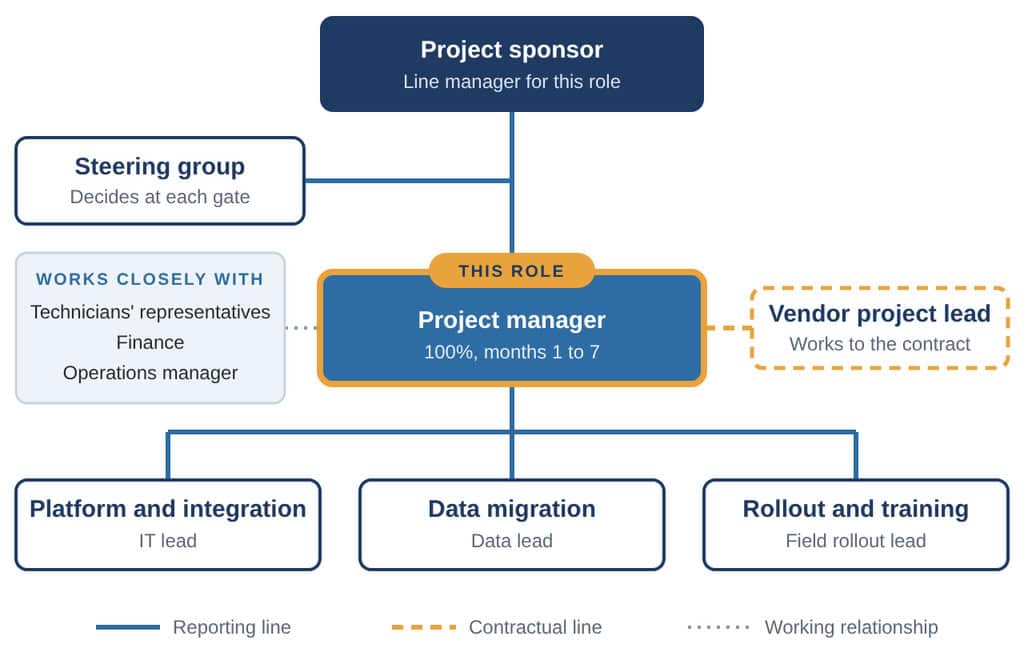
Section 4 places the role in the project organisation. In the worked example, the project manager reports to the sponsor, answers to the steering group at each gate, manages three workstream leads and, under the contract, the vendor project lead, and depends on people they have no authority over, such as the technicians’ representatives.
Authority, measures and selection
A job description that lists tasks but says nothing about decision rights or performance leaves the person to guess where their job ends. For a project manager, the template copies the authority and tolerances from the charter, for example plus or minus 10% on cost and 2 weeks on any milestone, so there is only one version of the truth. The performance measures then link to the charter’s milestones: in the example, the pilot gate in month 3 at 4.5 jobs per technician per day, all depots live by month 6, and closure in month 7.
The form checks that the shares of time add up to 100% and converts them into days per week, which shows quickly whether a role is realistic. When you are choosing between candidates, it multiplies each rating by the weight of its criterion and ranks the candidates on a score out of 10. In the example, Candidate A scores 7.4 and Candidate B 7.3, a margin small enough for the panel to take up references for both before deciding.
Where the job description fits
The job description comes straight after the initiation documents. Each one answers a different question, and each takes its facts from the one before.
- The proposal establishes that the problem is worth solving.
- The feasibility study tests whether each candidate solution can realistically be delivered.
- The business case justifies the preferred option financially and secures the funding.
- The project charter formally starts the project, names the key roles and gives the project manager their authority.
- The job description defines each key role in full, so the person can be appointed, briefed and later assessed.
See our Project Charter Template, Business Case Template, Feasibility Study Template and Project Proposal Template. The worked examples in all five follow the same fictional project, Northfield Home Services, so you can see how the facts carry through: the full-time project manager appointed by the charter for months 1 to 7 is the role this job description defines, with the same budget of 260,000 one-off and 70,000 per year.
When to write one
Write a job description for every key role named in the charter, before the person starts. You need one when:
- A project manager or workstream lead is being appointed, from inside or outside the organisation
- Someone is seconded to the project and their line manager needs to know what they are released for
- The role carries authority over people, money or suppliers
- You are choosing between several candidates and want to score them fairly against the same criteria
- The role has a fixed term, and the person’s performance will be reviewed at the stage gates
Keep it focused on outcomes. Describe the work rather than the person, keep the essential requirements to what the role genuinely needs, accept equivalent experience in place of a named qualification, and tell candidates how to ask for adjustments.