
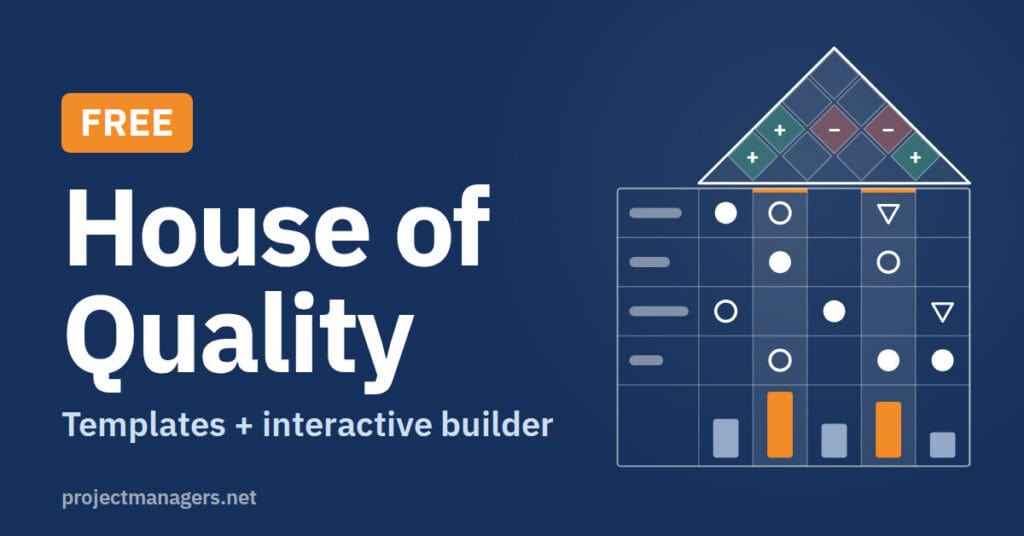
The House of Quality (HOQ) is a structured product development framework guided entirely by the customer’s needs. It turns what customers say they want into measurable engineering targets, then shows which product features matter most so your team spends its time and budget where it counts.
In this guide, you’ll find a clear explanation of how the House of Quality works, how it relates to Quality Function Deployment (QFD), best practices, and a list of free templates in Excel, PowerPoint and PDF. You can also try our free interactive House of Quality builder just below to build your own matrix and see instantly which features deserve your team’s attention.
Try our Free Interactive House of Quality Builder Below
Before diving into the theory, see the House of Quality below in action. List what your customers want and rate how important each need is, then link each one to the technical features that deliver it. Click any cell to set a strong, medium or weak relationship, and click the diamonds in the roof to mark where features support or work against each other. The builder scores every feature as you go and highlights your top three priorities. Step-by-step instructions.
Instructions to use the house of quality builder above:
- Start from an example or a blank house. Use the “Start from” menu to load the coffee maker or mobile banking app example, or choose “Blank house” to begin from scratch. You can add up to 12 customer needs and 10 technical features with the “+ Customer need” and “+ Technical feature” buttons.
- List your customer needs and rate their importance. Type each need in the left column, using your customers’ own words, such as “Easy to clean.” Then rate how much it matters from 1 (nice to have) to 5 (critical) in the Importance column.
- Name your technical features and link them to each need. Click a feature name at the top of the grid to rename it. Then click the grid cell where a need meets a feature to set the relationship: strong (●), medium (○), weak (▽), or empty if there’s no link.
- Fill in the roof, direction and targets. Click a diamond in the roof to show how two features affect each other, from strong synergy (++) to strong trade-off (−−). Below the grid, set whether more or less of each feature is better, and enter a measurable target such as “Under 45 dB” or “$38.”
- Compare yourself to a competitor and review your results. In the “How you compare” column, click the dots to rate your product and a competitor’s from 1 to 5 on each need. The builder scores every feature as you go, highlights your top three priorities in orange, and lists trade-offs, gaps and unaddressed needs under “What your house is telling you.”
Tip: Your house is saved automatically in your browser, so you can close the page and pick up where you left off. When you’re ready to share it, click “Print or save as PDF” for a clean two-page report, or “Download CSV” to open it in Excel.
House of Quality vs. QFD: Understanding the Difference

These two terms are often used interchangeably, but they refer to different things:
- The House of Quality: A House of Quality is a specific tool used in the initial stage of product development. It captures customer needs, translates them into measurable engineering requirements, and prioritizes which features to build first.
- Quality Function Deployment (QFD): The broader organizational methodology of which the HOQ is just one part. QFD describes an entire system for transforming customer requirements into product specifications across multiple stages of development, from concept through manufacturing.
Think of QFD as the strategy and the House of Quality as the first and most critical tactic within that strategy.
Why Do You Need a House of Quality?
1. It Guides Decisions on Product Design
Customer needs can be wide-ranging, contradictory, and difficult to prioritize. Without a structured framework, product development can quickly become chaotic, with teams chasing features that sound good internally but fail to resonate with users. The House of Quality solves this by creating a clear, logical structure for the development process. It helps teams:
- Identify the Features That Truly Matter: Focus on what customers actually need rather than relying on guesswork or internal assumptions about what will sell.
- Map Customer Language to Engineering Actions: Translate vague desires like “the app should feel fast” into specific, measurable technical targets that developers can act on.
- Create an Executable Development Roadmap: Align cross-functional teams around shared priorities so everyone is building toward the same goal.
- Reduce Costly Rework: Resolve design conflicts early in the process, before they become expensive problems in production or post-launch fixes.
2. It Increases Customer Satisfaction
A product built around internal assumptions rather than real customer input risks missing the mark entirely. The House of Quality keeps the customer’s voice at the center of every decision. By using the HOQ framework, teams can:
- Identify Specific Customer Needs and Wants: Structure research through interviews, surveys, and usage data rather than relying on anecdotal feedback or gut instinct.
- Prioritize Features for the Target Audience: Ensure that development time and budget are spent on what customers actually value most, not what the team finds most interesting to build.
- Benchmark Against Competitors: Identify where your product currently falls short and where it has an opportunity to lead in the market.
- Align the Entire Team: Build a shared, customer-first vision that reduces internal disagreements and keeps development focused on delivering real value.
The result is a product that genuinely meets customer expectations, which translates directly into higher satisfaction scores, stronger retention, and better reviews.
3. It Creates a More Efficient Development Process
Resource allocation is one of the most challenging aspects of product development. Teams rarely have unlimited time, budget, or personnel, and making the wrong call on where to invest can be costly. A well-completed House of Quality template makes resource decisions clearer and more defensible by helping teams:
- Identify the Highest-Impact Areas: Use weighted customer priorities and competitive analysis to determine where effort will generate the greatest return.
- Allocate Resources Strategically: Direct people, machines, materials, time, and budget to the areas that will generate the greatest customer value rather than spreading thin across everything.
- Reduce Duplication of Effort: Give every team member a shared reference document for what is being built and why, cutting down on redundant work and misaligned efforts.
- Speed Up Development Cycles: Eliminate debates over scope and keep the team aligned on priorities from day one, avoiding the delays that come from revisiting settled decisions.
Why Is the HOQ Essential to Understand?
While the HOQ diagram may look straightforward at first glance, its real power comes from understanding the relationships between its different sections, often called “rooms.” Mastering these interrelationships is what separates teams that get superficial results from those that unlock genuine product breakthroughs.
It is a Powerful Collaborative Tool
The House of Quality is not a document that one person completes in isolation. Its power comes from the combination of customer inputs and cross-functional team collaboration. When engineers, designers, marketers, and product managers work through the HOQ together, they develop a shared understanding of both the what (customer requirements) and the how (engineering responses).
This collaborative process also surfaces hidden assumptions, conflicting priorities, and gaps in knowledge early, before they become expensive problems later in development.
It Reveals Critical Correlations
Two rooms in the HOQ matrix require teams to actively correlate and assess relationships:
- The Relationship Matrix: Maps how strongly each engineering characteristic addresses each customer requirement. Understanding these relationships, whether strong, moderate, weak, or none, helps teams focus engineering effort where it will have the greatest customer impact.
- The Correlation Matrix: Sometimes called the “roof,” this section maps relationships between engineering characteristics themselves, revealing where improving one attribute might help or hinder another. This is essential for avoiding unintended trade-offs in the design process.
Understanding how to rate and interpret these correlations is what makes the HOQ a genuinely analytical tool rather than just a visual exercise.
It Bridges Design and Delivery
There is an important distinction between designing something that meets customer needs and being able to actually produce and deliver it at scale. The HOQ forces teams to confront this gap directly. By requiring teams to assess their own technical capabilities alongside customer requirements, the HOQ ensures that design decisions are grounded in operational reality.
Coordination between design, engineering, manufacturing, and supply chain teams becomes a built-in part of the process rather than an afterthought. When all project stakeholders are aligned from the outset, the risk of costly redesigns and last-minute surprises is dramatically reduced, keeping projects on time and within budget.
House of Quality Templates
Excel Format
- Free House of Quality Excel Template: Kickstart your QFD journey with this ready-to-use template that covers all essential components, including Customer Requirements and Improvement Direction, making it ideal for Six Sigma practitioners at any level.
- Comprehensive QFD House of Quality Excel Template: This template offers a fully structured QFD matrix with up to 11+ columns and multiple revision-ready fields. Perfect for teams looking for a thorough, project-ready HOQ framework in Excel format.
- Guidelines for using the House of Quality: A companion reference document explaining how to score relationships and interpret results accurately.
- QFD Templates Download: A full suite of QFD templates covering multiple phases of the deployment process, from initial customer research through to final engineering specifications.
PowerPoint Format
- House of Quality Template – PowerPoint: A presentation-ready version of the HOQ matrix, ideal for sharing with stakeholders or walking a team through the framework in a meeting setting.
PDF Format
- House of Quality Template (PDF): The House of Quality Template is a powerful, easy-to-use tool designed to help teams align customer needs with product development goals. Use it to map out competitive insights and technical requirements, all in one clear, structured format.
Online Tools
- Creately: A visual framework tool with a built-in HOQ template. Use it to map customer needs, assign ratings, and collaborate with distributed teams in real time. Particularly useful for teams that want a guided, visual experience without setting up a spreadsheet from scratch.
- LucidChart: An intuitive diagramming platform that supports HOQ creation alongside flowcharts, mockups, and UML diagrams. Ideal for teams already using LucidChart for other process documentation who want to keep everything in one place.
House of Quality Best Practices
The House of Quality is sometimes referred to as the House of Pain, because building one properly requires significant time, honesty, and cross-functional alignment. By following these best practices, you can minimize the friction and maximize the value.
- Start With Well-Defined, Direct Customer Requirements: Do not assume you already know what the customer needs. Gather real customer feedback and input through interviews, surveys, focus groups, and usage data. Once you have that input, ensure that every team member agrees on what it means and how it will be measured. Ambiguous requirements lead to ambiguous products.
- Think Both Quantitatively and Qualitatively: The more you can quantify customer needs and engineering responses with real data, the less room there is for subjectivity, internal politics, or emotion to distort decision-making. Use rating scales, benchmarks, and measurable targets wherever possible, while still leaving room for qualitative context where data alone is insufficient.
- Be Realistic About Your Organization’s Capabilities: The HOQ can inspire ambitious product visions, but ambition must be tempered by honest self-assessment. Before committing to design targets, evaluate whether your team, technology, and supply chain can actually deliver them. Setting unrealistic targets undermines the entire process and erodes trust across teams.
- Revisit and Update the HOQ as You Learn More: The House of Quality is a living document, not a one-time exercise. As customer research deepens, competitive landscapes shift, and engineering constraints become clearer, the HOQ should be updated to reflect new information.
- Involve Cross-Functional Stakeholders From the Start: The HOQ is most valuable when it reflects the perspectives of engineering, design, marketing, manufacturing, and customer-facing teams simultaneously. Siloed completion leads to blind spots and rework.
Video about Building a House of Quality
Watch this step-by-step video guide on building a House of Quality. Dr. Jennifer Trout walks you through the key components, from capturing customer requirements to mapping engineering responses, helping you master this essential product development tool.
Conclusion
The House of Quality is one of the most effective tools available for teams committed to customer-centered product development. By creating a structured bridge between what customers want and what engineers can realistically deliver, it transforms vague requirements into actionable development priorities. Whether you are launching a new product, refining an existing one, or aligning a cross-functional team around a shared vision, the HOQ provides the clarity and discipline needed to make better decisions faster.
The templates and tools outlined in this article make it straightforward to get started, regardless of your team’s size or experience level. Used consistently and collaboratively, the House of Quality does not just improve products; it improves the entire process of building them.
House of Quality FAQs
What is the most critical aspect of the house of quality?
The HOQ relies on accurately identifying and maintaining the Voice of the Customer (VOC). The VOC is the systematic process of capturing customer requirements, preferences, and expectations, and it forms the foundation on which every other room in the matrix is built. Without a strong, validated VOC, even a perfectly structured HOQ will produce misleading results.
What is the main benefit of the house of quality?
The primary benefit is that it shifts product development from reactive to proactive. Rather than responding to complaints or fixing problems after launch, the HOQ encourages teams to deeply understand and anticipate customer needs before design decisions are finalized. This proactive approach reduces costly revisions and increases the likelihood of building something customers genuinely love.
Whose responsibility is quality in the HOQ process?
The project manager is generally responsible for quality management and for ensuring the HOQ process is followed. However, quality is ultimately a shared responsibility. Larger projects may also involve dedicated quality control, quality assurance, or subject matter expert roles to oversee specific aspects of the matrix and validation process.
What type of tool is the house of quality?
The HOQ is a matrix-based planning tool that resembles a house in structure, with rooms representing different stages of the customer-to-engineering translation process. It is considered the primary tool in the Quality Function Deployment methodology and functions as a roadmap that guides a product from initial customer insight all the way through to final engineering specifications.
Suggested articles:
- 18 X Product Canvas Template PPT, Word
- 18 x Product Launch Plan Templates
- The Gap Between Plan and Product: Why PMOs are Hiring Product Management Consultants

Shane Drumm, holding certifications in PMP®, PMI-ACP®, CSM, and LPM, is the author behind numerous articles featured here. Hailing from County Cork, Ireland, his expertise lies in implementing Agile methodologies with geographically dispersed teams for software development projects. In his leisure, he dedicates time to web development and Ironman triathlon training. Find out more about Shane on shanedrumm.com and please reach out and connect with Shane on LinkedIn.