
A four-person team signs up for monday.com expecting a simple task board and finds a platform that can run projects, sales pipelines, marketing campaigns, and IT requests side by side. That breadth is its biggest strength and its main learning curve. Teams get boards, dashboards, automations, and AI agents in one place. What they pay depends on seats, plans, and AI credits.
- An AI Work Platform for Every Team: Monday.com brings projects, sales, marketing, IT, and product work onto customizable boards, with AI agents, the Sidekick assistant, and AI credits on every paid plan.
- Eight Features Do Most of the Work: AI, dashboards, Kanban boards, integrations, automations, file management, Gantt charts, and forms cover what most project teams need day to day.
- Six Use Cases, Updated for 2026: Work management, monday dev, marketing and campaigns, monday CRM, PMO projects, and monday service for IT cover where teams use the platform most.
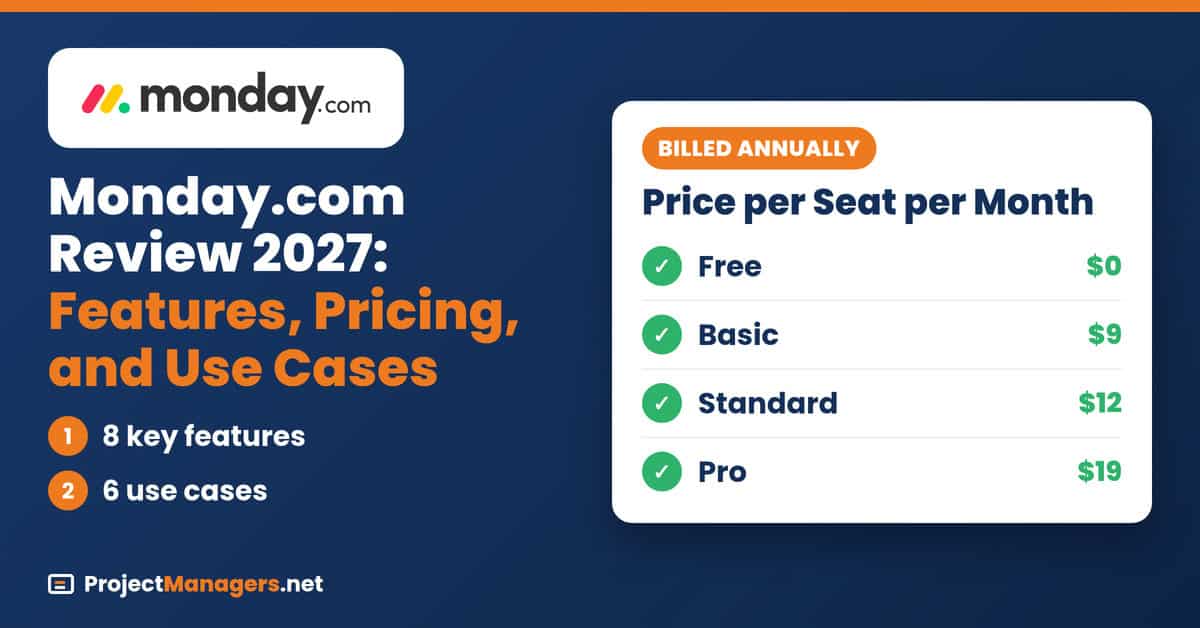
- Pricing Starts Free, Then $9 per Seat: The Free plan covers 2 seats, while Basic, Standard, and Pro cost $9, $12, and $19 per seat per month billed annually, sold from 3 seats.
Monday.com describes itself as an AI work platform, used by more than 250,000 customers to plan, run, and report on work without code. This review covers its eight key features, six use cases, and every pricing plan. Teams that find per-seat billing steep can compare AceProject, which charges per project instead of per user for potentially large savings.
Monday.com Top 8 Key Features
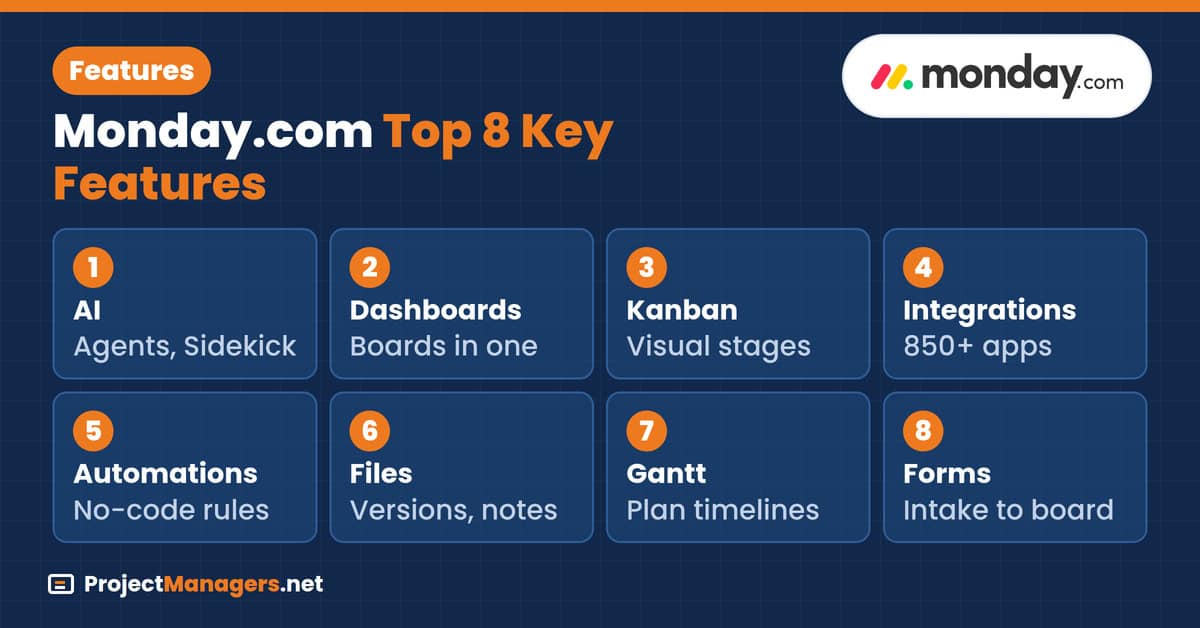
The platform combines AI tools, customizable workflows, dashboards, and reporting, which makes it versatile for businesses of every size. It connects with more than 850 apps and offers views such as Gantt, Kanban, Timeline, and Workload. Together, they give a project manager one overview of tasks, owners, and progress. These eight features, checked against monday.com’s feature pages in November 2026, matter most:
1. Monday’s AI That Works for You
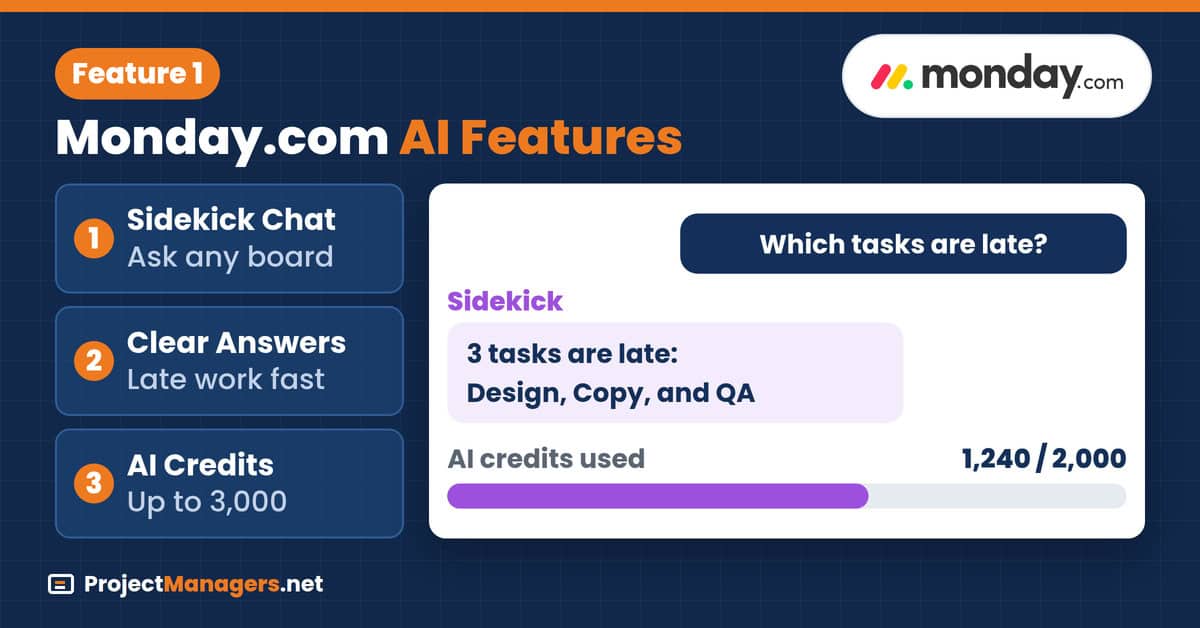
Monday.com’s AI features run on monthly AI credits included with every paid plan: 1,000 on Basic, 2,000 on Standard, and 3,000 on Pro. Credits power AI agents, the Sidekick assistant, and the Vibe app builder, while Standard and Pro add AI columns and a meeting notetaker. Demand is real: monday.com’s third-quarter 2026 results put AI revenue at $36 million a year.
In day-to-day project work, the AI tools show up in four places:
- Ready-Made Agents: Agents such as Project Monitor, Status Reporter, and Risk Analyzer run on a schedule, surfacing hidden risks and writing status updates without anyone pulling the data by hand.
- Sidekick Assistant: Sidekick answers questions about a board in plain language, drafts updates, and can even fill in a WorkForm through a conversation, asking for missing details step by step.
- Custom and Connected Agents: Teams can describe a job in plain words to build their own agent, or bring in assistants such as Claude, Copilot, and ChatGPT through official integrations or the monday MCP.
- Controls: An activity log records every agent action, permissions limit what each agent can read or edit, simulation mode tests agents first, and an AI cost center tracks credit spend per team.
2. Monday.com Dashboards
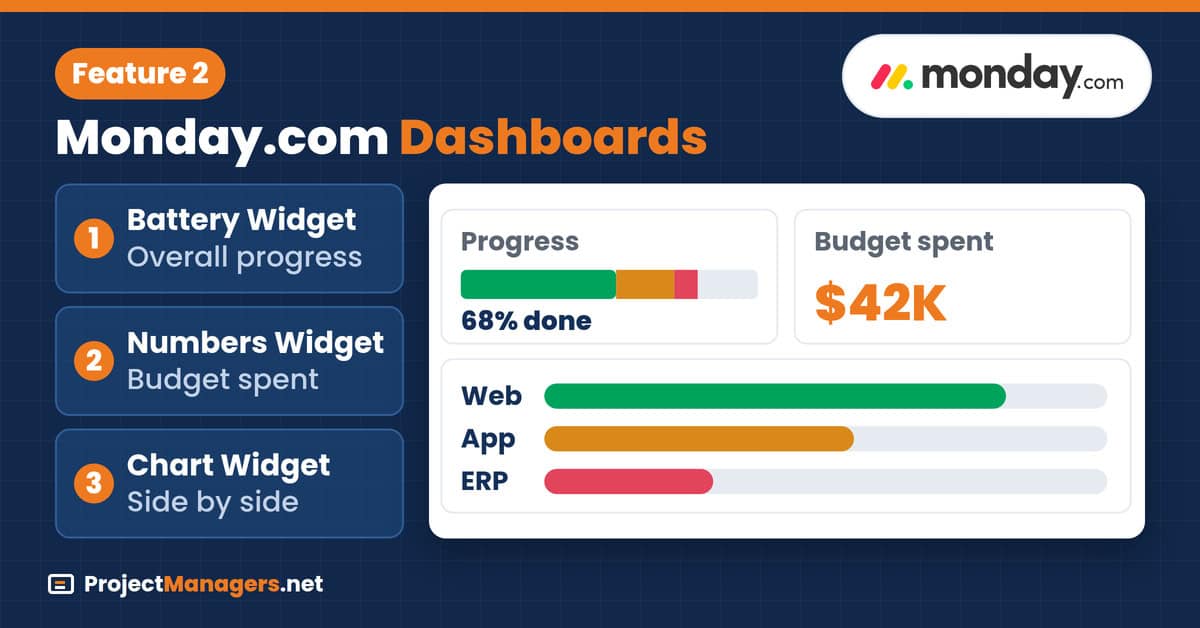
With personalized dashboards, a project manager tracks progress, timelines, and budgets across many boards from one screen. Dashboards now add AI-generated summaries, proactive AI alerts, and executive summary reports, so leaders see what changed without reading every board. Higher plans combine more boards per dashboard, and monday dev, for example, allows 5 on Standard, 20 on Pro, and 50 on Enterprise.
Dashboards are built from widgets, and a few of them do most of the reporting work:
- Chart and Numbers Widgets: Branded charts visualize any board column, while the Numbers widget sums a column such as budget or hours to show whether a goal is on track.
- Battery and Gantt Widgets: The Battery widget turns overall progress into one colored bar, and the Gantt widget presents a project timeline that updates as dates change on the source boards.
- AI Summaries and Alerts: AI-generated summaries and contextual risk alerts explain what changed since the last review, and executive summary reports package the key points for leadership.
- Scheduled Reports: Dashboards stay live and can also go out as scheduled reports, so sponsors receive a regular update without asking the project manager for one.
- Plain-Language Questions: With Sidekick, anyone can ask for data in plain words, such as which tasks are overdue this week, instead of building a new widget.
3. Monday.com Kanban Boards
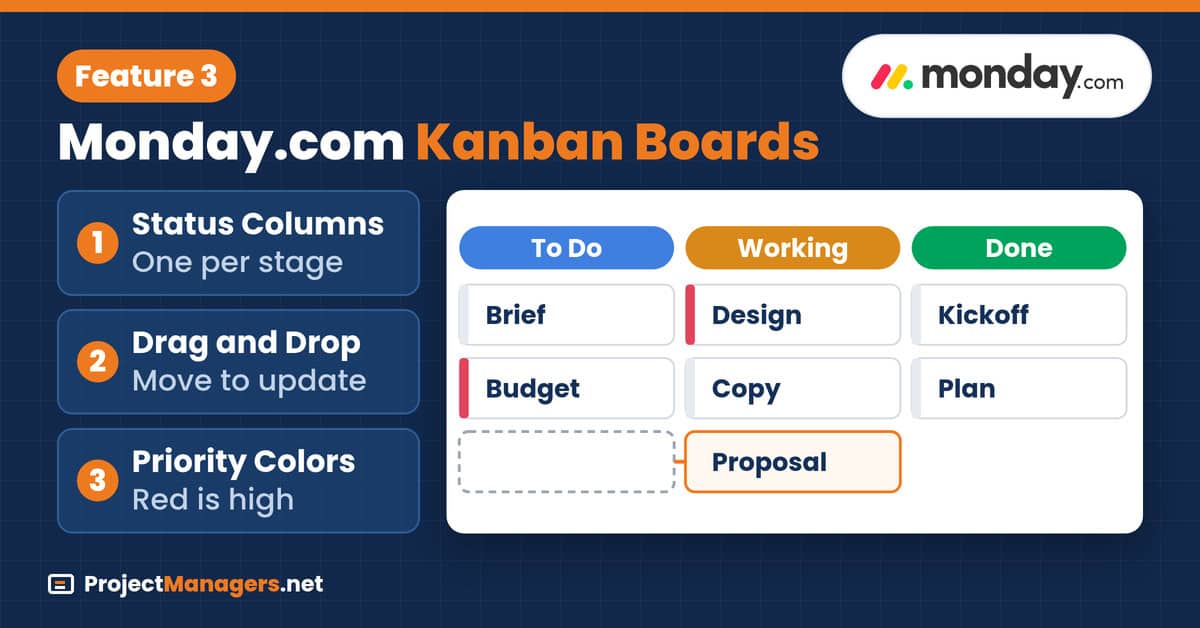
Monday.com offers ultimate Kanban views that turn any board into columns of cards by status. Cards move by drag and drop, statuses are color-coded, and smart sorting and filters by priority or any custom field keep large boards manageable. The Agile Alliance definition of Kanban stresses visualizing work, and monday.com makes that visible to clients and partners too.
On a busy board, the Kanban view helps a project manager in four practical ways:
- Drag-and-Drop Updates: Dropping a card into a new column updates its status instantly, and moving it up or down the column changes its priority.
- Color-Coding: Each status column keeps its board color, so blocked or stuck work stands out at a glance during a stand-up.
- Custom Groups and Filters: Cards can be grouped and filtered by priority, status, or any custom field, which keeps a board with hundreds of tasks readable.
- One Shared Data Set: Changes sync to every viewer in real time, and the same items stay available in Table, Gantt, or Calendar view, so nobody maintains a separate Kanban board.
4. Monday.com Integrations
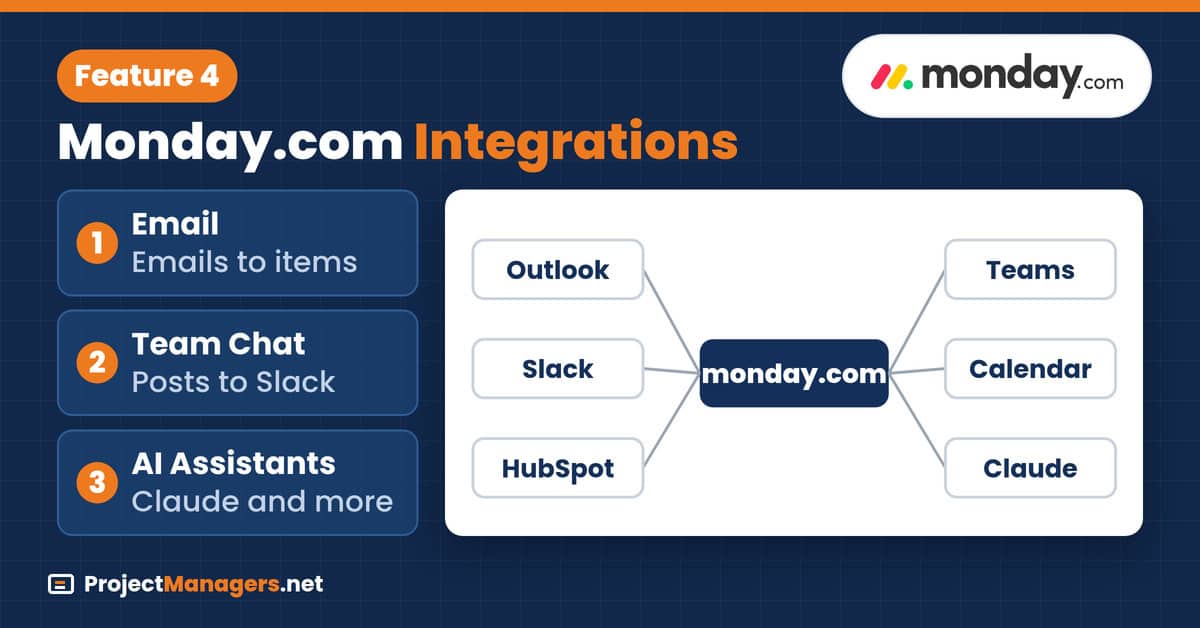
Monday.com now lists more than 850 popular integrations and apps, including Outlook, Microsoft Teams, Dropbox, Google Calendar, and Slack, many with two-way sync. Emails become items, boards embed in Teams chats, and updates post to Slack channels. Integration actions are metered: Standard includes 250 a month and Pro 25,000, so heavily connected teams usually need Pro.
Integrations matter most in these everyday project scenarios:
- Email and Calendar: The Outlook integration turns important emails into items so requests are not missed, and Google Calendar sync keeps board due dates on personal calendars.
- Team Chat: Microsoft Teams and Slack integrations post board updates into channels, so stakeholders follow progress where they already talk.
- Sales and Finance Tools: Salesforce, HubSpot, and QuickBooks connections bring leads, opportunities, and invoices onto boards for teams that track delivery against revenue.
- AI Assistants: Official integrations and the monday MCP let assistants such as Claude, Copilot, and ChatGPT read and update work in monday.com without switching tools.
- Custom Connections: When no ready-made app exists, the monday marketplace, no-code connector platforms, and monday.com’s APIs and SDKs fill the gap.
5. Monday.com Automations
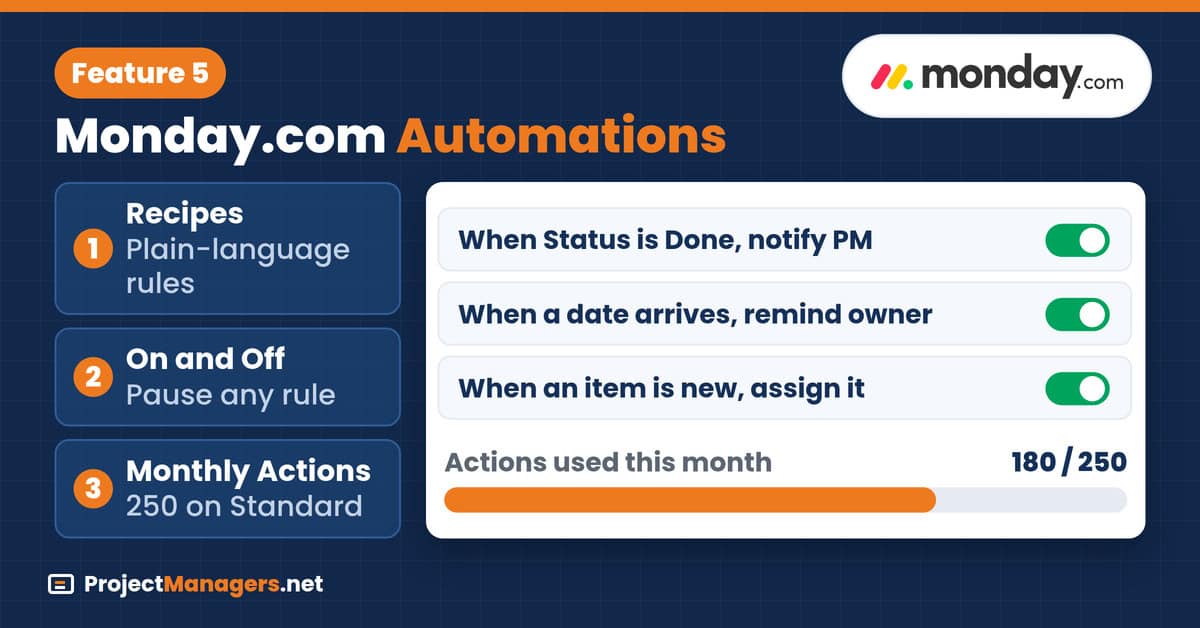
Code-free automation feature recipes cover notifications, date reminders, auto-assigning tasks, task creation, and handovers, and custom automations or multi-step workflows handle the rest. Standard includes 250 automation actions a month and 3 workflows, while Pro allows 25,000 actions and 20 workflows. One construction customer quoted on monday.com saves more than 40,000 manual actions a month.
Most teams start with a handful of ready-made recipes like these:
- Date Reminders: An email or notification goes out automatically when a due date arrives, so owners hear about deadlines before the status meeting.
- Auto-Assign Tasks: When a status changes, the next person in the workflow is assigned, which turns handovers between design, review, and approval into one step.
- Task Creation: A new item can be created from a status change, a form submission, or a recurring schedule, such as a weekly report task every Monday.
- Completion Updates: Real-time notifications tell a project manager when tasks are completed, which cuts follow-up emails and status-check meetings.
- Custom Workflows: When recipes are not enough, the code-free builder chains triggers, conditions, and actions within the monthly action limit of each plan.
6. Monday.com File Management
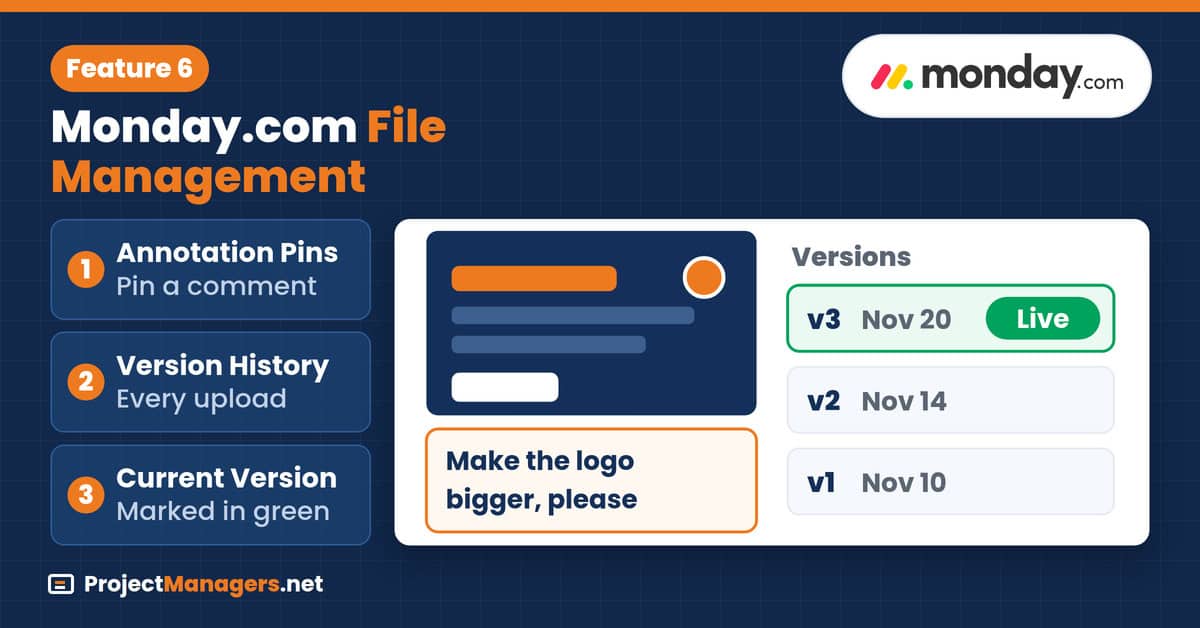
Monday.com lets you manage all of your team’s files in one space with live annotations, file versioning, and digital asset management. Files can be uploaded from a computer, Google Drive, Dropbox, Box, or OneDrive; every version sits on one timeline, and custom permissions decide whether stakeholders, freelancers, or clients can view or edit each one.
Here is how file management helps during reviews and handovers:
- Live Annotations: Reviewers comment directly on the file, and status updates and smart notifications shorten the feedback loop between designers and approvers.
- Version Timeline: Every iteration sits on one coherent timeline, so nobody has to guess whether a file named final-final2 is really the latest version.
- Asset Library: Files of any format are stored in one central place and found quickly, whether they came from a computer or a cloud drive.
- Files in Context: Files can be viewed as detailed cards, a visual grid, or inside the full project, next to due dates, dependencies, and automations.
- Access Control: Permissions decide whether stakeholders, freelancers, or clients can see or edit each file, which matters on client-facing projects.
7. Monday.com Gantt Charts
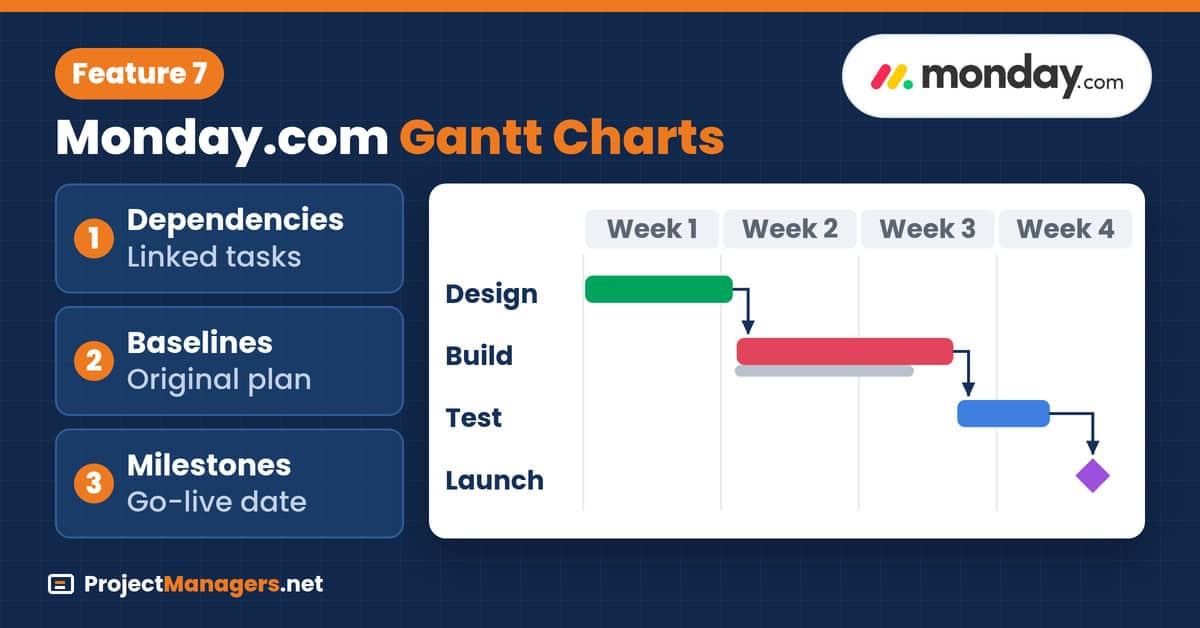
Monday.com’s powerful Gantt charts turn any board with dates into an interactive, drag-and-drop timeline, and the view is available from the Standard plan. As Atlassian’s guide to Gantt charts explains, the format shows how long each task runs and how tasks link over time. Teams can also import existing Excel spreadsheets and view them as Gantt charts, which makes moving an old schedule across quick.
Here is what the Gantt view gives a project manager once a schedule is on the board:
- Milestones: Key dates such as a client sign-off or a go-live day appear as diamonds on the timeline, so nobody has to scroll through rows to find the next deadline.
- Task Dependencies: Links such as finish-to-start, the default type, tie one task to the next, and Strict or Flexible mode shift the dependent dates automatically when an earlier task slips.
- Critical Path: A Gantt setting highlights the chain of linked tasks that decides the end date, which shows exactly where a one-day delay moves the whole project.
- Baselines: A baseline saves the original plan as gray snapshot bars, and items turn red once they run past it, so plan-versus-actual reviews take minutes instead of a spreadsheet.
- Plan Check: The Gantt view starts on Standard, but monday.com’s help center lists dependencies and baselines as Pro and Enterprise features, so teams that schedule with linked tasks should budget for Pro.
8. Monday.com Forms
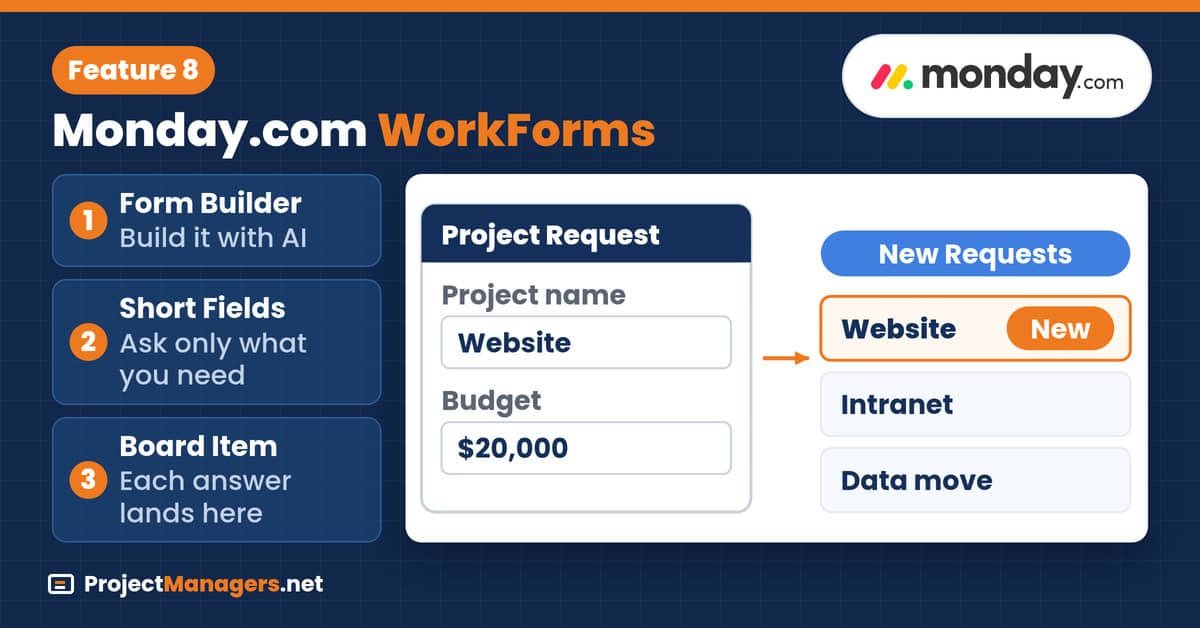
The no-code form builder, now called WorkForms, can start a form with AI, from scratch, or from a template. Teams match colors, fonts, and layouts to their brand and add welcome and thank-you pages. Conditional questions collect the right details, and each submission lands on a board where automations route it to the right person.
Beyond the basic builder, WorkForms adds several details that save intake time:
- Build with AI: Describing the form in one sentence produces a first draft with questions and a layout, which the team then refines in the same editor used for templates.
- Conditional Questions: Follow-up questions appear only when an earlier answer calls for them, so a bug report asks for a browser version while a feature request skips it.
- AI Translation: A form setting lets each submitter pick from up to 50 languages, which helps teams that collect requests from international clients, suppliers, or contractors.
- Save as Draft: Long forms can show a Save as Draft button next to Submit, so a submitter can stop halfway and return later, although files and signatures are not kept in the draft.
- Results and Routing: Every response becomes an item on the connected board; the Results view shows summaries and analytics, and automations assign each new item to an owner, as the WorkForms getting started guide describes.
Real-Life Example: A PMO running twelve client projects replaced a weekly status spreadsheet with a monday.com dashboard pulling from every project board. Intake forms fed new requests straight onto the right board, and automations alerted owners when due dates slipped. Status meetings dropped from an hour to twenty minutes, because sponsors could already see risks and workload before the call.
Monday.com Use Cases
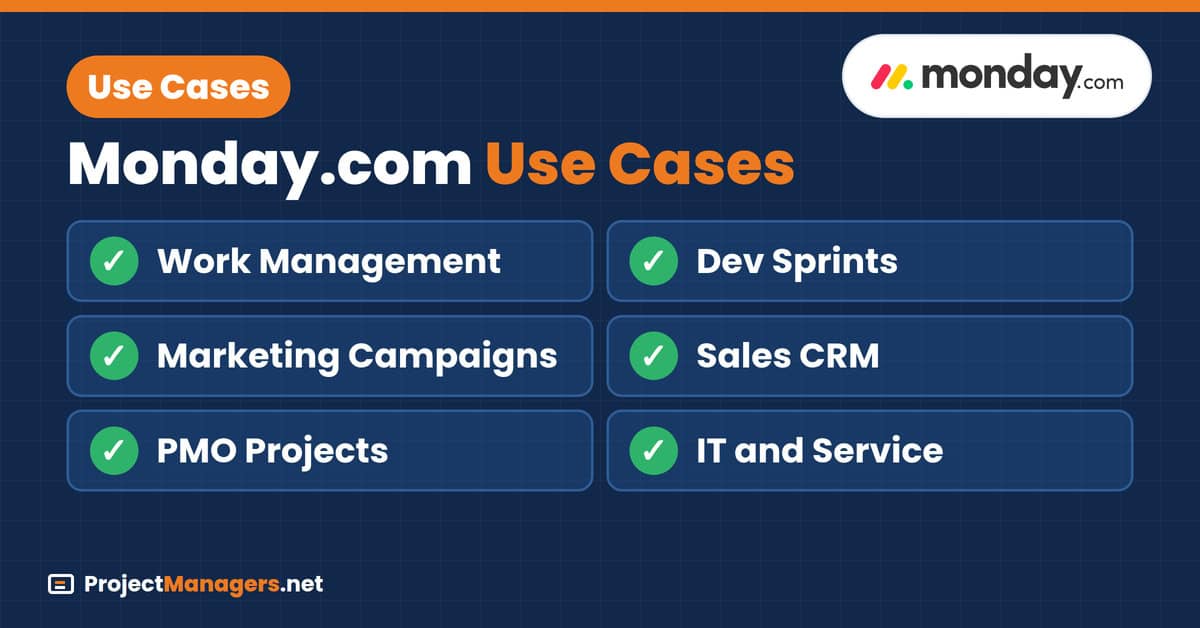
Monday.com’s work platform lets teams shape workflows their way instead of forcing them into a fixed process. Connected boards keep one source of truth across departments, which matters when several teams depend on the same project dates. The use cases below follow the original review, renamed to match monday.com’s 2026 products, plus IT service as a sixth:
Use Case #1: Work Management
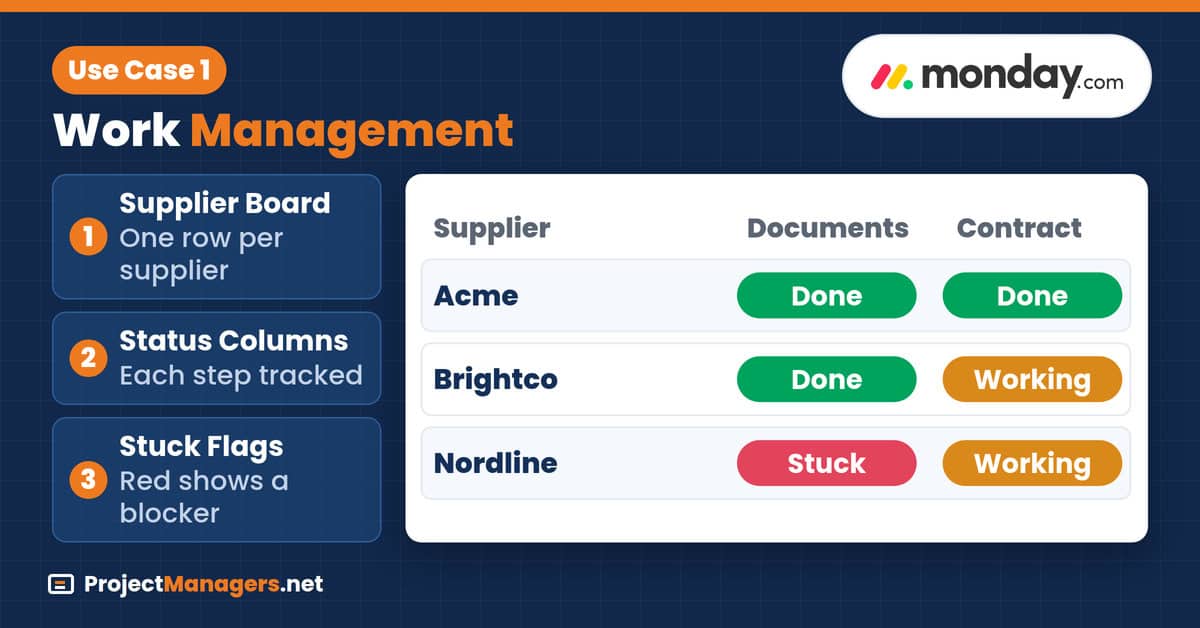
Monday’s work management helps teams run tasks, projects, and processes at scale in one shared workspace. Work can be viewed in more than ten ways, from table to timeline, and real-time overviews show where everything stands. Operations, HR, legal, and finance teams use it to replace scattered spreadsheets and email threads with boards everyone can check.
Common work management setups include:
- Operations Boards: Operations teams track recurring processes such as vendor onboarding, with each step as a status and automations moving items between owners.
- HR Workflows: HR teams run hiring pipelines and employee onboarding checklists on boards, with forms collecting new-hire details.
- Legal and Finance Requests: Contract reviews and budget approvals arrive through a WorkForm and are tracked on a board until sign-off.
- Shared Views: Each department can work in its preferred view, from Table to Timeline, while leadership reads one dashboard across all of them.
Real-Life Application: Consider an operations team at a logistics company that ran supplier onboarding through email and a shared spreadsheet. After moving the process to a monday.com board, each supplier became an item with a status for documents, contract, and system setup. Automations notified the next owner at every step, and the average onboarding time became visible on a dashboard for the first time.
Use Case #2: Dev
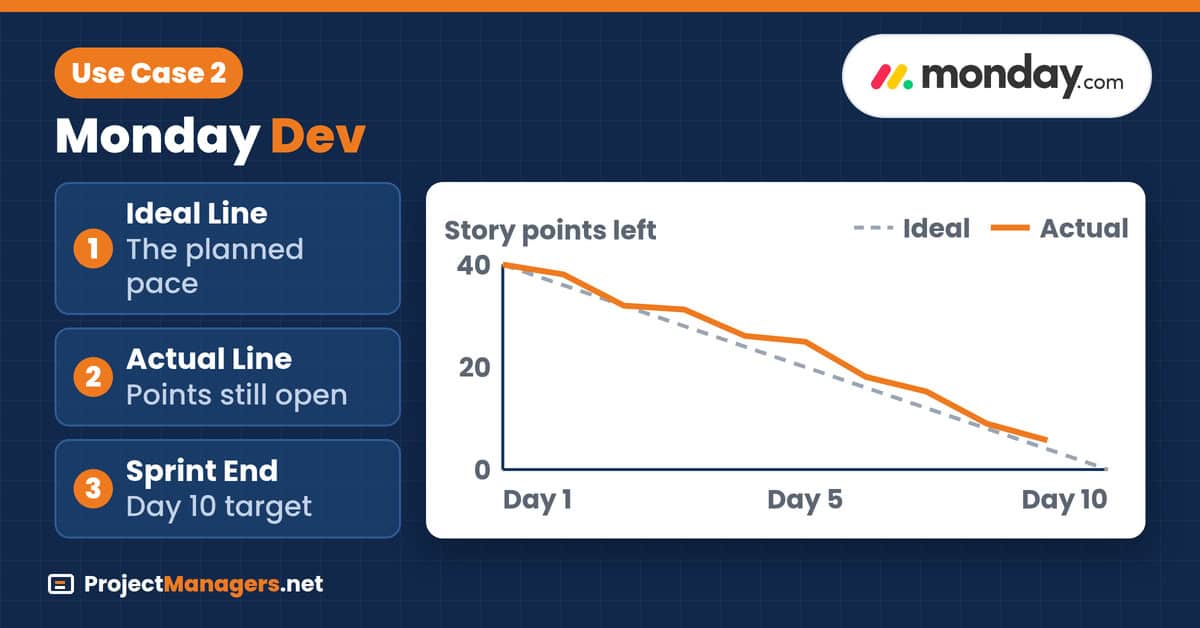
With monday dev, teams can tailor any product development process around their strategy. Basic now adds capacity planning, a daily stand-up view, and AI sprint summaries, while Standard brings sprint management, roadmaps, and the GitHub integration. Sprints can follow the Agile Alliance guide to sprint planning, and monday dev starts at $9 per seat per month.
Product and engineering teams typically use monday dev for:
- Roadmaps: Feature requests and customer feedback feed a prioritized roadmap that can be shared with client-facing teams, so sales and support know what ships when.
- Sprints: Scrum or Kanban sprints run on customizable boards, with sprint automations replacing manual reports and real-time analytics showing delays across sprints.
- AI Bug Triage: AI analyzes each bug report as it arrives, categorizes it, and assigns it to the right team, so engineers see new work in their queue without a triage meeting.
- Product Docs: Collaborative docs act as a product wiki, and AI can summarize long requirement documents into the tasks that depend on them.
Real-Life Application: Consider a 25-person software team that tracked bugs in one tool, roadmaps in slides, and sprints on a whiteboard. Moving all three into monday dev let product managers link each roadmap feature to its sprint tasks. AI triage sorted incoming bug reports by area, and the engineering lead reviewed cross-team progress on one dashboard instead of chasing three separate stand-ups each week.
Use Case #3: Marketing
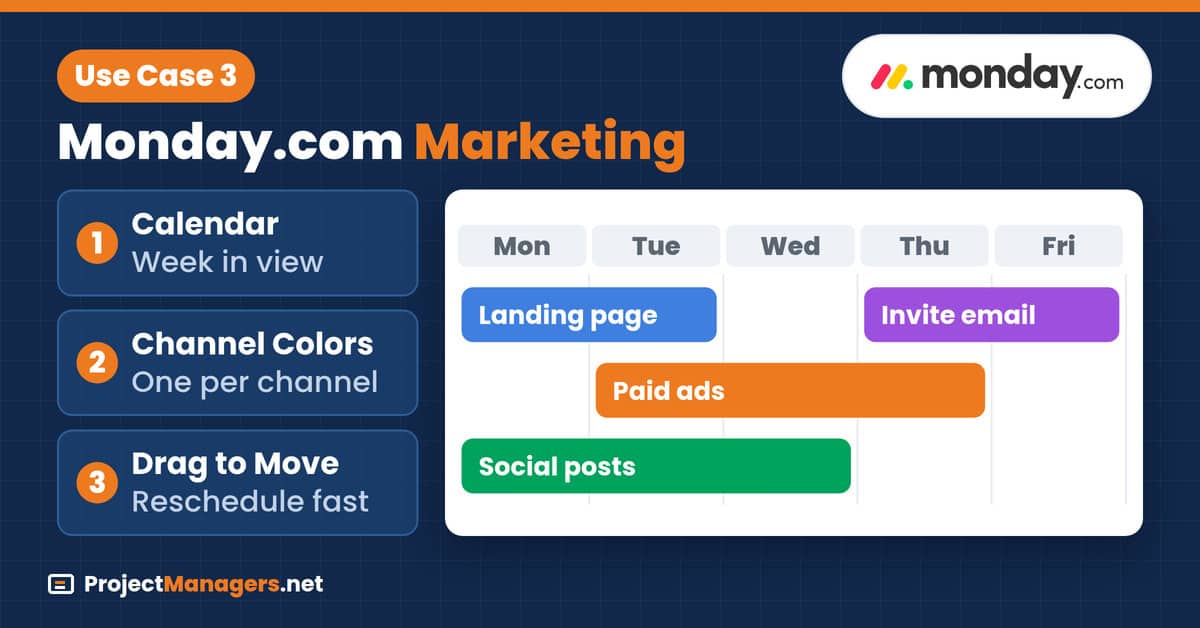
Marketing teams use monday.com to track all ongoing marketing campaigns and creative work in one view. Automations flag deadlines and final approvals, while forms, annotations, and versioning move assets from campaign managers to copywriters and designers. For email marketing, monday campaigns is now a separate product, so teams can plan and send campaigns from the same account.
A marketing team’s monday.com workspace usually covers:
- Campaign Plans: A goal described in plain language can become a campaign plan with a brief, milestones, owners, and channels, which the team then adjusts.
- Creative Approvals: Annotations and versioning keep feedback on each asset in one place, and automations flag final approvals before launch dates.
- Marketing Agents: AI agents draft on-brand copy, produce ad variations, audit pages for SEO gaps, and recommend where to move ad spend based on results.
- Email Campaigns: Monday campaigns sends email marketing from the same account, so campaign results sit next to the project plan.
Real-Life Application: Consider a five-person marketing team launching a product webinar. The brief became a campaign board with tasks for the landing page, emails, and social posts, each with an owner and due date. Designers uploaded drafts, the manager annotated them directly, and an automation alerted the team lead when assets reached final approval, two days before the email went out through Monday campaigns.
Use Case #4: Sales CRM
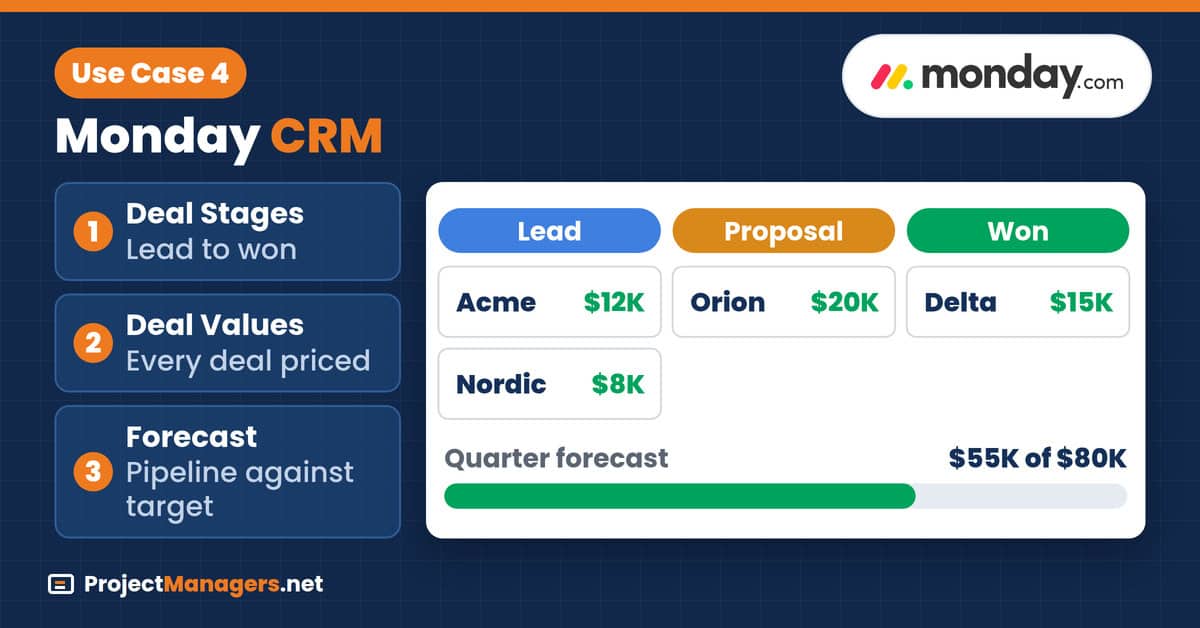
Monday CRM, now at its own address, helps sales teams manage your sales processes without developer help. AI sources, enriches, and scores leads, logs calls and emails to the right fields, and prepares meeting notes and follow-ups. It is priced separately from work management, with CRM Standard at $17 per seat per month billed annually, and serves more than 35,000 customers.
Monday CRM covers the full sales cycle with tools such as:
- Lead Sourcing: A Lead Sourcing Agent finds, enriches, and scores prospects, so reps start the day with qualified leads instead of cold lists.
- Automatic Logging: Calls, emails, and meetings fill the right CRM fields automatically, which removes the end-of-week data cleanup.
- Meeting Prep and Follow-Up: Agents prepare call notes, summarize meetings, and draft follow-ups, while a Pipeline Monitor Agent watches for deals that stall.
- Forecasting: Forecasts are backed by pipeline coverage analysis, stage-by-stage diagnosis, and deal velocity, which gives sales leaders numbers they can commit to.
Real-Life Application: Consider a 12-person consulting firm whose partners tracked deals in personal spreadsheets. With monday CRM, every proposal moved through one pipeline, and emails logged themselves against each account. When a deal reached Closed Won, an automation created a project board from the firm’s delivery template, so the project manager inherited scope, contacts, and dates on day one.
Use Case #5: Projects
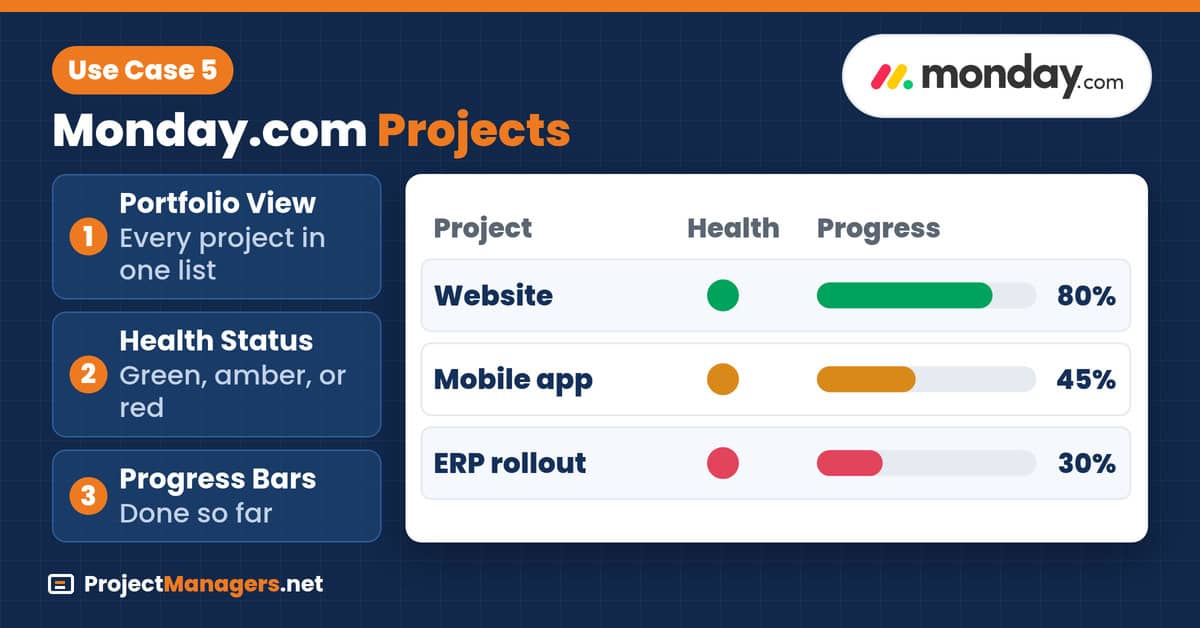
Project managers and PMOs use monday.com to manage multiple projects from one place. Dashboards show bottlenecks, risks, and workload while forms create items instantly, and automations handle approvals. Portfolio and resource management sit on the Enterprise plan, so PMOs on Standard or Pro usually build their own workload boards to see capacity across all their projects.
A typical PMO setup on monday.com combines four building blocks:
- Portfolio Board: Each project is a row in a portfolio that rolls up status, dates, and budget, and the newer portfolio at scale, still in beta, holds up to 5,000 projects in one portfolio.
- Intake Form: A WorkForm collects new project requests with sponsor, budget, and deadline, and each submission lands on the portfolio board for review instead of in someone’s inbox.
- Workload View: The Workload view shows how many tasks or hours each person carries across boards, so a PMO lead can spot an overloaded designer before approving another project.
- Approval Automations: When a request moves to Approved, an automation can create the project board from a template, assign the project manager, and notify the sponsor.
Real-Life Application: Consider a PMO at a 200-person engineering firm that runs about 30 client projects at once. New requests arrive through one WorkForm, approved ones spin up from a standard project template, and the portfolio dashboard shows every red status in one place. Monthly portfolio reviews move from compiling slides to discussing the three or four projects that need a decision.
Use Case #6: IT and Service
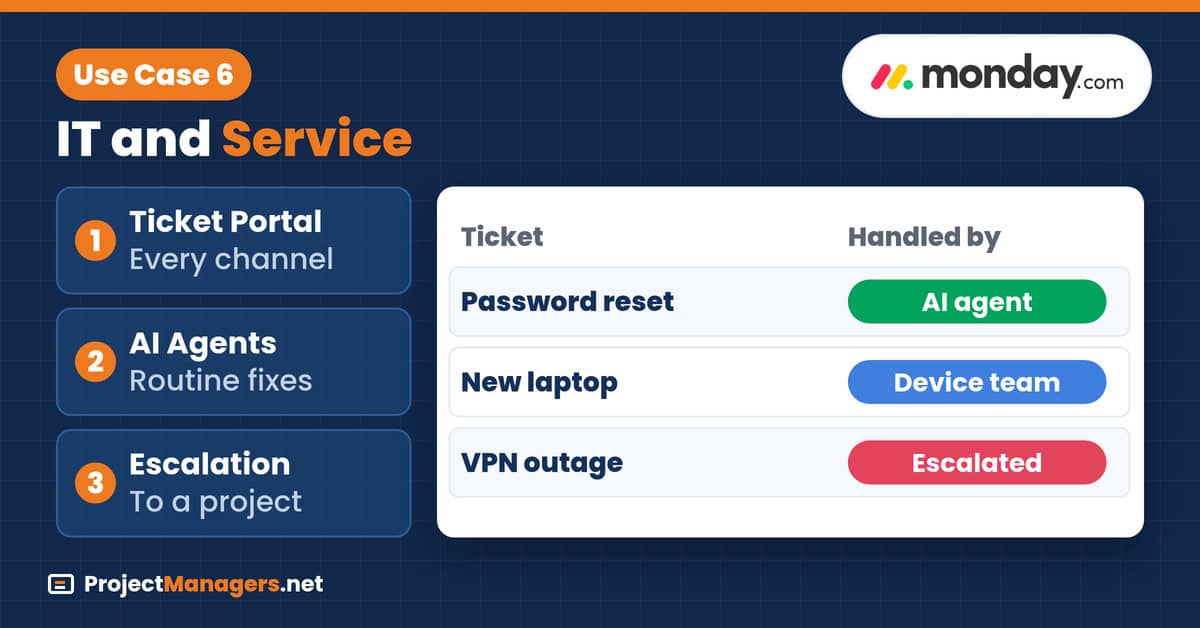
IT and support teams can use monday service, which now includes an AI service workforce of agents that resolve tickets using a team’s knowledge, workflows, and past tickets, then hand off to a person with full context when needed. Standard costs $31 per seat per month billed annually, with unlimited tickets and AI ticket triage for one board.
IT and service teams rely on four parts of monday service:
- Service Portal: A self-service portal gives employees or customers one place to ask for help, which cuts ad-hoc interruptions for the service team.
- Smart Intake and Triage: Requests from every channel are categorized, summarized, and routed automatically, and one financial services customer reports 98% of tickets auto-triaged with AI.
- Specialized Agents: IT Help, Device, and Access agents handle technical incidents, device replacements, and system access requests, and teams can build agents for other request types.
- Connected Escalation: Bugs can be escalated straight onto dev boards, and larger requests can become structured projects that the PMO tracks.
Real-Life Application: Consider an internal IT team of four supporting 300 employees, with password resets and access requests filling most of its week. After launching a Monday service portal, an Access Agent handled routine requests within the team’s approval rules, and a request for office laptops became a tracked project board. The team spent its time on incidents and upgrades instead of the queue.
Monday.com Pricing Plans
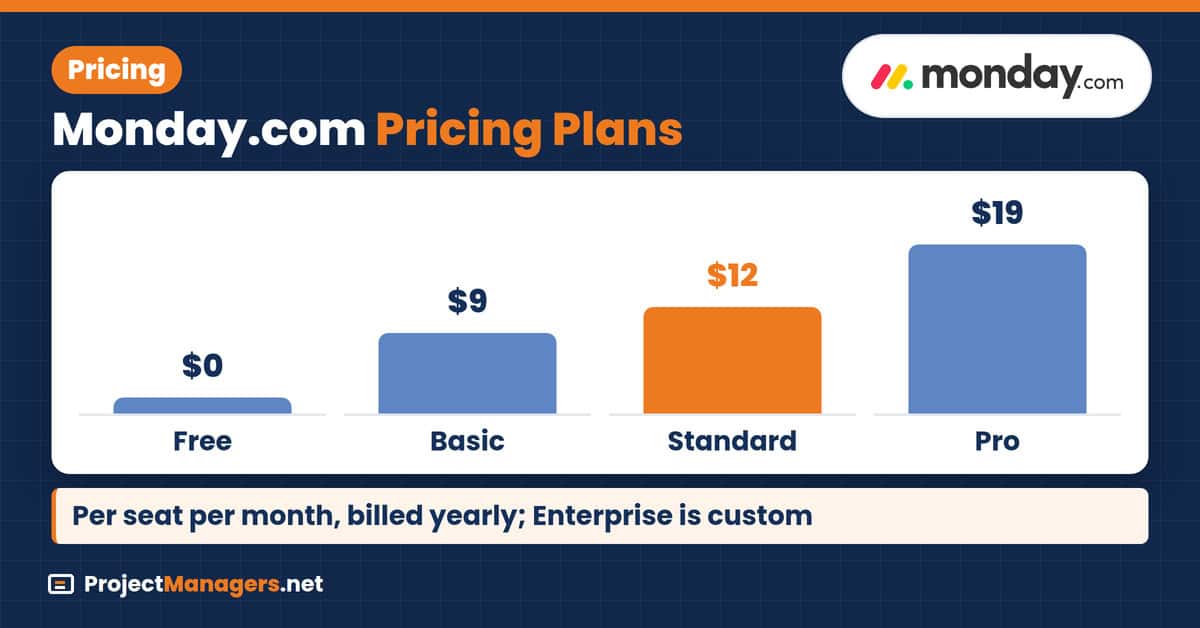
Monday.com offers five pricing plans: Free, Basic, Standard, Pro, and Enterprise. Paid plans are sold per seat in buckets that start at 3 seats, such as 3, 5, 10, and 15, so a team of four pays for five. Yearly billing saves 18%, and a 14-day Pro trial is available. Prices below were checked on November 17, 2026:
Monday.com Work Management Plans (November 2026)
| Plan | Billed Annually | Billed Monthly | Key Features | Best For |
|---|---|---|---|---|
| Free | $0 | $0 | Up to 2 seats, 3 boards, 3 Docs, 200+ templates, and 8 column types, free forever with no credit card | Individuals testing the basics |
| Basic | $9 | $12 | Unlimited items and free viewers, the Sidekick AI assistant, and 1,000 AI credits | Small teams managing work in one place |
| Standard | $12 | $14 | Timeline, Gantt, and Calendar views, guest access, 250 automation actions, and 2,000 AI credits | Most project teams |
| Pro | $19 | $24 | Private boards, time tracking, 25,000 automation actions, and 3,000 AI credits | Teams with complex workflows |
| Enterprise | Custom | Custom | Portfolio and resource management, 250 workflows, multi-level permissions, and enterprise-grade security and support | Large organizations and PMOs |
Whether you run a small business or a large enterprise, one of these plans should fit, and the 14-day Pro trial is the best way to test which tier your team really needs. For billing questions or setup help, monday.com’s help center answers most of them. For per-seat examples and CRM and dev prices, see our pricing guide.
Real-Life Example: A nine-person design agency compared Standard and Pro during the 14-day trial. Its boards fired about 400 automation actions a month, over Standard’s 250 limit, and two client boards needed to stay private. Pro cost $7 more per seat per month, or $70 a month for ten seats, but removed both limits, so the agency chose Pro.
Video: Inside the Monday.com AI Work Platform
Monday.com published this 23-minute walkthrough on March 17, 2026, so it shows the current interface and the AI tools covered above. A presenter tours boards, dashboards, automations, and AI agents inside a working account. Watch it before you start the 14-day Pro trial, then rebuild one of your own project boards to see how the platform fits your team.
Inside the Best AI Work Platform (monday.com, 22:59)
An official tour of monday.com boards, dashboards, automations, and AI agents, recorded in March 2026.
Monday.com FAQs
Monday.com FAQs
What Is Monday.com Used For?
Monday.com is an AI work platform for managing projects, tasks, sales pipelines, marketing campaigns, product development, and service requests on customizable boards with dashboards and automations.
Is Monday.com Free?
Yes. The Free plan covers up to 2 seats, 3 boards, and 3 Docs with no time limit. Teams need a paid plan, which starts at 3 seats, and can try Pro free for 14 days.
How Much Does Monday.com Cost?
Basic costs $9, Standard $12, and Pro $19 per seat per month billed annually, or $12, $14, and $24 monthly. Enterprise is custom priced. Prices were checked on November 17, 2026.
Does Monday.com Have Gantt Charts?
Yes. Timeline and Gantt views with milestones are included from the Standard plan upward, while task dependencies and Gantt baselines need the Pro or Enterprise plan.
Does Monday.com Include AI?
Yes. Every paid plan includes monthly AI credits, from 1,000 on Basic to 3,000 on Pro, which power AI agents, the Sidekick assistant, AI columns, and the meeting notetaker.
Can Monday.com Be Used as a CRM?
Yes. Monday CRM is a separate product with its own pricing, starting at $12 per seat per month billed annually for Basic and $17 for Standard.
Is Monday.com Good for Project Management?
Yes, for teams that want configurable boards, dashboards, and automations across several projects. Portfolio and resource management require the Enterprise plan.
Conclusion
Monday.com is more than project management software. It is an AI work platform that puts projects, sales, marketing, and product work on one set of boards, with dashboards and automations most teams configure without IT. Users give it a 4.8 rating from more than 48,000 App Store ratings and a 4.9 rating on Google Play.
The plan you need depends on seats, automation volume, and privacy. Count your team against the seat buckets, estimate monthly automation actions, and list which boards must stay private, then run the 14-day Pro trial on one live project. If per-seat pricing still feels steep after that test, AceProject’s per-project model is worth comparing before you commit to a yearly plan.
Suggested Articles:
- Monday.com Pricing Plans & Costs Guide
- The Pros and Cons of Using Monday.com Software
- Project Management Tools: How to Streamline Teams and Increase Efficiency

Daniel Raymond, a project manager with over 20 years of experience, is the former CEO of a successful software company called Websystems. With a strong background in managing complex projects, he applied his expertise to develop AceProject and Bridge24, innovative project management tools designed to streamline processes and improve productivity. Throughout his career, Daniel has consistently demonstrated a commitment to excellence and a passion for empowering teams to achieve their goals.