
Every business runs on contracts, and every project starts with one. A statement of work with a client, a subcontract with a supplier, an NDA with a partner, a software licence for the project team: each one has to be drafted, checked, approved and signed before the real work can begin. Done by hand, that process eats days of a project manager’s schedule, and a single missing clause can turn into a costly dispute months later.
This is where AI agreement generators come in. They turn a short list of project details into a structured first draft in minutes, flag what is missing and route the contract for review and signature. In this guide, you will learn what an AI contract generator is, the 6 benefits it brings to businesses and project teams, where it fits in the contract workflow, and the limits every project manager should know before trusting it.
- An AI contract generator turns your key terms (parties, scope, price, dates, governing law) into a structured draft in minutes instead of days.
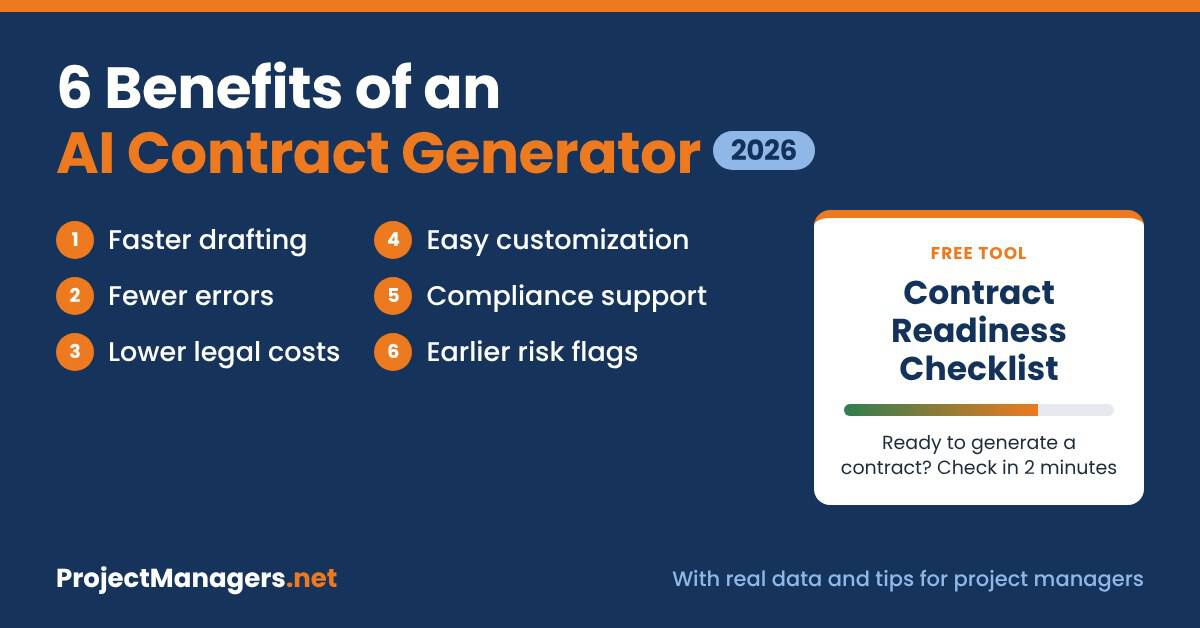
- The 6 main benefits are speed, fewer errors, lower costs, easy customization, compliance support and earlier risk flags.
- AI is not a lawyer: Stanford researchers found leading legal AI tools gave wrong answers in more than 17% of test queries, so a human review is still required.
- Check your key terms with the free Contract Readiness Checklist below before you generate a draft, and get a ready-to-paste AI brief.
The timing matters. Analysts at Gartner expect legal technology budgets to double by 2028, and contract work is one of the first areas being automated. Project managers who know how to use these tools well, and when not to rely on them, will close agreements faster and start projects on time.
What Is an AI Contract Generator?
An AI contract generator is software that uses artificial intelligence to draft, adapt and check legal agreements. It is often part of a wider contract management process that also covers approvals, signatures, storage and renewals. You enter the key details (the parties, the scope of work, the price, the dates and the governing law), and the tool combines approved templates, standard clauses and language models to produce a customized contract, much like a legal AI solution does for law firms.
Behind the scenes, these tools use natural language processing (NLP) and machine learning. They can read plain-English instructions such as “add a 30-day termination for convenience clause,” suggest wording, compare a draft against your playbook and highlight clauses that are missing or unusual. For a project manager, the practical result is simple: the first draft no longer blocks the project kickoff.
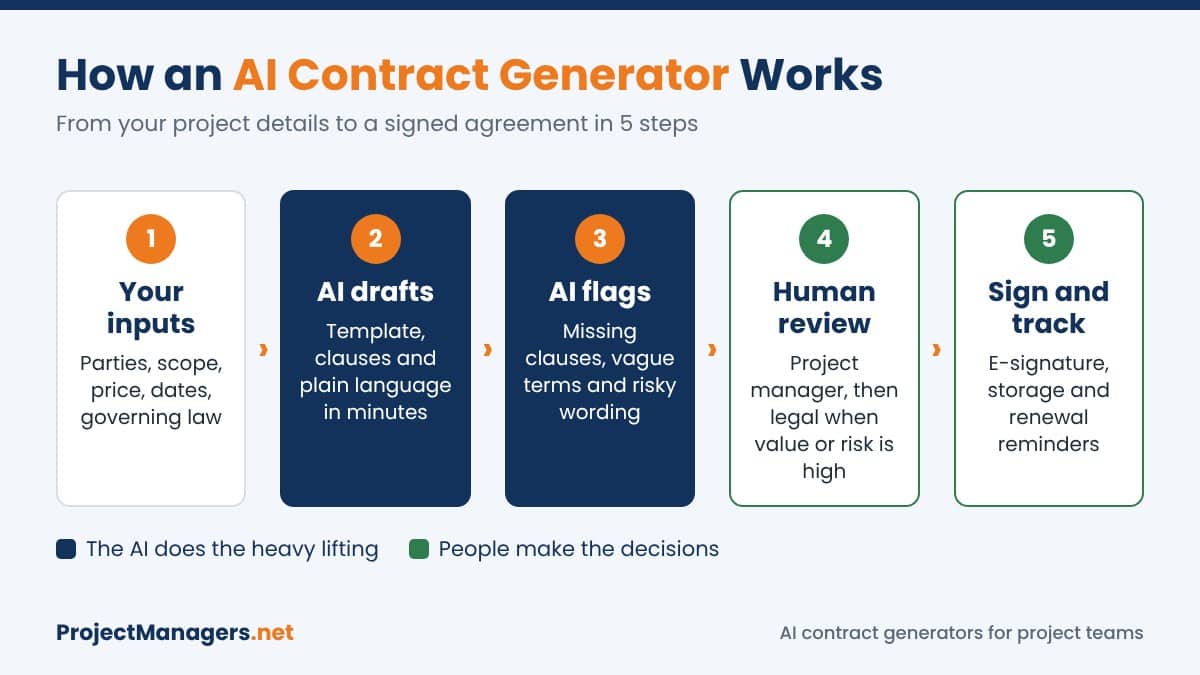
Most AI contract generators follow the same 5 steps:
- Inputs: you enter the parties, the project scope, the price, the milestones and the governing law, or the tool pulls them from your CRM or project management software.
- Draft: the AI builds the contract from a template and adapts the clauses to your inputs.
- Flags: it highlights missing clauses, vague terms and risky wording.
- Review: the project manager checks the business terms, and a lawyer reviews high-value or unusual agreements.
- Sign and track: the contract goes out for e-signature, and key dates and obligations are stored for the rest of the project.
Real-life example
JPMorgan’s COIN reviews loan agreements in seconds
In 2017, JPMorgan Chase revealed COIN (short for Contract Intelligence), a machine learning program that interprets commercial loan agreements. The bank used it on about 12,000 new agreements a year, work that had taken lawyers and loan officers roughly 360,000 hours annually. The lesson for project managers: the biggest gains come from high-volume, repetitive contracts, not one-off strategic deals.
Source: ABA Journal
Numbers that matter
6 Key Benefits of Using an AI Contract Generator
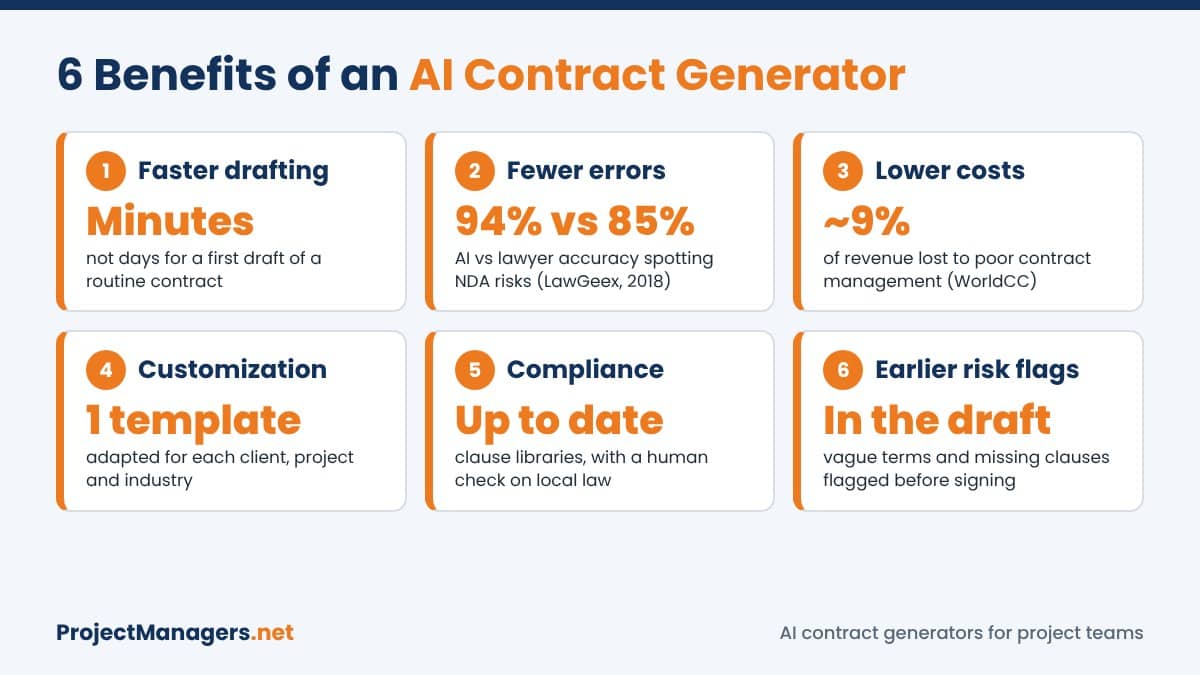
AI contract generators bring benefits to legal teams, finance teams and project teams alike. Here are the 6 that matter most for businesses, with the evidence behind each one and what a project manager should watch.
1. Speed and Efficiency
Speed is the most visible benefit. Traditional contract creation is manual: someone finds an old agreement, copies it, edits the names and terms, sends it to legal and waits. With several rounds of revisions, a simple service agreement can take days or weeks, and the project start date slips with it.
An AI contract generator produces a usable first draft of a routine contract in minutes. Repetitive work such as filling in party details, payment terms and standard clauses is automated, so the team can streamline workflows and handle more agreements without adding staff. For a project manager juggling several vendors and clients, that means contracts stop being the bottleneck on the critical path.
Numbers that matter
- 5 hoursper week that professionals expect AI to free up for them within a year (survey of 2,275 professionals, 2025).Source: Thomson Reuters
- $19,000of value per professional per year from those time savings, according to the same report.Source: Thomson Reuters
2. Improved Accuracy and Consistency
Manual drafting is prone to inconsistent wording, outdated clauses, wrong party names and missing sections. These errors are easy to make when a contract is copied from the last project, and they can lead to disputes, delays or compliance issues later.
AI generators reduce these errors by starting from approved templates and clause libraries, and by checking the draft against what a contract of that type should contain. The same terms are written the same way every time, which makes contracts easier to review and compare across projects. Accuracy still depends on your inputs, though: if the scope or the price is wrong, the AI will draft the wrong contract very quickly.
Real-life example
AI vs. 20 lawyers on 5 NDAs
In a 2018 study run by LawGeex, 20 experienced US lawyers and an AI system were asked to spot legal issues in 5 non-disclosure agreements. The AI reached an average accuracy of 94%, compared with 85% for the lawyers. It is a small, older test on one simple contract type, so treat it as a sign of what AI does well (repetitive, rule-based checks), not proof that it beats lawyers on complex deals.
Source: ABA Journal
Numbers that matter
- 94% vs 85%average accuracy of the AI vs. the lawyers in spotting NDA issues.Source: ABA Journal
- 26 secondsfor the AI to review all 5 NDAs, compared with an average of 92 minutes for the lawyers.Source: ABA Journal
3. Cost Savings
Hiring lawyers to draft and review every contract is expensive, especially for small and mid-sized businesses. AI contract generators handle routine agreements such as NDAs, simple service agreements and statements of work, so legal budgets can go to the contracts that truly need expert attention.
The bigger saving is often indirect. Poorly managed contracts leak value through missed obligations, unclaimed discounts, late renewals and disputes. Faster turnaround also means deals close sooner and projects start earlier, which brings revenue forward. For startups and growing businesses, that efficiency can be a real competitive advantage.
Numbers that matter
- ~9%of annual revenue lost by the average business to poor contract management, and more than 15% in complex industries.Source: World Commerce & Contracting via CFO.com
- $90M+a year at stake for a business with $1 billion in revenue, based on the same research.Source: World Commerce & Contracting via CFO.com
4. Customization and Flexibility
AI contract generators work from templates, but they are not rigid. You can adjust terms, clauses and conditions in plain language: change an NDA from one-way to mutual, add a milestone payment schedule to a service agreement or adapt a subcontract to a new project location. The team no longer starts from a blank page or an old file.
This flexibility also helps businesses that work across industries and regions. Finance, healthcare, construction and technology projects all have their own standard clauses and regulations, and a good generator lets you keep a separate approved template for each one. The project manager picks the right starting point, and the AI adapts it to the specific project.
Numbers that matter
5. Legal Compliance Support
Regulations change constantly, and keeping every template up to date by hand is hard. Many AI contract tools update clause libraries when laws change and check drafts against compliance rules, which is especially useful in heavily regulated work such as government contracting software, where requirements are complex and evolve quickly.
Automated checks reduce manual review time and catch common compliance gaps early. But compliance support is not a compliance guarantee. AI tools can produce confident text that is simply wrong, so the project manager and the legal team should confirm that the governing law, data protection terms and industry rules really apply to the project at hand.
Research finding
Even legal AI tools make things up
In 2024, Stanford researchers tested leading AI legal research tools on a benchmark of real legal questions. The tools reduced errors compared with general chatbots, but they still produced incorrect or misleading information in a significant share of answers. For contract work, the takeaway is clear: use AI to draft and flag, then verify anything that affects compliance.
Source: Stanford HAI
Numbers that matter
- 17%+of test queries answered incorrectly by Lexis+ AI and Ask Practical Law AI.Source: Stanford HAI
- 34%+of test queries with hallucinations for Westlaw AI-Assisted Research.Source: Stanford HAI
6. Reduced Risk
AI tools can spot common pitfalls early in the drafting process: vague deliverables, missing liability caps, one-sided indemnities, unclear termination rights or a missing confidentiality clause. They highlight these issues and suggest revisions before the contract goes out, when changes are still cheap.
Over time, some tools also learn from your contract history and flag terms that differ from your standard positions or create risk in a specific jurisdiction. This turns contract management from a reactive task into a proactive risk management practice, which fits naturally into a project’s risk register. The flip side is that over-trusting AI output creates new risks, as the example below shows.
Real-life example
Lawyers fined for AI-invented cases
In Mata v. Avianca, a New York federal judge sanctioned two lawyers and their firm in June 2023 after they filed a brief citing court cases that ChatGPT had invented. The court ordered them to pay a $5,000 fine. Contracts are not court briefs, but the lesson is the same: AI output must be checked by a person who understands what it should say.
Source: Bloomberg Law
Numbers that matter
- $5,000fine ordered in Mata v. Avianca for filing AI-generated fake case citations.Source: Bloomberg Law
- ~50%of contract reviews expected to be handled by self-service systems by 2029, with lawyers kept in control of what is accepted.Source: Gartner
Free Contract Readiness Checklist
An AI contract generator is only as good as the terms you give it. If the scope, price or liability cap is still open, the AI will fill the gap with generic defaults. Use this free checklist before you generate a draft:
- Load an example or start from scratch, then enter the contract name, type, value and governing law.
- Answer Yes, Partly or No for the 4 items in each of the 5 areas.
- Read your score, the gaps to fix first and the legal review recommendation.
- Copy your AI brief and paste it into any AI contract generator. Open points are marked [TO CONFIRM] so the AI does not invent them.
Loading the Contract Readiness Checklist…
How AI Contract Generators Improve Workflow and Productivity
AI contract generators do more than draft documents. Used well, they improve the whole contract workflow, from the first request to the last renewal. Here is how.
Integration with Business Tools and Platforms
Many AI contract generators connect to CRM systems, document management platforms, e-signature services and project management tools. Client names, deal values and project dates flow into the contract automatically, and signed contracts flow back to the project record. This reduces manual data entry, avoids copy errors and gives the whole project team one source of truth.
Streamlining Contract Workflows
AI contract management software streamlines contract workflows with real-time collaboration and document sharing. Several stakeholders can review and comment at the same time, approvals are routed automatically and every change is tracked, so everyone works on the latest version. For a project manager, this removes the email chains and “final_v7” attachments that usually slow down procurement.
Automating Repetitive Tasks
AI tools automate the repetitive parts of contract work: data entry, first drafts, clause comparisons, compliance checks and reminders for renewal or notice dates. Legal professionals can focus on negotiation and complex terms, and project managers can focus on delivering the project instead of chasing signatures.
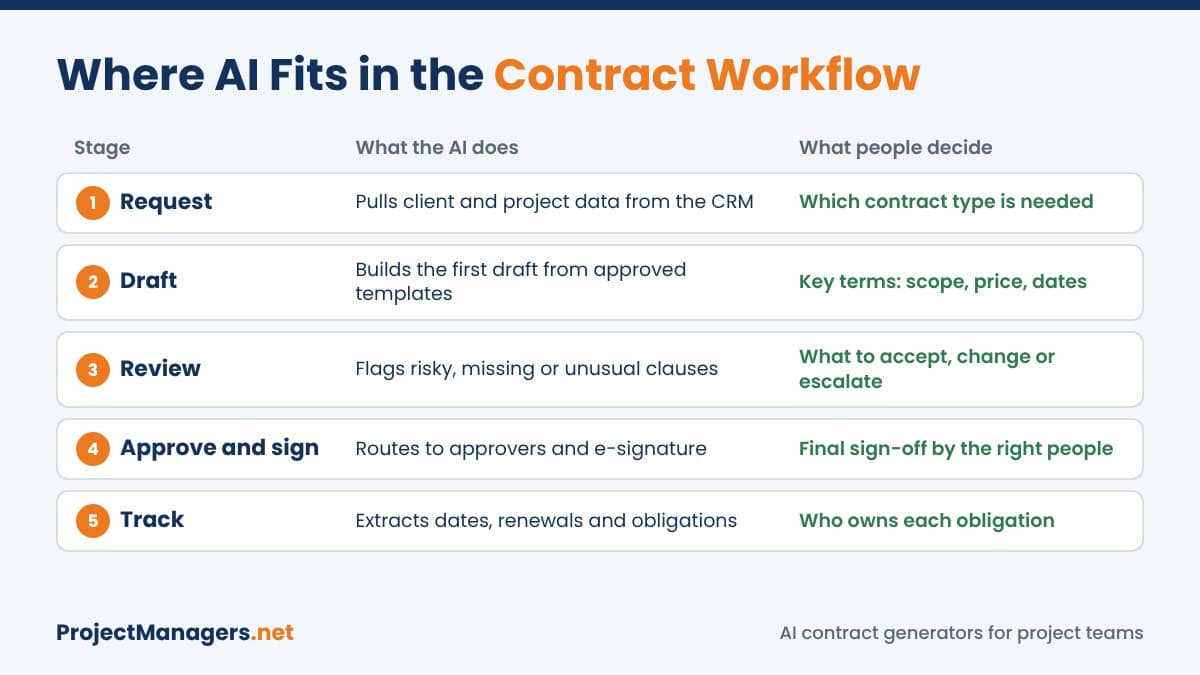
Contract workflow: who does what
A practical split between the AI, the project manager and the legal team at each stage.
| Stage | What the AI does | What the project manager does | Done when |
|---|---|---|---|
| 1. Request | Pulls client, vendor and project data from the CRM or project tool | Confirms the contract type and the key terms with the other party | Scope, price, dates and governing law are agreed |
| 2. Draft | Builds the first draft from an approved template | Checks names, scope, milestones and payment terms | The draft matches the project plan |
| 3. Review | Flags missing, risky or unusual clauses | Escalates high-value or unusual terms to legal | Every flag is accepted, changed or explained |
| 4. Approve and sign | Routes the contract to approvers and e-signature | Follows up with approvers and the other party | All signatures are collected |
| 5. Track | Extracts key dates, renewals and obligations | Assigns an owner to each obligation in the project plan | Reminders are set and the contract is stored |
Best Practices for Using AI Contract Generators
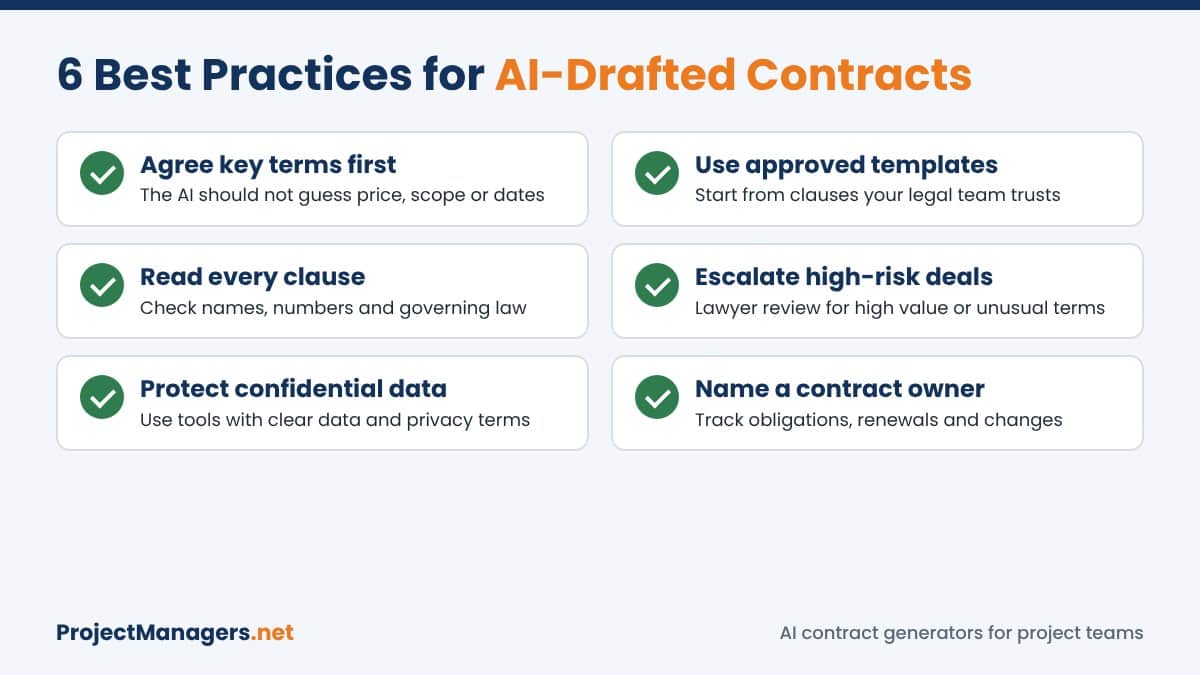
To get the most out of an AI contract generator while keeping risk under control, project managers and businesses should follow these best practices:
- Agree the key terms first: provide accurate and complete details (parties, scope, price, dates, governing law). The AI should never have to guess the business terms.
- Start from approved templates: keep a small library of templates your legal team has reviewed, and update them regularly so contracts stay compliant and reflect current business needs.
- Combine AI drafts with human oversight: AI tools can handle routine contracts, but complex or high-value agreements should still be reviewed by legal professionals to ensure full compliance.
- Use AI suggestions, but verify them: treat the tool’s recommendations as a smart second opinion that improves clarity, not as the final word.
- Protect confidential data: check where the tool stores your data, whether it trains on your documents and what security terms it offers before you upload client or project information.
- Name a contract owner: one person should track obligations, renewals and change requests after signature, so the contract keeps working for the project.
Test Your Knowledge: 10 Quick Questions
10 questions on AI contract generators
Check what you learned. Click Show answer under each question.
What is the main job of an AI contract generator?
- AReplace the legal team
- BTurn key terms into a structured contract draft
- CNegotiate prices with suppliers
- DStore signed contracts only
Show answer
Answer B. It turns your inputs (parties, scope, price, dates, law) into a draft using templates, clauses and language models.
What should a project manager do before generating a contract?
- AAgree the key terms with the other party
- BSign the contract
- CSkip the scope to save time
- DAsk the AI to choose the price
Show answer
Answer A. The AI fills gaps with generic defaults, so the business terms must be agreed first.
In the 2018 LawGeex study, how accurate was the AI at spotting NDA issues?
- A75%
- B85%
- C94%
- D100%
Show answer
Answer C. The AI averaged 94%, compared with 85% for the 20 lawyers.
About how many hours of work did JPMorgan’s COIN replace each year?
- A3,600
- B36,000
- C120,000
- D360,000
Show answer
Answer D. COIN handled work that took lawyers and loan officers about 360,000 hours a year.
According to World Commerce & Contracting, how much revenue does the average business lose to poor contract management?
- AAbout 1%
- BAbout 9%
- CAbout 25%
- DAbout 40%
Show answer
Answer B. The average is almost 9% of annual revenue, and more than 15% in complex industries.
What did Stanford researchers find about leading legal AI research tools?
- AThey never make mistakes
- BThey are slower than lawyers
- CThey gave wrong or misleading answers in more than 17% of test queries
- DThey only work in English law
Show answer
Answer C. Lexis+ AI and Ask Practical Law AI were wrong more than 17% of the time, and Westlaw AI more than 34%.
Which contracts are the best fit for AI generation with light review?
- ARoutine, low-value agreements such as standard NDAs
- BMergers and acquisitions
- CComplex international joint ventures
- DAny contract above $1 million
Show answer
Answer A. Routine, repetitive contracts give the biggest gains with the lowest risk.
What happened in Mata v. Avianca in 2023?
- AA company won a contract dispute using AI
- BAI was banned in US courts
- CAn AI signed a contract by mistake
- DLawyers were fined for citing cases invented by ChatGPT
Show answer
Answer D. The court ordered a $5,000 fine for filing AI-generated fake citations.
How do integrations help project teams?
- AThey remove the need for e-signatures
- BThey pull client and project data into contracts and reduce manual entry
- CThey replace the project schedule
- DThey make contracts longer
Show answer
Answer B. Integrations with CRM, document and project management tools give the team one source of truth.
Who should track obligations and renewals after signature?
- ANobody, the AI does it alone
- BThe other party
- CA named contract owner
- DOnly the finance team
Show answer
Answer C. A named owner keeps the contract working for the project after signature.
Video: How Legal Teams Use AI to Spot Contract Risk
This short video from Docusign shows how AI flags risky clauses during contract review, and where human judgment still decides what is acceptable.
Video: Legal Teams: How to Identify Contract Risk with AI, Docusign on YouTube.
Facts Worth Checking
Facts worth checking
Common claims about AI contract generators, checked against the original source.
| Claim | Verdict | What the source says |
|---|---|---|
| AI can review contracts much faster than lawyers. | True | In the LawGeex test, the AI reviewed 5 NDAs in 26 seconds, against an average of 92 minutes for the lawyers. ABA Journal |
| AI is more accurate than lawyers on every contract. | Partly | The AI beat lawyers (94% vs 85%) on 5 simple NDAs in 2018. That does not prove it on complex or high-value contracts. ABA Journal |
| Legal AI tools do not make things up. | False | Leading legal AI tools gave incorrect information in more than 17% of test queries, and one in more than 34%. Stanford HAI |
| Poor contract management costs businesses about 9% of revenue. | True | The average business loses almost 9% of annual revenue, and more than 15% in complex industries. World Commerce & Contracting via CFO.com |
| JPMorgan saved 360,000 hours a year with contract AI. | True | COIN replaced about 360,000 hours of annual work on commercial loan agreements (reported in 2017). ABA Journal |
| Half of organizations already use AI contract tools. | Partly | It is a Gartner prediction for 2027 about AI tools in supplier contract negotiations, not a measured fact today. Gartner |
| AI saves professionals 5 hours a week. | Partly | It is what 2,275 professionals expect within a year in a 2025 survey, not a measured average. Thomson Reuters |
| Lawyers have been fined for trusting AI output. | True | In Mata v. Avianca (2023), two lawyers and their firm were ordered to pay $5,000 for citing cases ChatGPT invented. Bloomberg Law |
| AI will soon replace contract lawyers. | False | Gartner expects self-service systems to handle about half of contract reviews by 2029, with lawyers kept in control and about 1 in 10 reviews escalated. Gartner |
| An AI-generated contract is automatically compliant. | False | Compliance support is not a guarantee. A person must confirm the governing law, data protection and industry rules for each project. This guide |
Checked November 9, 2026.
FAQs About AI Contract Generators
Are contracts made with an AI contract generator legally binding?
Yes, if they meet the usual requirements of a valid contract in your jurisdiction, such as offer and acceptance, consideration, capacity and a lawful purpose, and are properly signed. The fact that AI drafted the text does not change that. What matters is that the terms are correct and that both parties agree to them.
Can an AI contract generator replace a lawyer?
No. It can replace much of the repetitive drafting and first-pass review, but not legal judgment. Use it for routine agreements, and have a lawyer review high-value, unusual or cross-border contracts before signing.
Which contracts are best suited to an AI contract generator?
Routine, repeatable agreements work best: NDAs, simple service agreements, statements of work, freelance and consulting contracts, and standard purchase orders. Complex deals such as mergers, joint ventures or large construction contracts still need experienced legal drafting.
Is it safe to upload confidential project information to an AI contract tool?
It depends on the tool. Before uploading client or project data, check where the data is stored, whether the vendor uses your documents to train its models, and what security and privacy terms it offers. Prefer business plans with clear data protection commitments.
How do project managers use AI contract generators?
Project managers use them to draft statements of work, subcontracts, vendor agreements and NDAs faster, to check that milestones and payment terms match the project plan, and to track obligations and renewal dates after signature.
How much does an AI contract generator cost?
Prices vary widely. Some tools offer free tiers or low monthly plans for individuals and small teams, while enterprise contract lifecycle management platforms are usually priced on request. Compare the cost with the time your team spends drafting today and the value at risk in your contracts.
Final Thoughts
AI agreement generators give businesses a fast, consistent way to create contracts. Instead of spending days drafting a non-disclosure agreement or a service contract by hand, a project team can produce a solid first draft in minutes, flag the risky parts and send it for signature the same day. That saves time and money, reduces delays and lets projects start on schedule.
The best results come from a simple rule: let the AI do the drafting and checking, and let people make the decisions. Agree the key terms first, start from approved templates, review every clause and escalate high-value deals to a lawyer. Run your next contract through the free checklist above, and you will know exactly what to fix before you press Generate.
Suggested articles:
- Streamline Legal Work With AI Contract Review Tools
- AI Tools Revolutionizing Project Management
- How AI is Transforming Modern Recruitment Practices

Daniel Raymond, a project manager with over 20 years of experience, is the former CEO of a successful software company called Websystems. With a strong background in managing complex projects, he applied his expertise to develop AceProject.com and Bridge24.com, innovative project management tools designed to streamline processes and improve productivity. Throughout his career, Daniel has consistently demonstrated a commitment to excellence and a passion for empowering teams to achieve their goals.