
A sprint review ends with the team demoing a finished feature. Then the product owner says it is not what customers asked for. Nobody wrote down why the feature mattered or what done looked like, so every person filled the gap differently. That is the hidden cost of a vague feature. Clear features keep project managers, developers, and stakeholders aligned before work begins.
- Features Sit between Epics and Stories: In agile project management, a feature is a chunk of customer value large enough to matter in a release and small enough to finish within one planning increment.
- Start with the Why and the Value: A well-written agile feature states the user benefit it should create, then weighs reach, frequency, timing, and effort so project teams fund the right work first.
- Acceptance Criteria Define Done: Writing testable acceptance criteria before development starts gives project managers, testers, and stakeholders one shared definition of a finished feature.
- Split Features into User Stories: Breaking each feature into sprint-sized user stories lets agile teams track progress weekly and catch wrong assumptions in days rather than months.
Agile features turn a product vision into deliverable value, but only when they are written with care. This guide explains what a feature is, how feature points size it, and how features relate to epics and user stories. It then walks through the four steps to writing features in agile, the traits of a strong feature, a reusable template, and common mistakes to avoid.
What Is a Feature in Agile?
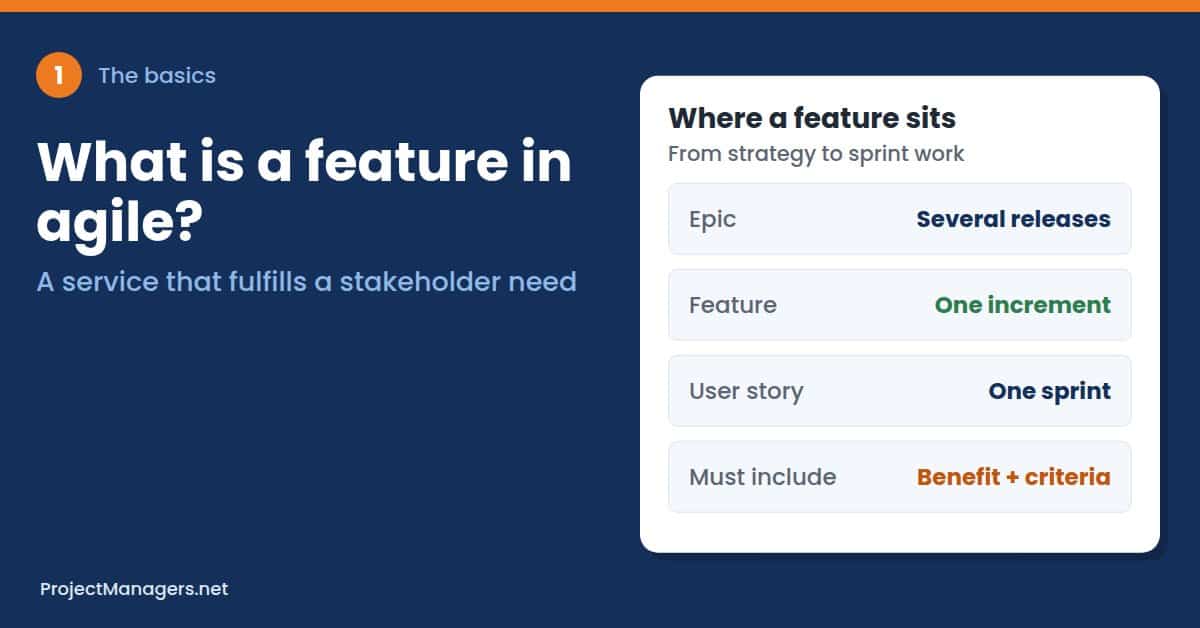
In agile, a feature is a functional piece of a product that delivers clear business value and meets a stakeholder need. The Scaled Agile Framework (SAFe) describes a feature as solution functionality that delivers business value, fulfills a stakeholder need, and is sized to be delivered within one program increment. Features describe functionality at a macro level, which helps teams plan releases realistically.
Features feed sprint planning and release planning, where teams refine them into user stories with estimates. Scrum.org describes this refinement as breaking backlog items into smaller, more precise items. Different agile methods also use different names for the same idea, so project managers working across teams should agree on terms early. Common naming conventions include:
- Scrum: Product backlog items, which many teams label as features when they span several sprints.
- Extreme Programming (XP): Stories, which carry the customer value and the conversation behind it.
- DSDM: Requirements, prioritized with the MoSCoW method of must, should, could, and won’t.
- Agile Unified Process: Requirements and use cases that describe how a user interacts with the system.
Real-Life Example: A payments project manager inherited three teams that each used a different word for the same backlog level. Release reviews kept stalling because one team counted features and another counted stories, so progress reports never matched. The project manager agreed on one glossary with the product owners, and the next quarterly plan showed a single, comparable list of features across every team.
Feature Points: Sizing a Feature before You Commit
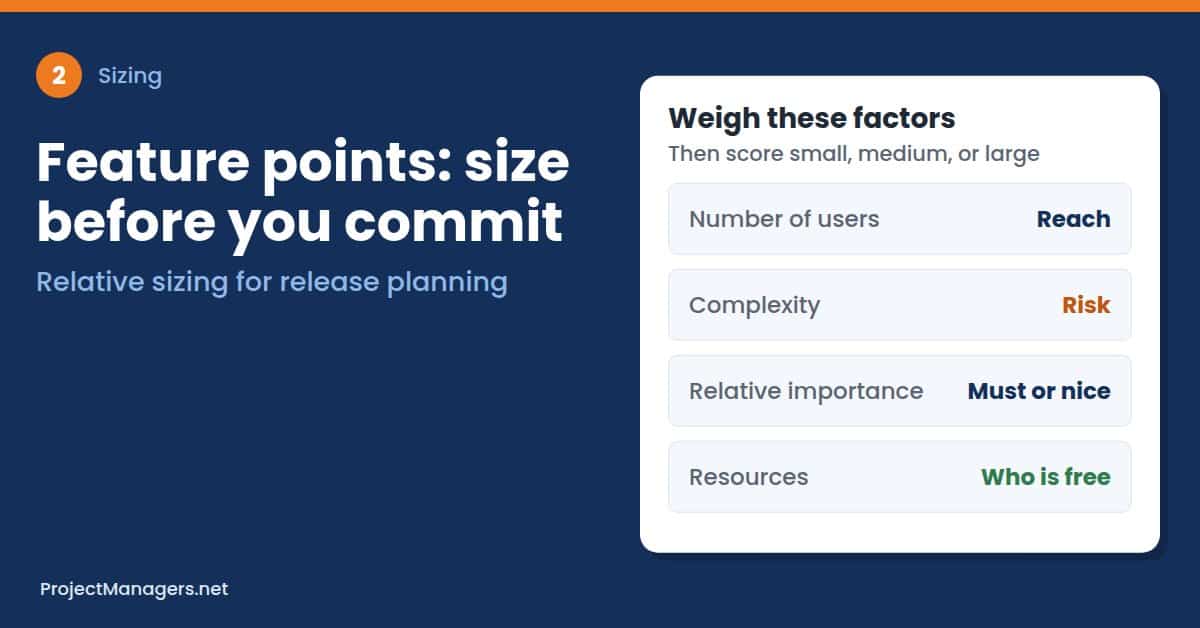
Feature points estimate the complexity, time, and know-how needed to finish one feature. They work like story points but apply to a whole feature rather than a single user story. Many teams use a simple relative scale of small, medium, and large, based on past delivery experience. The point is a fast comparison between competing features, not a precise forecast of hours.
Feature points matter most when several features compete for the same people and budget, because they let project managers compare options quickly. Teams then add up the factor scores to estimate the total size of a feature and plan capacity. When assigning feature points, project teams should weigh these factors:
- Number of Users: How many people will use the feature, and how often they will rely on it.
- Complexity: Technical difficulty, integrations, data changes, and unknowns that raise risk.
- Relative Importance: Whether the feature is a must-have for the release or a nice-to-have.
- Resource Availability: Which developers, designers, and testers are free to build it.
Real-Life Example: A project team planning a customer portal release had eight candidate features and capacity for about five. The project manager ran a 30-minute sizing session using small, medium, and large feature points, then plotted size against expected value. Two large, low-value features moved to the next release, and the team committed to a plan it actually finished on time.
How Features, Epics, and User Stories Fit Together
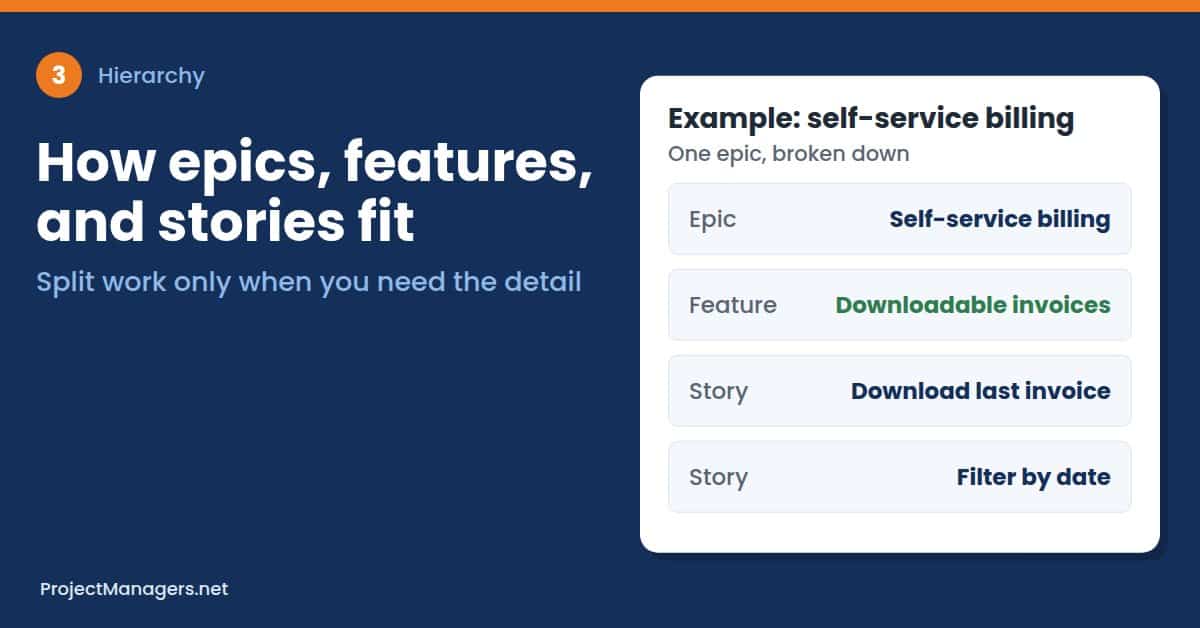
An agile epic is a large body of work delivered across many sprints, usually backed by a business case. Epics split into features, and each feature splits into user stories, the smallest unit of work. A user story describes what a user needs to do, from that user’s point of view, so the team can define the functionality without guessing.
Remember that customers can be internal colleagues who depend on your team, not only external end users. Features stay big enough to deliver a noticeable benefit when released, while stories stay small enough to finish inside one sprint. A feature breakdown structure then splits each feature into units of work only when the details are needed for design and delivery.
- Epic: A strategic initiative, such as a self-service billing experience, delivered over several releases.
- Feature: A releasable capability within the epic, such as downloadable invoices for customers.
- User Story: One sprint-sized slice, such as letting an account owner download last month’s invoice as a PDF.
- Feature Breakdown Structure: A just-in-time map of how each feature splits into stories as the work progresses.
Real-Life Example: A software project team planning a self-service billing epic first tried to estimate every story up front and spent two weeks on analysis. The project manager switched to a feature breakdown structure, detailing only the next feature, downloadable invoices. The team shipped that feature in three sprints and refined the remaining features with fresh customer feedback instead of old assumptions.
Why Break Features into User Stories?
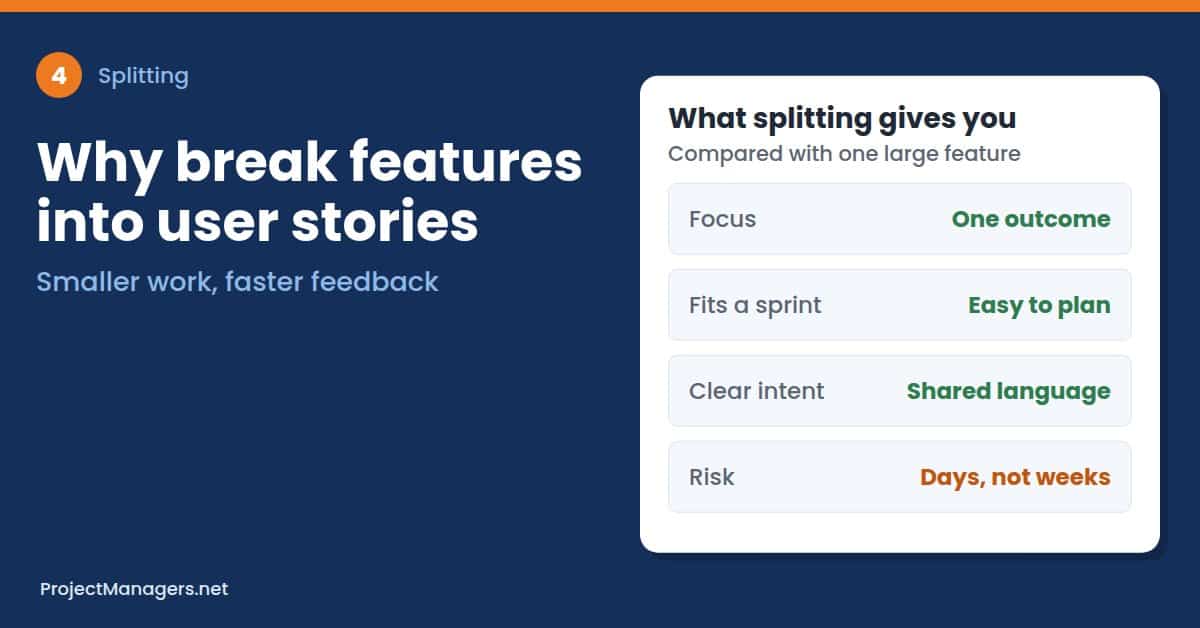
In Scrum, a feature is usually too large to finish in one sprint, so teams break it into stories they can deliver and measure incrementally. Each story narrows the focus to one outcome a developer can build and test. This makes progress visible every sprint and gives project managers real data for forecasting the rest of the feature.
Smaller stories also lower risk, and the Agile Alliance lists splitting oversized stories as a core refinement task. Large items hide more assumptions, and a wrong assumption buried in a big feature may surface only weeks into development. When work arrives in sprint-sized stories, the team can spot and fix a bad assumption within days. The main benefits of splitting features into user stories are:
- Narrower Focus: Each story covers one user outcome, so developers know exactly what to build next.
- Sprint-Sized Work: Stories fit inside a sprint, which keeps scheduling and capacity planning simple.
- Clearer Intent: Stories state the desired outcome in plain language that developers and stakeholders share.
- Lower Risk: Wrong assumptions surface within days instead of several weeks into development.
Real-Life Example: A mobile banking project team broke a new card controls feature into six user stories, including freezing a card and setting a spending limit. The first sprint review showed users ignored the spending limit screen. The project manager reprioritized the backlog that afternoon, saving roughly two sprints of work the team would otherwise have spent polishing an unwanted screen.
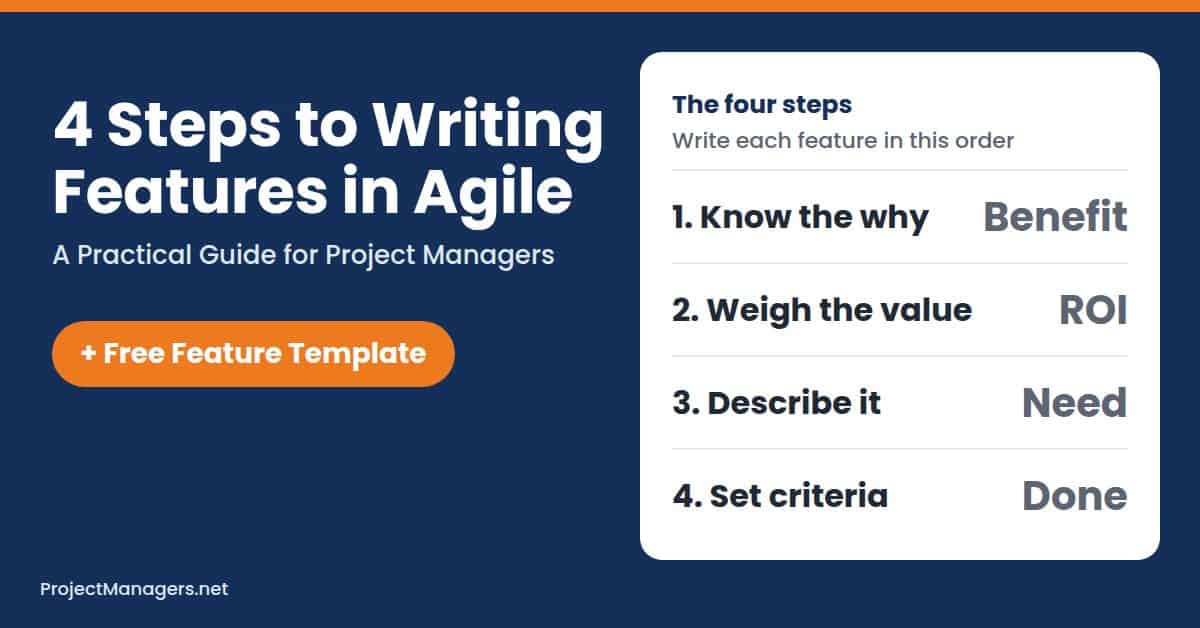
The 4 Steps to Writing Features in Agile
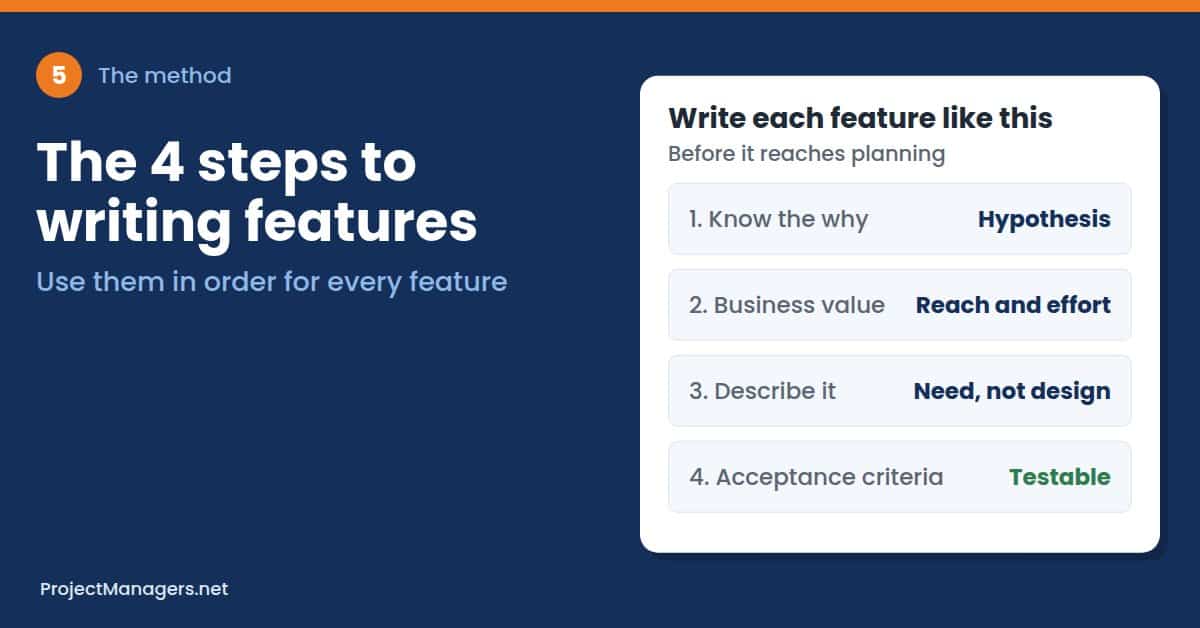
Product managers usually own features, deciding what goes into each one and where it sits in the backlog. Other team members often help write them, which only works with a healthy team culture and a psychologically safe agile environment. People must feel free to question a vague feature before it reaches a sprint. Use these four steps to write each feature:
Step 1: Know the Why
Start from the product mission and the customer journey, then write a benefit hypothesis: the measurable gain users should get from the feature. A good hypothesis names the user, the change, and the signal you will watch, such as fewer support tickets or faster checkout. If nobody can state the why in one sentence, the feature is not ready for the backlog.
Step 2: Evaluate Your Business Value
Weigh the number of users, how often they will use the feature, the timing of the release, and the development effort required. Together, these factors give a rough return on investment. A feature that delivers a large benefit for little effort earns priority, while a costly feature that few people will use should wait or be split into a smaller first version.
Step 3: Describe the Feature
Describe how users will use the feature and which need it meets, not how developers will build it. Leave implementation choices to the team that does the work. Keep the description short, use plain language that customers, testers, and executives all understand, and avoid internal jargon. One or two sentences plus the benefit hypothesis is usually enough for planning.
Step 4: Note the Acceptance Criteria
Acceptance criteria define when a feature is done, much like the criteria on a user story but at a higher level. They give every stakeholder a shared picture of what must be delivered, reduce ambiguity during development, and make progress easy to judge. Write them as testable statements before development starts, so mismatched expectations surface in refinement rather than at the sprint review.
- Why: One sentence naming the user, the change, and how success will be measured.
- Value: Reach, frequency, timing, and effort scored before the feature is prioritized.
- Description: What users can do and why, written without implementation detail.
- Acceptance Criteria: Three to five testable statements that define a finished feature.
Real-Life Example: A project manager on a retail app team rewrote a backlog item called better search into a proper feature. The benefit hypothesis targeted a 20 percent drop in zero-result searches, and the acceptance criteria covered typos, synonyms, and filters. Testers wrote their checks before development began, and the feature passed its first review without the usual round of rework.
Characteristics of a Well-Written Agile Feature
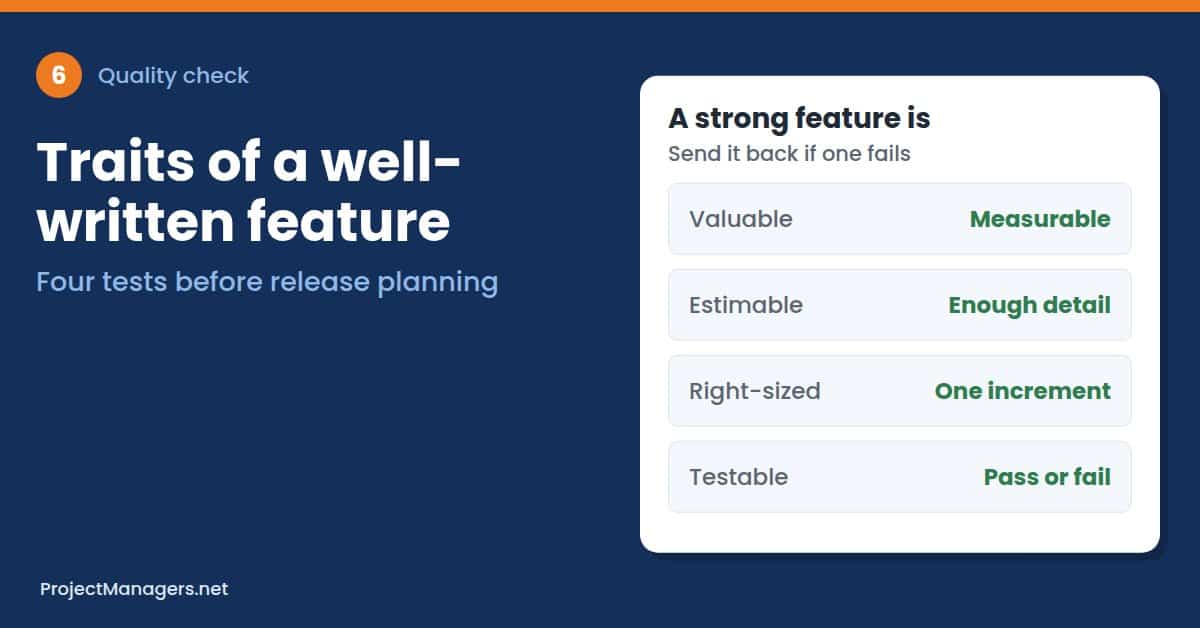
A strong feature passes a few quick tests before it enters release planning. These traits help project managers spot weak features early, when rewriting them costs minutes rather than sprints. If a feature fails one of these tests, send it back to refinement instead of letting the team discover the gap mid-sprint. An effective agile feature has these characteristics:
- Measurable Business Value: It can be measured in financial return, time saved, or user satisfaction.
- Enough Detail to Estimate: It holds enough information for the project team to judge effort and set priority.
- Fits One Planning Increment: It can be finished within one program increment, which SAFe puts at generally under two months of total effort.
- Testable: Its acceptance criteria can be verified with clear pass or fail results.
Real-Life Example: During backlog refinement, a project team reviewed twelve proposed features against these four traits. Three had no measurable value, and two could not fit one increment, so they went back to the product owner for rework. The team’s next planning session took half the usual time, because every feature on the board was already ready to estimate.
Agile Feature Template with a Worked Example
A template keeps every feature in the backlog consistent, which makes features easier to compare during planning. The fields below follow the four steps above, and the right-hand column shows a filled-in example. For wider context on methods and roles, see our agile project management guide. Copy the template into your backlog tool and adapt the fields to your team:
Agile Feature Template
| Field | Worked Example |
|---|---|
| Feature Name | Downloadable invoices |
| Benefit Hypothesis | Account owners can get past invoices without contacting support, cutting billing tickets by 25 percent. |
| Description | Account owners can view and download any invoice from the last 24 months as a PDF. |
| Priority Level | High (must-have for the billing release) |
| Dependencies | Invoice archive service and the new account settings page |
| Feature Points | Medium |
| Acceptance Criteria | Invoices from the last 24 months are listed; each downloads as a PDF in under three seconds; only account owners see the list. |
Common Mistakes When Writing Agile Features
Most feature problems start in writing, long before a developer touches the code. A few habits cause the bulk of rework, and project managers can catch each of them during refinement. Watch for these common mistakes, and treat any feature that shows one of them as not ready for planning until the gap is fixed:
- Writing a Solution Instead of a Need: Naming the database table or screen layout locks the team into one design too early.
- Skipping the Benefit Hypothesis: Without a measurable why, the team cannot tell whether the feature worked after release.
- Features Too Big for One Increment: A feature that spans several increments is really an epic and should be split.
- Vague Acceptance Criteria: Phrases like fast or easy to use cannot be tested, so done becomes a debate.
- Writing Features Alone: Features written without developers and testers miss effort, risk, and edge cases.
Feature Writing Checklist
Run each feature through this short checklist before it enters release planning. It takes a few minutes per feature and turns the four steps into a routine the whole project team can share. Any item left unchecked is a reason to send the feature back to refinement rather than into a sprint, where fixing it costs far more:
- The feature states who benefits and why, in one sentence.
- A measurable benefit hypothesis names the signal the team will track.
- Reach, frequency, timing, and effort have been weighed against other features.
- The description explains the user need without prescribing the design.
- Three to five testable acceptance criteria define done.
- The feature fits within one planning increment, or it has been split.
- Dependencies and a feature point size are recorded.
Video: Writing User Stories and Acceptance Criteria
This recent tutorial covers the story and acceptance criteria side of the process, which is where most features are refined after the four steps above. It is a useful refresher for product owners and project managers who coach teams on backlog writing, and it introduces the INVEST checks that many agile teams use during refinement sessions.
How to Write Agile User Stories, Acceptance Criteria & INVEST Principles (VoClick, 9:16)
A July 2026 walkthrough that writes user stories in the standard format, adds testable acceptance criteria, and checks each story against the INVEST principles. It shows how a feature becomes sprint-ready work.
Agile Features FAQs
Agile Features FAQs
What Is the Difference between a Feature and a User Story in Agile?
A feature is a releasable capability that delivers business value and usually takes several sprints. A user story is one sprint-sized slice of that feature, written from the user’s point of view. Teams split each feature into stories so they can deliver and test it step by step.
Who Writes Features in Agile?
Product managers or product owners usually own features and set their priority. Developers, testers, and project managers often help write them, which adds effort estimates, risks, and edge cases the owner might miss.
How Big Should an Agile Feature Be?
A feature should be small enough to finish within one planning increment, which SAFe puts at generally under two months of total effort, and large enough to deliver a benefit users notice. If it needs more than one increment, treat it as an epic and split it.
What Should Acceptance Criteria for a Feature Include?
Include three to five testable statements that describe what the feature must do to count as done, such as response times, permissions, or data rules. Avoid vague words like fast or simple that cannot be verified.
What Is a Benefit Hypothesis?
A benefit hypothesis is a short statement of the measurable gain a feature should create, such as fewer support tickets or faster checkout. It tells the team what to measure after release to judge whether the feature worked.
How Do Feature Points Differ from Story Points?
Both are relative estimates of effort and complexity. Story points size a single user story, while feature points size a whole feature, often on a simple small, medium, and large scale used for release planning.
Do Project Managers Need to Write Features Themselves?
Not always, but project managers should make sure every feature has a clear why, a value estimate, and testable acceptance criteria before planning. Their role is often to coach the team and keep features consistent across the backlog.
Conclusion
The four steps are simple, but they change what reaches the sprint board. When every feature carries a one-sentence why, a value estimate, a plain description, and testable acceptance criteria, sprint reviews stop turning into debates about what was meant. The team spends its time building the right thing, and stakeholders can see why each feature earned its place in the plan.
Start small. Take the next three features in your backlog, run them through the checklist above, and rewrite any that fail. Use the template to keep them consistent, and split anything that will not fit one increment. Keep each feature precise, measurable, and focused on users, and the wider Agile Methodology becomes much easier to run release after release.
Suggested Articles:
- Top 10 Cons of Agile Methodology (2026)
- 3 T-Shirt Sizing Agile Methods (Guide + Free Sizing Board)
- Building an Agile Work Environment: 7 Steps, Examples, and Best Practices

Shane Drumm, holding certifications in PMP®, PMI-ACP®, CSM, and LPM, is the author behind numerous articles featured here. Hailing from County Cork, Ireland, his expertise lies in implementing Agile methodologies with geographically dispersed teams for software development projects. In his leisure, he dedicates time to web development and Ironman triathlon training. Find out more about Shane on shanedrumm.com and please reach out and connect with Shane on LinkedIn.