
An agile work environment is a workplace, physical or virtual, designed to help teams respond quickly to change, collaborate closely, and deliver value in short cycles. It goes beyond adopting Scrum or Kanban ceremonies, shaping the physical layout, technology, and culture that make those practices actually work. Organizations that get this right see faster decisions and stronger engagement.
This guide breaks down what defines an agile environment, walks through seven practical steps for building an agile physical space, and shares real examples from companies known for agile success. You will also find guidance on adapting agile spaces for hybrid teams and a rundown of common mistakes worth avoiding before you start redesigning your workplace today.
What Is an Agile Work Environment?
An agile work environment prioritizes fast feedback, close collaboration, and adaptability over rigid structure and long planning cycles. It is built around cross-functional teams that can pivot quickly when priorities shift, rather than following long, fixed, sequential processes common in traditional offices. The goal is a workplace where communication flows freely, and obstacles surface early instead of late in a project.
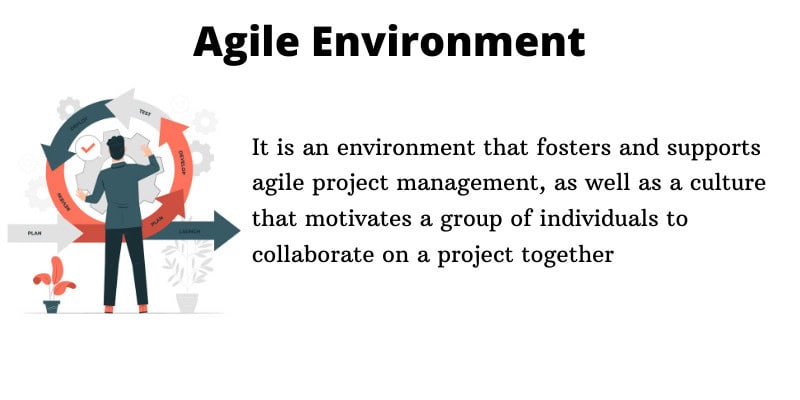
Unlike a traditional office optimized for individual, heads-down work, an agile environment is engineered for constant interaction between people. Teams typically sit together, share visible progress boards, and hold brief, frequent check-ins throughout the week. The result is a workplace that feels less hierarchical and more like a shared workshop focused on solving problems together.
Key Characteristics of an Agile Environment
Several distinct traits consistently show up across agile workplaces, regardless of industry, company size, or how long the organization has practiced agile methods overall. Understanding these characteristics helps leaders evaluate whether their current setup actually supports agile ways of working, or merely borrows agile terminology without changing daily habits, decision-making patterns, or how teams communicate.
The following list breaks down the core traits worth measuring:
- Iterative and Incremental: Work happens in short, repeatable cycles rather than one long project arc, allowing teams to test ideas, gather feedback, and adjust before committing more resources.
- Highly Collaborative: Teams communicate constantly through stand-ups, pairing sessions, and shared visual boards, reducing the delays that come from waiting on formal status reports.
- Adaptable to Change: Priorities can shift mid-sprint without derailing the entire project, since agile teams plan in shorter horizons and revisit backlogs regularly.
- Results-Oriented: Success is measured by delivered value to the customer or user, not by hours logged or tasks technically completed on a checklist.
- Open to Iteration and Feedback: Team members routinely revise their own work based on peer input, retrospectives, and real usage data rather than treating first drafts as final.
How to Create an Agile Physical Environment: 7 Steps
Building an agile physical environment starts with the workspace itself, since layout and access to tools directly shape how often and how easily people collaborate. An open, well-lit space with flexible seating and dedicated meeting areas removes friction from daily communication and speeds up decisions. The seven steps below cover the essentials for getting the physical setup right from day one.
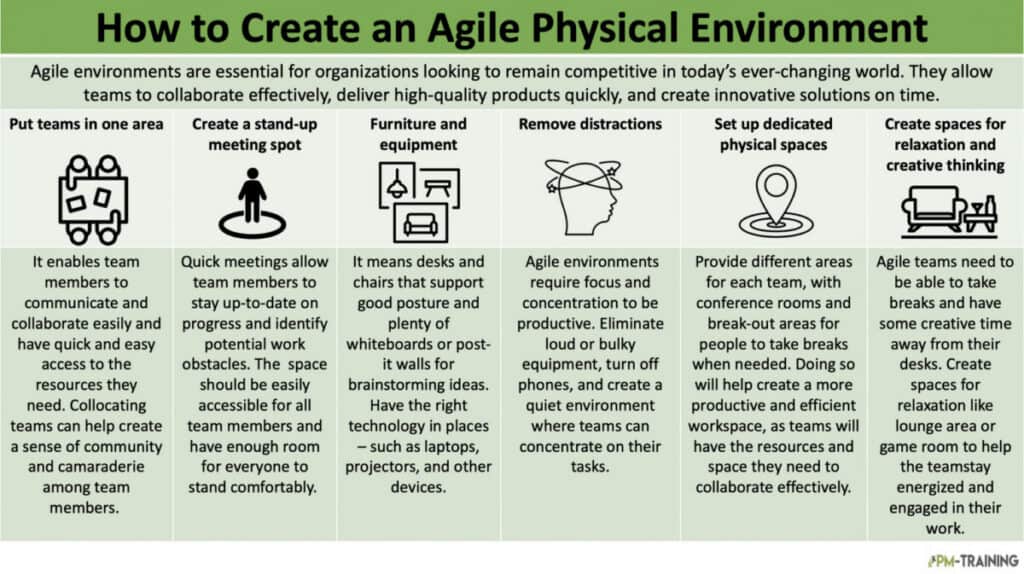
1. Put Teams in One Area
Co-locating a team in a single area remains one of the most effective ways to build an efficient agile workspace, even as more organizations adopt hybrid models. Sitting close together gives team members quick access to each other and to shared resources, cutting down the delays caused by scheduling formal meetings just to ask small, everyday questions.
There are real tradeoffs worth acknowledging here, including higher ambient noise levels and more frequent interruptions for people doing focused, individual work that requires deep concentration for extended periods. Even so, most agile organizations find the collaboration benefits clearly outweigh these drawbacks, particularly for teams that depend heavily on frequent, informal communication throughout each working day.
Keep these practical benefits in mind when planning your layout:
- Faster Communication: Team members can ask quick questions or clarify requirements without booking a meeting room or waiting for a video call to connect.
- Stronger Team Identity: Sitting together builds a sense of shared ownership over outcomes, which tends to improve accountability during sprint reviews and retrospectives.
- Easier Resource Sharing: Physical tools like whiteboards, printed backlogs, and reference materials stay accessible to everyone without duplicating setups across the office.
2. Create a Dedicated Stand-Up Meeting Spot
The daily stand-up is one of the most recognizable agile ceremonies, giving the team a short, focused checkpoint to surface blockers and align on shared priorities before work continues. Because this meeting happens every working day, it deserves a consistent, easily accessible location rather than a rotating conference room that changes from week to week without notice.
A dedicated stand-up spot should hold the full team comfortably without crowding, and it should sit close enough to the team’s regular workspace that nobody wastes time walking across the entire building each morning. Choosing the right location signals that this daily ceremony matters just as much as any other scheduled meeting on the calendar.
Consider these setup essentials when choosing or building the space:
- Visible Progress Boards: Mount a physical or digital Kanban board where everyone can see current work items during the meeting, reinforcing what each update actually means.
- Standing-Friendly Layout: Keep the space free of chairs or tables that encourage people to sit down, since standing naturally keeps these meetings short and focused.
- Minimal Foot Traffic: Position the spot away from high-traffic walkways so the meeting is not constantly interrupted by unrelated foot traffic or noise.
3. Invest in the Right Furniture and Equipment
Agile workspaces depend on furniture and equipment that actively support collaboration rather than just filling floor space with rows of fixed desks. Desks and chairs should encourage good posture during long working sessions, while ample whiteboard or writable wall space gives teams room to sketch ideas, map user flows, and run retrospectives without hunting for supplies.
Technology matters just as much as furniture, particularly for teams that split their working time between in-person collaboration and remote work throughout a typical week and month. Reliable laptops, large-format displays, and dependable video conferencing hardware keep hybrid participants fully included in group discussions rather than treated as an afterthought during planning and review sessions.
Prioritize these agile furniture ideas and equipment categories when budgeting for a new agile space:
- Collaborative Surfaces: Whiteboards, writable walls, or digital displays give teams a shared canvas for planning sessions, story mapping, and visual problem solving.
- Reliable Meeting Technology: High-quality cameras, microphones, and displays ensure remote participants can see and hear the room clearly during hybrid ceremonies.
- Flexible Furniture: Modular tables and lightweight chairs let teams quickly reconfigure a room for pairing, workshops, or full-team planning sessions.
4. Remove Distractions
Agile teams depend on sustained focus during working sessions, so anything that fragments attention works directly against the goals of the space and slows delivery. This does not mean eliminating collaboration noise, but it does mean being deliberate about which distractions are acceptable and which ones consistently derail otherwise productive work throughout the day.
Loud equipment, unmanaged notification sounds, and poorly soundproofed meeting rooms are common culprits worth auditing carefully first, before making any larger investments in a full workplace redesign project or renovation plan. Small, low-cost changes often solve most of the problem without requiring a complete renovation of the existing office layout, floor plan, or seating chart.
A few practical changes tend to make the biggest difference:
- Quiet Zones for Deep Work: Set aside smaller rooms or corners where individuals can focus without interruption when a task genuinely requires uninterrupted concentration.
- Notification Discipline: Encourage teams to mute non-urgent alerts during focused work blocks, reserving real-time notifications for genuinely time-sensitive issues.
- Soundproofed Meeting Rooms: Insulate meeting spaces so conversations do not bleed into open areas where other team members are trying to concentrate.
5. Set Up Dedicated Physical Spaces for Each Team
Providing each team with its own defined area, complete with nearby breakout space, helps teams feel ownership over their environment while keeping the broader office organized and easy to navigate. This is especially important in larger organizations running multiple agile teams simultaneously, where shared spaces can otherwise become a source of scheduling conflict and frustration.
Design these dedicated areas with both creativity and practicality in mind, since agile work often shifts between focused planning sessions and open, energetic brainstorming throughout a single working day. Getting this balance right helps teams move fluidly between different modes of work without needing to relocate constantly between separate conference rooms or entirely different office floors.
Consider the following elements when allocating space to each team:
- Team-Specific Boards: Give each team its own visible backlog or Kanban board, positioned where the team naturally gathers rather than tucked away in a shared hallway.
- Nearby Breakout Rooms: Place small breakout rooms close to each team’s primary area so members can step away for a quick discussion without losing momentum.
- Natural Light and Open Layouts: Favor open layouts with access to natural light, which research consistently links to better mood, focus, and reported energy levels.
6. Create Spaces for Relaxation and Creative Thinking
Sustained agile work requires genuine breaks, not just a change of task, since creative problem solving often happens away from the desk rather than during it, in quieter, unstructured moments. Lounge areas, informal seating nooks, or even a small game room give teams somewhere to reset between sprints, retrospectives, and demo sessions throughout the week.
These spaces also double as informal collaboration zones, where some of the best problem-solving happens outside of scheduled meetings and formal agenda items entirely, away from any deadline pressure whatsoever or looming sprint goals nearby. Encouraging spontaneous conversation in a relaxed setting often surfaces ideas that structured brainstorming sessions never quite manage to reach.
A few design choices help these areas earn their place:
- Comfortable Informal Seating: Couches or soft seating signal that the space is meant for relaxation, not another version of the formal meeting room.
- Low-Pressure Environment: Keep this area free of visible task boards or deadlines, giving people a genuine mental break from active project tracking.
- Proximity Without Overlap: Locate relaxation spaces close enough to the main work area for convenience, but separate enough to avoid noise bleed.
7. Design for Hybrid and Remote Collaboration
Most agile teams today operate in some form of hybrid arrangement, which means the physical environment has to extend into virtual space rather than assume everyone is in the building. Recent industry research shows hybrid work has become the dominant model for knowledge workers, with roughly half of knowledge workers globally now operating in hybrid roles, making this step essential rather than optional.
Meeting equity, the principle that remote and in-person participants should be able to see, hear, and contribute equally, has become a defining requirement for agile ceremonies. Studies on hybrid agile software teams also found that practitioners generally preferred flexible office attendance policies over full-time remote work, with in-person meetings viewed as especially valuable for social interaction.
Build hybrid readiness into your workspace with these ongoing priorities:
- Camera-Ready Meeting Rooms: Position cameras and microphones so remote participants get a clear, wide view of the room rather than a narrow shot of whoever sits closest to the laptop.
- Asynchronous Documentation: Record decisions and updates in shared tools so team members joining later or working different hours are not left out of context.
- Consistent Hybrid Ceremonies: Run stand-ups, retrospectives, and planning sessions the same way regardless of who is remote that day, rather than defaulting to in-room-only habits.
Examples of Agile Environments in the Workplace
Beyond the seven steps above, several specific layout patterns have become common shorthand for agile-friendly design across the technology and business industries alike today. These setups show up repeatedly across companies that have invested seriously in supporting collaborative, fast-moving teams over time. Understanding them gives you concrete starting points rather than abstract design principles alone.
Common Physical Layouts
Recent workplace research highlights a clear shift toward flexible, activity-based working layouts rather than fixed desk assignments, with activity-based workspaces, hot-desking, hybrid meeting rooms, lounge-style spaces, and wellness-oriented features replacing traditional row-and-cubicle designs across many modern offices today. These patterns give teams meaningful options depending on the specific task in front of them at any given moment.
Consider these common layout options when planning your own space:
- Communal Tables: Large shared tables replace individual cubicles, giving teams room to spread out materials during planning sessions and brainstorm without physical barriers between people.
- Project Rooms: Dedicated rooms let teams focus on a specific initiative with the privacy needed for sensitive discussions, extended planning, or deep design work.
- Flexible Seating: Standing desks, couches, and bean bags give people choices in how and where they work, supporting both focused tasks and casual collaboration.
- Activity-Based Zones: Huddle rooms, quiet pods, and open collaboration hubs let teams match their environment to the specific task rather than working in one fixed spot all day.
Companies That Use Agile Environments Successfully
Several well-known organizations have built their workplace design directly around agile principles, offering useful reference points for teams planning their own workplace transformation journey. Their approaches differ in the details, but each prioritizes flexibility, visible collaboration, and rapid iteration over rigid, traditional office structures and management hierarchies. The examples below illustrate that range clearly.

Reviewing how established companies structure their agile spaces can guide decisions about your own layout:
- Google: Google has built open workspaces across much of its footprint specifically to encourage spontaneous collaboration and communication between engineering and product teams working on fast-moving initiatives.
- Dropbox: Dropbox pairs flexible seating with dedicated project rooms, giving distributed and in-office teams a consistent set of spaces for brainstorming and focused delivery work.
- Amazon: Amazon applies agile principles across many of its product teams, using small, autonomous groups supported by workspace design that favors fast decision-making over lengthy approval chains.
- Microsoft: Microsoft has redesigned many campus buildings around activity-based working, letting employees choose collaborative work environments or quiet zones depending on the task in front of them.
- Apple: Apple emphasizes tightly integrated, cross-functional teams working in proximity with each other, reflecting agile values even in an organization known for a more controlled overall culture.
Agile Environments in Software Engineering
Software engineering remains the domain most closely associated with agile methodology, and the physical and cultural environment around engineering teams plays a direct role in delivery speed and code quality. In this setting, an agile environment means breaking large projects into smaller, testable increments while giving engineers the space to adjust course when new information surfaces mid-sprint.
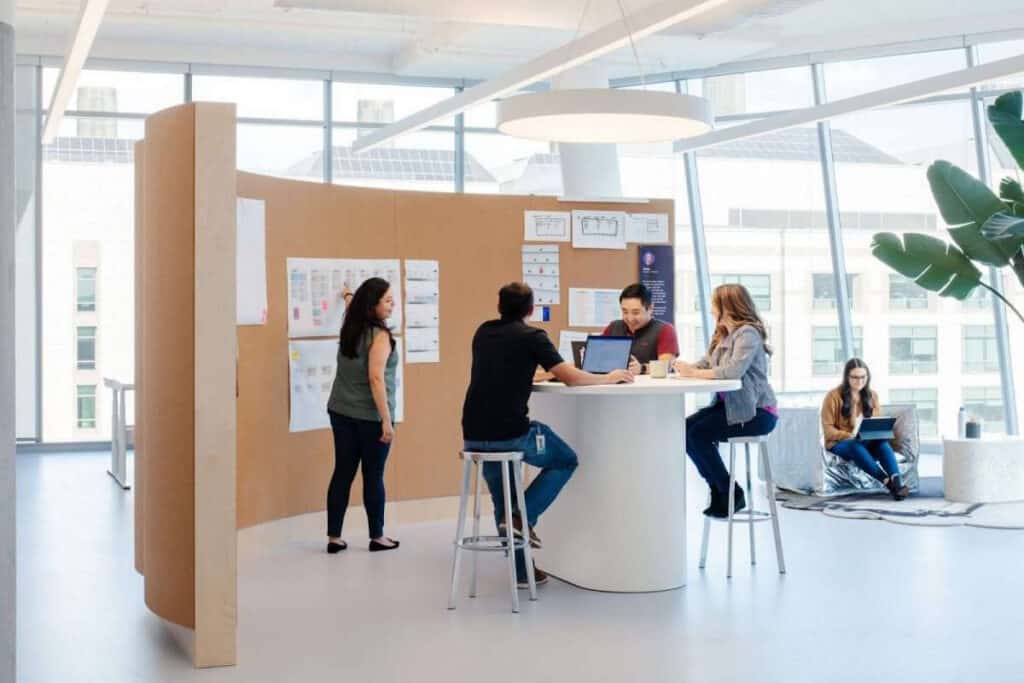
Image Source: https://hga.com/projects/dropbox/
Psychological safety has emerged as a critical, research-backed factor in how well agile software teams actually perform, especially under pressure. Studies on agile psychological safety describe it as the shared belief that team members will respond constructively when someone asks a question, reports a mistake, or proposes a new idea, which directly shapes how openly a team communicates.
Hybrid arrangements add a new layer here, since safety must hold up virtually too:
- Openness Without Blame: Teams that avoid finger-pointing during retrospectives tend to surface real problems earlier, rather than letting issues quietly resurface later in the sprint.
- Leadership Ownership: Research on psychological safety in agile teams found that collective decision-making and leadership ownership function as core pillars of a psychologically safe workplace, more so than autonomy alone.
- Consistent Ceremony Structure: Predictable stand-ups, reviews, and retrospectives give engineers a reliable outlet to raise concerns before they escalate into larger delivery risks.
Common Mistakes to Avoid When Building an Agile Environment
Even well-intentioned agile transformations can stall when the physical or cultural changes are applied inconsistently across different teams, departments, and leadership levels over time. Recognizing these pitfalls early saves time and prevents teams from associating agile principles with disruption rather than genuine, lasting improvement. The mistakes below show up repeatedly across organizations attempting this shift.
Avoid these common missteps as you plan or refine your own agile workspace:
- Redesigning the Office Without Changing Habits: Open layouts alone will not create agility if teams still rely on lengthy approval chains and infrequent, formal status updates.
- Ignoring Hybrid Participants: Treating remote team members as an afterthought during ceremonies undermines the collaboration and trust an agile environment is meant to build.
- Skipping Psychological Safety: Fast-paced spaces without genuine trust often produce more anxiety than agility, especially during retrospectives where honesty matters most.
- Overcrowding Shared Spaces: Cramming too many teams into one open area creates noise and distraction that undercuts the focus agile teams actually need to deliver.
Video About Agile Working Environments
Watch the video below for a quick visual overview of what an agile working environment looks like in practice and how these principles come to life in real teams.
Conclusion
An agile work environment combines the right physical layout, the right technology, and a culture built on trust and fast feedback. The seven steps outlined here, from co-locating teams to designing for hybrid collaboration, give organizations a practical starting point for closing the gap between adopting agile terminology and actually working that way day to day.
Companies like Google, Dropbox, and Microsoft show that agile-friendly design pays off in faster decisions and stronger engagement across their teams. As hybrid work continues shaping how teams operate, the organizations that invest deliberately in both space and culture will be best positioned to deliver consistently, adapt quickly, and keep their people genuinely engaged over time.
Frequently Asked Questions About Agile Work Environments
What is the difference between an agile environment and a traditional office?
A traditional office is generally organized around individual desks, formal approval chains, and longer, more sequential planning cycles that limit flexibility and slow decisions. An agile environment prioritizes co-located or well-connected teams, visible progress tracking, and short feedback loops, with layout choices that actively encourage frequent, informal collaboration rather than isolated individual work throughout the day.
How many people should be in an agile team room?
Most agile teams range from five to nine members, which keeps communication manageable during stand-ups, planning sessions, and retrospectives without adding extra coordination overhead to the process. A team room or dedicated area should comfortably fit the full team plus a small buffer for guests, without feeling cramped during meetings or everyday collaborative work throughout the week.
Can a fully remote team have an agile work environment?
Yes, though it requires deliberate effort to replicate the collaboration benefits that physical proximity naturally provides to co-located teams working side by side. Fully remote agile teams rely on shared digital boards, consistent video ceremonies, and strong asynchronous documentation practices to maintain the same visibility and fast feedback that a physical space would otherwise provide.
What furniture is best for an agile workspace?
Flexible, modular furniture works best, including lightweight tables that can be rearranged quickly for different activities and varying group sizes throughout the entire working day and week, whiteboards or writable walls for visual planning, and comfortable seating that supports both short stand-ups and longer working sessions without requiring a full room reconfiguration every single time.
How long does it take to build an agile work environment?
Physical redesigns can take anywhere from a few weeks to several months, depending on scope, budget, and the overall size of the organization involved in the project. The cultural shift toward agile ways of working typically takes considerably longer. Most organizations see meaningful behavioral change within two to three quarters of consistent practice and steady leadership support.
Suggested articles:
- Why Physical Workspace Still Matters in Modern Project Delivery
- 5 Agile Team Requirement Examples
- 9 Agile Performance Metrics to Drive Better Outcomes

Shane Drumm, holding certifications in PMP®, PMI-ACP®, CSM, and LPM, is the author behind numerous articles featured here. Hailing from County Cork, Ireland, his expertise lies in implementing Agile methodologies with geographically dispersed teams for software development projects. In his leisure, he dedicates time to web development and Ironman triathlon training. Find out more about Shane on shanedrumm.com and please reach out and connect with Shane on LinkedIn.