
A customer rewards program looks simple on paper: a customer takes an action, the business sends a reward, and everyone moves on. In practice, the project behind that program touches marketing, finance, operations, IT, and customer support. When those teams are not aligned, duplicate payouts, failed deliveries, and budget surprises start to appear. Most of these problems trace back to decisions nobody made before launch. That is why project managers get better results when they treat a rewards program as a real project from the first planning session.
- Define the customer behavior worth rewarding and the business outcome it should drive before you compare any software.
- Write eligibility rules as acceptance criteria, so Marketing, Finance, and Customer Support approve rewards from the same definition.
- Map an owner for every step, from qualifying behavior to failed deliveries, and set a clear change path for after launch.
- Use the pilot to test awkward cases and budget limits, then judge the project on business results, not on rewards sent.
The best incentive program software does more than send rewards. It takes a clearly defined customer action from eligibility to delivery without creating more manual work as the program grows. Long before looking at different platforms, the business needs to decide what success looks like: what behavior is worth rewarding, what proves that someone is qualified, where that information already lives, and whether rewards will go out in planned batches or continuously. Once this is decided, it is time to shop around and scale. Giftogram’s incentive program software supports bulk distribution, integrations, and automated workflows. Still, it can only automate rules the business has already defined, which is why the initial decision process matters so much for a successful incentive program.
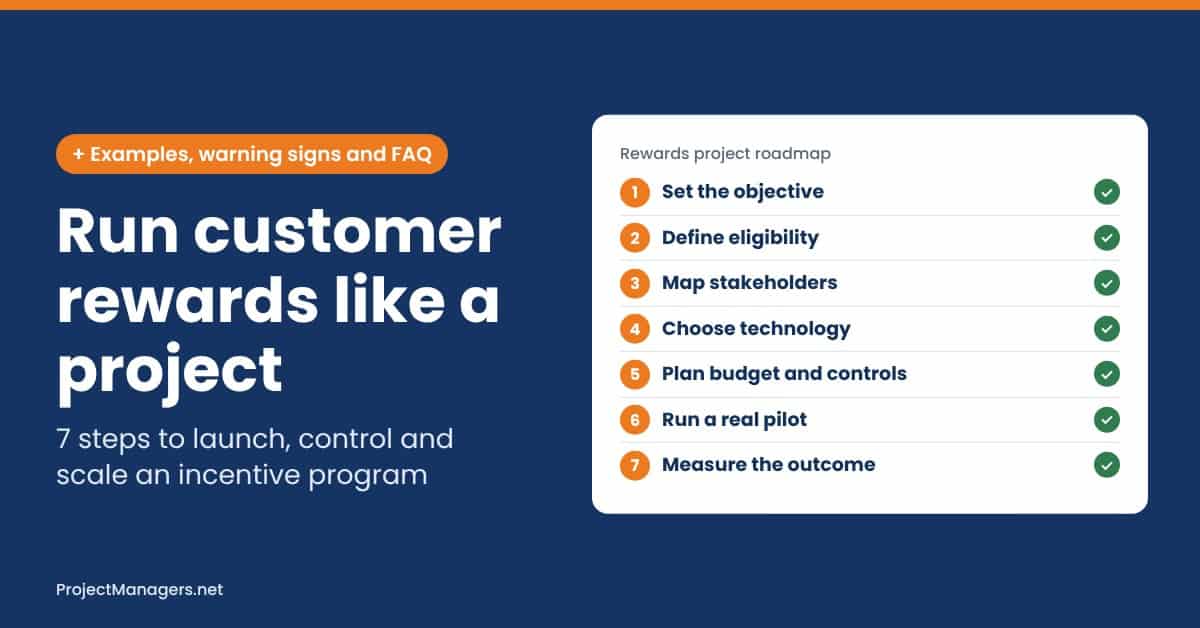
Below are seven steps project managers can follow to plan, launch, and scale a customer rewards project, followed by warning signs to watch for, common mistakes to avoid, and a short pre-launch checklist.
1. Treat the Reward Program as a Project, Not a Marketing Extra

A customer rewards initiative looks simple from the outside: define an action, send a reward, and track the result. For a project manager, however, the real work sits between those steps. The initiative touches marketing, finance, operations, IT, customer support, and sometimes legal or compliance. If those teams are not aligned, even a good incentive can become messy to operate.
The project manager should start by writing a short project objective. What customer behavior should change? What business outcome should follow? A referral initiative, for example, may aim to increase qualified introductions rather than raw sign-ups. A survey program may care more about response quality than response volume. The clearer the objective, the easier it is to judge every later decision.
A useful project objective usually answers four questions:
- Behavior: Which customer action are you rewarding, described in one sentence?
- Outcome: Which business result should that behavior produce, such as new customers, better research data, or repeat purchases?
- Measure: Which metric will show that the project worked, and who already tracks it?
- Rhythm: Will rewards go out in planned batches or continuously, as soon as someone qualifies?
Example: Consider a software company that launched a referral campaign as a quick marketing idea. Within weeks, Sales complained about low-quality leads, Finance could not explain the spend, and Support had no script for reward questions. When the project manager restarted the initiative with a written objective focused on qualified introductions, every team finally knew what the program was supposed to achieve.
2. Define Eligibility as Project Acceptance Criteria

Every rewards project needs a precise definition of ‘done.’ In project management terms, eligibility rules work much like acceptance criteria. They tell the team exactly what must happen before a reward is approved.
A project manager should remove vague language before launch. Does a referral qualify when a lead submits a form, attends a call, makes a purchase, or remains a customer for 30 days? If the team cannot answer that in one sentence, the rule is not ready for automation. Clear acceptance criteria also reduce disputes later because customer support and finance are working from the same definition.
This is also where project managers should document exceptions rather than leaving them to individual judgment. A simple risk register can capture issues such as duplicate referrals, failed deliveries, suspected abuse, budget overruns, and system outages before they become project emergencies.
Eligibility rules also need a compliance check. If the program rewards customers for writing reviews, the reward must never depend on what the review says. The Federal Trade Commission’s 2024 rule on reviews and testimonials prohibits incentives conditioned on a particular sentiment, so a project manager should ask legal or compliance to review the wording before launch.
Example: Consider a subscription business that rewarded referrals as soon as a friend created a free account. Hundreds of rewards went out for accounts that never paid. The project team rewrote the rule so a reward was approved only after the referred customer’s first paid month, and the number of disputed rewards dropped because everyone could check the same criteria.
3. Map the Stakeholders Before Choosing the Platform
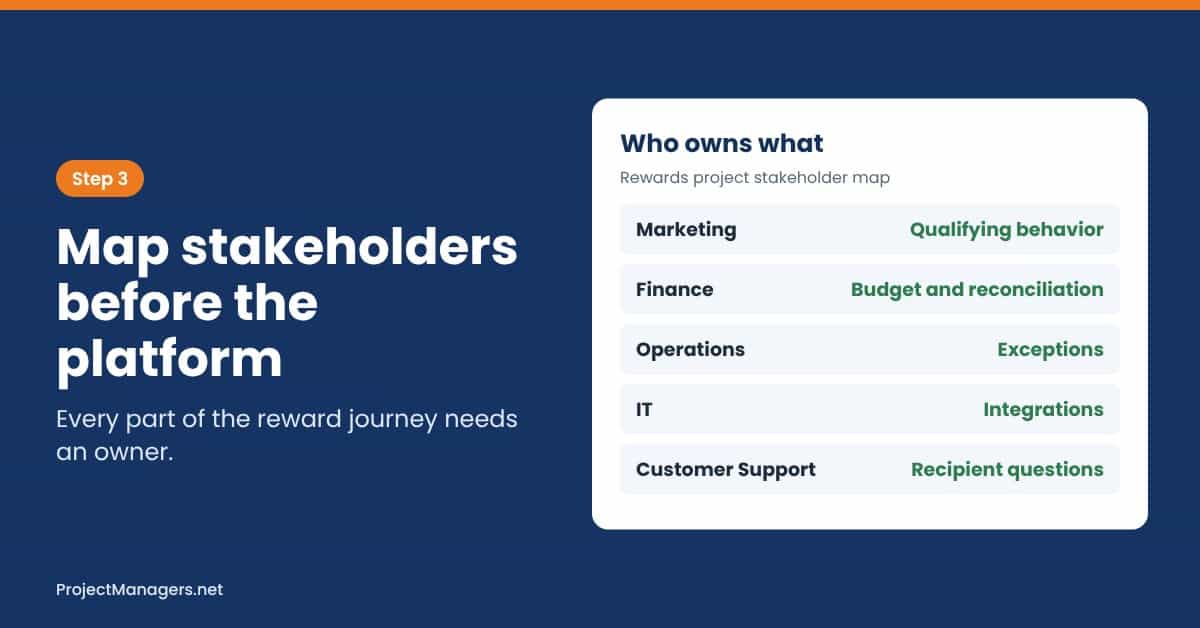
Software should not decide the project structure. The operating model should decide what the software needs to do. Before comparing platforms, the project manager should map who owns each part of the customer journey.
A practical stakeholder map might show Marketing owning the qualifying behavior, Finance controlling the project budget, Operations managing exceptions, IT handling integrations, and Customer Support dealing with questions from recipients. That project map quickly exposes gaps. If nobody owns a failed reward delivery, the project has an operating problem before it has a software problem.
The project manager should also identify who can approve changes. A rewards program often evolves after launch. If Marketing wants to double the reward value or add a new audience, the team needs a clear change path instead of an informal decision made in a chat thread.
Example: Consider a retailer whose loyalty bonus was raised by a marketing manager during a busy weekend. Finance only discovered the change when the monthly invoice arrived. After the project manager added a simple change request step with Finance as approver, reward changes were reviewed in days instead of being discovered weeks later.
4. Choose Technology Around the Project Workflow
Once the project workflow is clear, the software comparison becomes much easier. A campaign that sends rewards four times a year may only need a reviewed file and bulk distribution. An always-on program with hundreds of qualifying events may need integrations, automation, scheduled sends, permissions, reporting, and API access.
This is where a project manager should resist buying features simply because they sound advanced. An API does not improve a workflow that has no repeatable data flow. Complex automation does not fix unclear eligibility. The best platform is the one that removes friction from a process the team already understands.
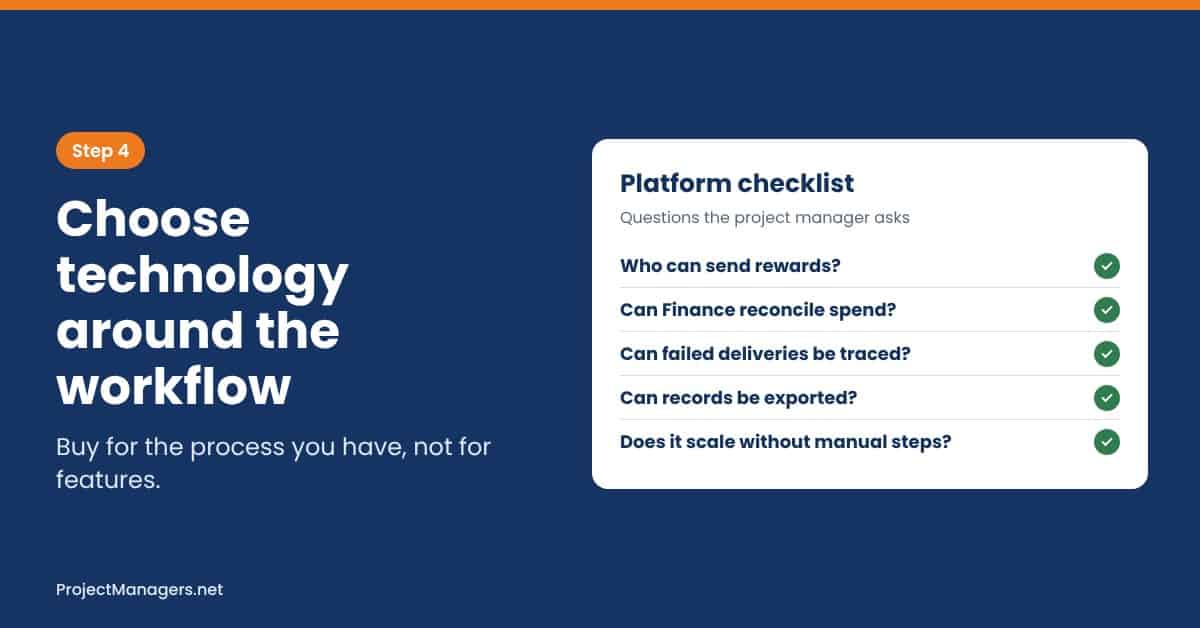
For the project manager, useful comparison questions include:
- Can the team control who can send rewards?
- Can Finance reconcile spend?
- Can failed deliveries be traced?
- Can records be exported for reporting?
- Can the workflow scale without adding manual steps each week?
Those questions connect technology directly to project delivery.
Example: Consider a market research team that ran four survey waves a year. It almost bought a platform with a full API integration, until the project manager pointed out that each wave already produced one reviewed list of respondents. Bulk distribution from that list met the need, and the team kept the integration budget for a later, always-on project.
5. Build Budget and Control Points Into the Project Plan
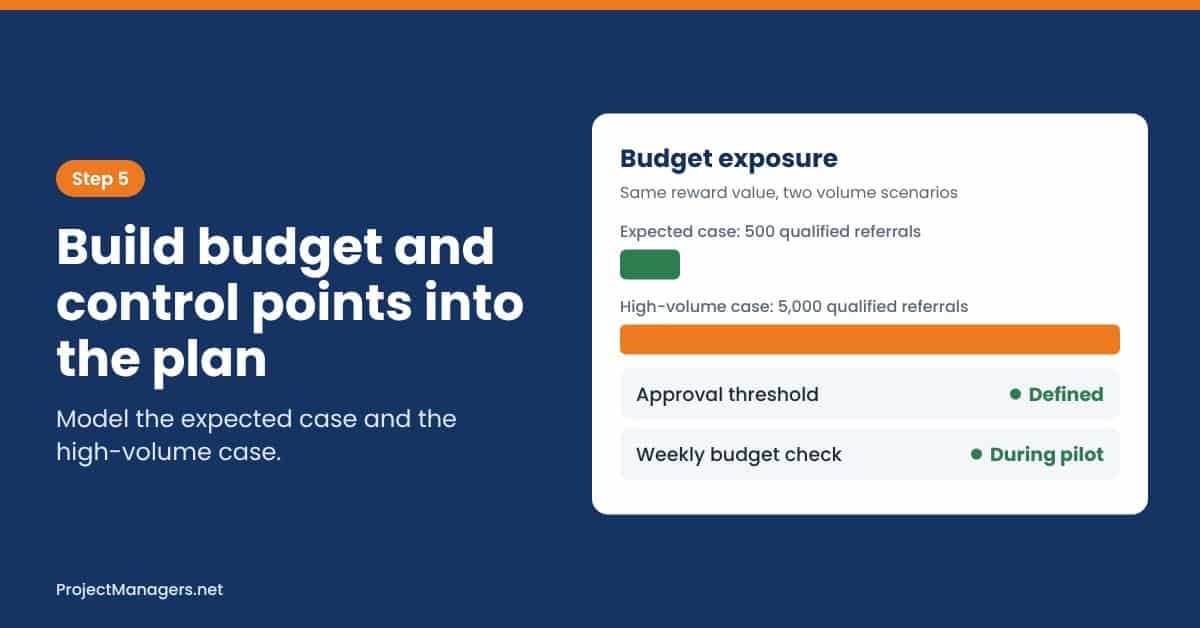
Rewards create a direct financial commitment, so the project plan needs more than a marketing budget. The project manager should define the approved reward value, expected volume, maximum exposure, approval thresholds, and the person responsible for reconciling actual spend.
Imagine a customer referral project expected to produce 500 qualified referrals but suddenly producing 5,000. That may be a great commercial result, but it can still create an operating problem if the funding process, approval limit, or support capacity was designed for the smaller volume. A project manager should model both the expected case and a high-volume case before launch.
Controls do not need to make the project slow. They simply make ownership visible. A weekly budget check during the pilot may be enough. Once the workflow is stable, the control can become lighter or more automated.
Example: Consider a fitness brand whose referral offer was shared by a popular creator. Qualified referrals tripled in one week. Because the project manager had already modeled a high-volume case and agreed a pause threshold with Finance, the team topped up the reward budget in a day instead of shutting the program down mid-campaign.
6. Use the Pilot as a Real Project Phase
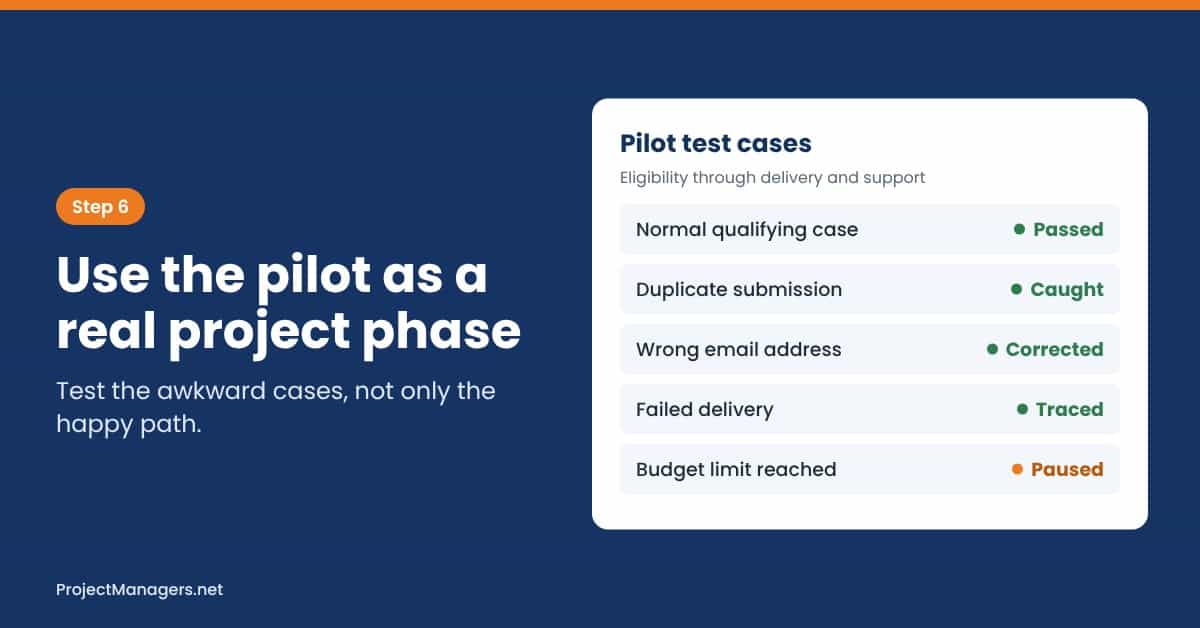
A pilot should test the full operating model, not only whether customers like receiving a reward. The project manager should use it to see how the process behaves from eligibility through delivery, reconciliation, support, and reporting.
Run a small but realistic sample. Include normal cases and awkward ones:
- Test a duplicate submission.
- Test a recipient who enters the wrong email address.
- Test a reward that fails to deliver.
- Test what happens when the project budget reaches its limit.
Those scenarios show whether the team can manage exceptions without building a new manual process every time something goes wrong.
At the end of the pilot, the project manager should hold a short review with the people who actually operated the process. What took longer than expected? Which handoff caused confusion? Which data was missing? The answers are often more useful than a dashboard full of delivery statistics.
Example: Consider a B2B software vendor that piloted partner rewards with 40 recipients. Two rewards bounced because of typos in email addresses, and nobody knew who should fix them. The pilot review gave Customer Support ownership of corrections and added an address check to the intake form before the full launch.
7. Measure the Project Against the Business Outcome
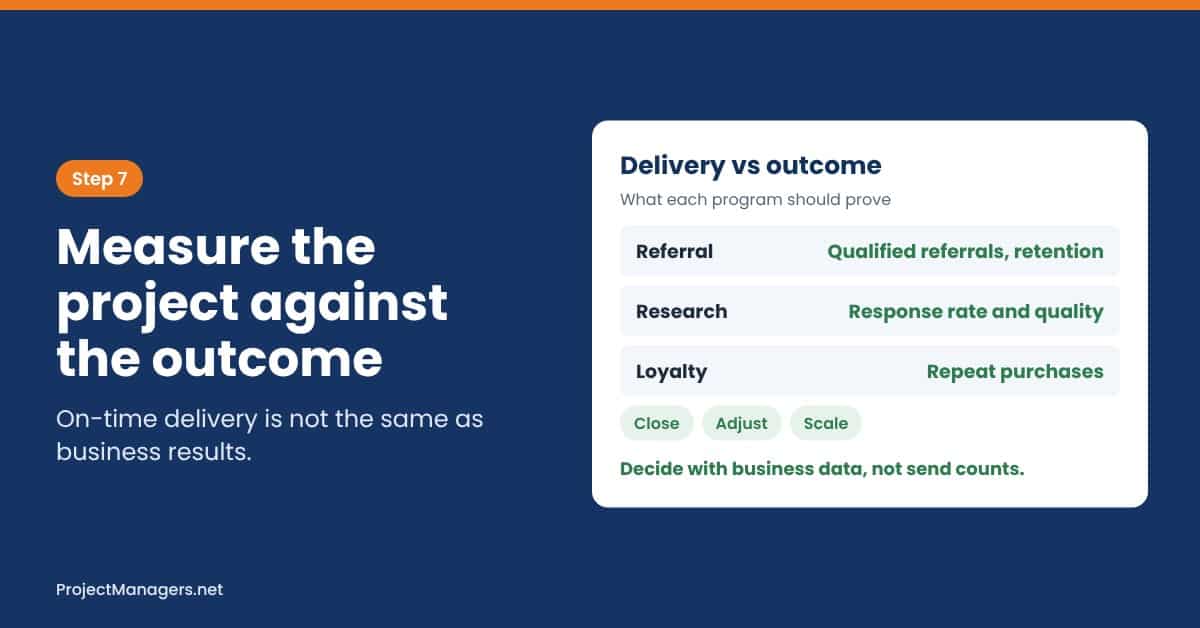
A rewards project can be operationally perfect and still fail commercially. Sending every reward on time is a delivery metric, not necessarily a business result. The project manager should connect reporting back to the behavior defined at the beginning.
For a referral project, that may mean qualified referrals, conversion rate, customer value, or retention. Research published in the Journal of Marketing found that referred customers were worth at least 16% more than comparable customers, mostly because they stayed longer, which is why retention belongs in the project report. For research, it may mean response rate and response quality. For loyalty, the business may care about repeat purchase behavior. The project manager does not need to own every commercial metric, but the project should make it possible to measure them.
This also gives the team a sensible point for a close-or-scale decision. If the project meets its operating targets but not its business target, changing the reward platform may not be the answer. The program may need a different incentive, audience, rule, or message.
Example: Consider a home services company whose rewards went out on time every week, yet new bookings barely moved. The project report showed that most referrals came from a small group of repeat customers. Instead of switching platforms, the team changed the audience and the message, and the next quarter produced more first-time bookings.
Warning Signs Your Rewards Project Needs More Structure
Even a small rewards program can drift out of control. Watch for these signs:
- Team members disagree about whether a specific customer qualified for a reward.
- Finance cannot match reward spend to qualifying events without a spreadsheet hunt.
- Failed or bounced rewards sit in an inbox because nobody owns them.
- Reward values or audiences change without a recorded decision.
- Customer Support learns about new offers from customers instead of from the project team.
- Reports show how many rewards were sent, but not what the program achieved.
If two or more of these sound familiar, pause and revisit the objective, the acceptance criteria, and the stakeholder map before adding volume.
Common Mistakes Project Managers Should Avoid
- Choosing software first: A platform demo cannot tell you which behavior to reward or who handles exceptions.
- Writing vague eligibility rules: Phrases like “active customer” or “successful referral” invite disputes and block automation.
- Planning only for the expected volume: A program that succeeds faster than planned can still break the budget and the support queue.
- Running a happy-path pilot: If the pilot never tests duplicates, typos, and failed deliveries, launch week will.
- Measuring activity instead of results: Rewards sent is an output; qualified referrals, response quality, and repeat purchases are outcomes.
Pre-Launch Checklist for the Project Manager
Before the program goes live, confirm that the project team can answer yes to each of these:
- The project objective, outcome, and success measure are written and approved.
- Eligibility rules fit in one sentence each and have been reviewed for compliance.
- Every step, including failed deliveries and recipient questions, has a named owner.
- Reward value, maximum exposure, and approval thresholds are agreed with Finance.
- The pilot tested exceptions, and its lessons are reflected in the final workflow.
- Reports connect reward activity to the business outcome, not only to delivery.
Video: How Referral Programs Work
Prefer to watch? This explainer walks through how a referral program works and the eligibility questions to answer before launch, so project managers can see the decisions behind a rewards project.
What is a Referral Program? How It Works + How to Build One (Lamar Duffy, 10:33)
A February 2026 explainer that defines referral programs, clears up common myths, walks through a five-step referral process, and ends with the eligibility questions to settle before launch.
Customer Rewards Project FAQ
Customer rewards projects: FAQ
Why should a customer rewards program be managed as a project?
A rewards program involves marketing, finance, operations, IT, and customer support. Managing it as a project gives it a clear objective, owners, a budget, a pilot, and success measures, which prevents the confusion that appears when it is treated as a marketing add-on.
What are eligibility rules in a rewards program?
Eligibility rules define exactly when a customer has earned a reward, such as a referred customer completing a first purchase. Project managers can treat them as acceptance criteria: if a rule cannot be stated in one sentence, it is not ready for automation.
Who should own a customer rewards project?
A project manager should coordinate the initiative, while each stakeholder owns a part of it. Marketing typically owns the qualifying behavior, Finance the budget, Operations the exceptions, IT the integrations, and Customer Support the recipient questions.
When does a rewards program need automation or an API?
Automation and API access make sense when qualifying events happen continuously and the data already flows from another system. A campaign that sends rewards a few times a year can often run on a reviewed file and bulk distribution.
How can project managers control the budget of a rewards program?
Define the reward value, expected volume, maximum exposure, and approval thresholds before launch. Model a high-volume scenario, name the person who reconciles spend, and run a weekly budget check during the pilot.
What should a rewards pilot test?
A pilot should test the full operating model, including duplicate submissions, wrong email addresses, failed deliveries, and what happens when the budget limit is reached. It should end with a review involving the people who ran the process.
How do you measure whether a rewards program worked?
Connect reporting to the behavior defined at the start. Referral projects may track qualified referrals, conversion, and retention, research projects may track response rate and quality, and loyalty projects may track repeat purchases.
Conclusion
Customer rewards work best when they are managed as a real project rather than treated as an add-on to a campaign. The project manager defines the objective, turns eligibility into acceptance criteria, maps stakeholders, chooses technology around the workflow, plans the budget, tests the operating model, and measures the result.
That project discipline matters more as volume grows. A manual process can hide weak decisions when a program sends 50 rewards. It becomes much harder to hide them when the same program sends 5,000. Automation scales whatever the project team designed, including the mistakes.
For a project manager, the goal is not to build the most complicated rewards project. It is to build a system the team can explain, operate, measure, and improve without losing control as it grows.
Suggested articles:
- Why Lifecycle Marketing Strategies Matter In Every Customer Engagement Project
- Project Stakeholder Management Guide
- How Small Businesses Can Keep Project Expenses Under Control

Daniel Raymond, a project manager with over 20 years of experience, is the former CEO of a successful software company called Websystems. With a strong background in managing complex projects, he applied his expertise to develop AceProject.com and Bridge24.com, innovative project management tools designed to streamline processes and improve productivity. Throughout his career, Daniel has consistently demonstrated a commitment to excellence and a passion for empowering teams to achieve their goals.