
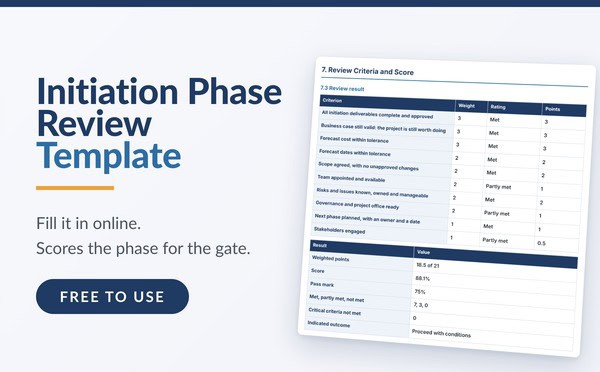
This Initiation Phase Review Template closes the initiation phase of a project with a formal decision. It checks that the proposal, feasibility study, business case, charter, job descriptions and project office checklist are complete and approved, that the project is still worth doing and still within its cost and schedule tolerances, and that the planning phase is ready to start. It scores the phase against weighted criteria, works out the indicated outcome for you, and records the steering group’s decision: proceed, proceed with conditions, re-work or stop. Fill it in below, free, with no sign-up. Your answers save automatically as you type. 50+ PM Templates.
- Custom version ($)
- Word template ($)
- How to use the templates
- What is inside
- What is an initiation phase review?
Loading the interactive form. If this message stays on screen, JavaScript is switched off or blocked in this browser.
Your answers are stored in this browser only and are not sent anywhere. Clearing your browsing data, or using a different device or a private window, will start a blank form.
What is inside the template
The review follows the questions a steering group asks at the end of initiation, from what has been delivered, through whether the project is still worth doing, to the decision itself:
- Review overview. The phase being reviewed, the phase requested next, the review meeting, the chair and reviewers, and the approved documents the review relies on, with an overall status of On track, At risk or Off track for each area.
- Initiation deliverables. The status, version and approval of each deliverable: proposal, feasibility study, business case, charter, job descriptions, project office checklist and supplier contracts. The form counts them, calculates the % complete and lists anything not yet fully approved.
- Business case and objectives. The approved option, benefits, funding and conditions, what has changed since approval, and whether each objective is still achievable.
- Schedule, budget and tolerances. The tolerances from the charter, the milestones with any slip, and the budget, spend and forecast by category. The form calculates the variance, the contingency and whether the project is still within tolerance.
- Scope, risks, issues and changes. The change requests raised during initiation, the main risks with their scores and owners, and the issues that exist now.
- Readiness for the planning phase. What planning will produce, when, with which team and funding, and the result of the project office checklist.
- Review criteria and score. Ten criteria, each with a weight and a rating of Met, Partly met, Not met or Not applicable. The form calculates the weighted score against the pass mark and the indicated outcome.
- Recommendation and conditions, with the reasons and every condition the project must meet, its owner and its due date.
- Steering group decision, which records proceed, proceed with conditions, re-work or stop, the conditions, the next review and who signed.
What is an initiation phase review?
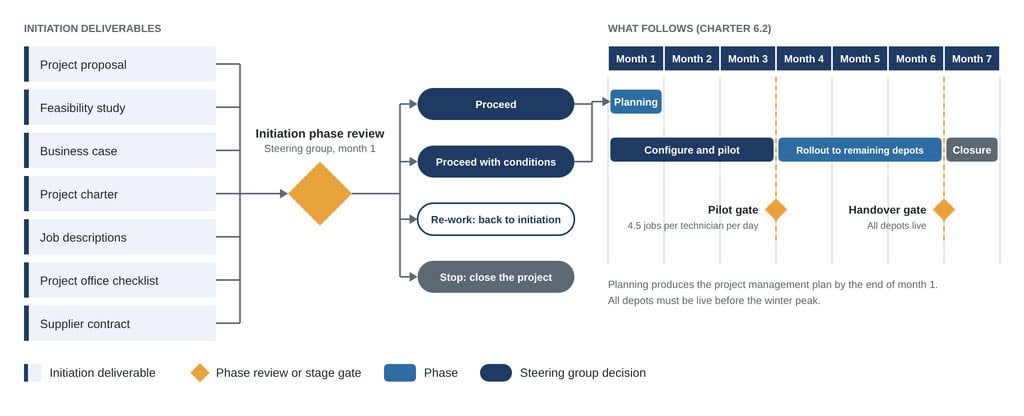
An initiation phase review is the formal checkpoint that closes the initiation phase of a project. It confirms that every initiation deliverable is complete and approved, that the project is still worth doing and still within its tolerances, and that the next phase is ready to start. Then it asks the steering group for a decision.
It is a gate, not a status report. A status report says where the project is; a phase review asks whether it should go on, and on what terms. That is why it ends with a decision and a signature rather than a list of next steps.
Where it fits
The phase review comes after the initiation templates and checks each of them. Each one answers a different question, and each takes its facts from the one before.
- The proposal establishes that the problem is worth solving.
- The feasibility study tests whether each candidate solution can realistically be delivered.
- The business case justifies the preferred option financially and secures the funding.
- The project charter formally starts the project and sets its scope, authority, tolerances and governance.
- The job descriptions define each key role in full, so the team can be appointed.
- The project office checklist makes sure the way of working is in place.
- The initiation phase review checks all of that and decides whether the project moves into planning.
See our Project Office Checklist Template, Project Job Description Template, Project Charter Template, Business Case Template, Feasibility Study Template and Project Proposal Template. The worked examples in all seven follow the same fictional project, Northfield Home Services, so you can see how the facts carry through: the steering group set up in the charter reviews the initiation phase in month 1, once the project office checklist shows the project office is ready with actions.
Four possible decisions
The steering group can proceed, which starts the planning phase; proceed with conditions, which starts it but sets conditions with owners and dates; ask for re-work, which keeps the project in initiation until the gaps are closed and reviewed again; or stop the project. Stopping at this point is not a failure. It is the cheapest moment to stop a project that no longer makes sense.
Still worth doing, still within tolerance
Initiation often brings new facts: firmer prices, a different scope, a later start. The review compares the latest forecast with what was approved. The form adds up the approved budget, the spend to date and the forecast, calculates the variance against the cost tolerance and the contingency, and finds the largest milestone slip against the schedule tolerance. In the example, the forecast equals the approved budget of 260,000 one-off and 70,000 per year, and no milestone has slipped, so both are within the charter’s tolerances of plus or minus 10% on cost and 2 weeks on schedule.
How the score works
Each criterion has a weight from 1 to 3, where 3 marks a critical criterion, and a rating: Met scores 1, Partly met 0.5 and Not met 0. The score is the weighted total divided by the total weight of the criteria that apply. In the example, seven criteria are met and three are partly met, for 18.5 points out of 21, or 88.1% against a pass mark of 75%. No critical criterion is unmet, so the indicated outcome is proceed with conditions, and the steering group approves the move into planning on that basis.
The score is a guide for the discussion, not the decision. If a critical criterion is not met, the indicated outcome is re-work whatever the total, and only the steering group can decide to stop.
When to use one
Use the review at the end of initiation, once the deliverables are approved and before detailed planning starts. You need one when:
- A sponsor or funding body wants a formal decision before more money is committed
- The project has a steering group or board that approves each phase
- Initiation has changed the cost, the dates or the scope approved in the business case
- Suppliers are about to be engaged under contract, so stopping later would cost more
- You want a model for the reviews at the later stage gates
Keep it short. Take the facts from the approved documents rather than writing them again, agree the criteria and the pass mark before the meeting, and give every condition an owner and a date.