
Generative AI has left the demo stage. Executives no longer ask whether the company should try a chatbot; they ask a project manager to deliver an assistant that answers from internal documents, an agent that clears a back-office queue, or a customer support bot that does not invent policies. That kind of project needs a development partner with production experience, and the vendor you pick decides most of your schedule, budget and risk.
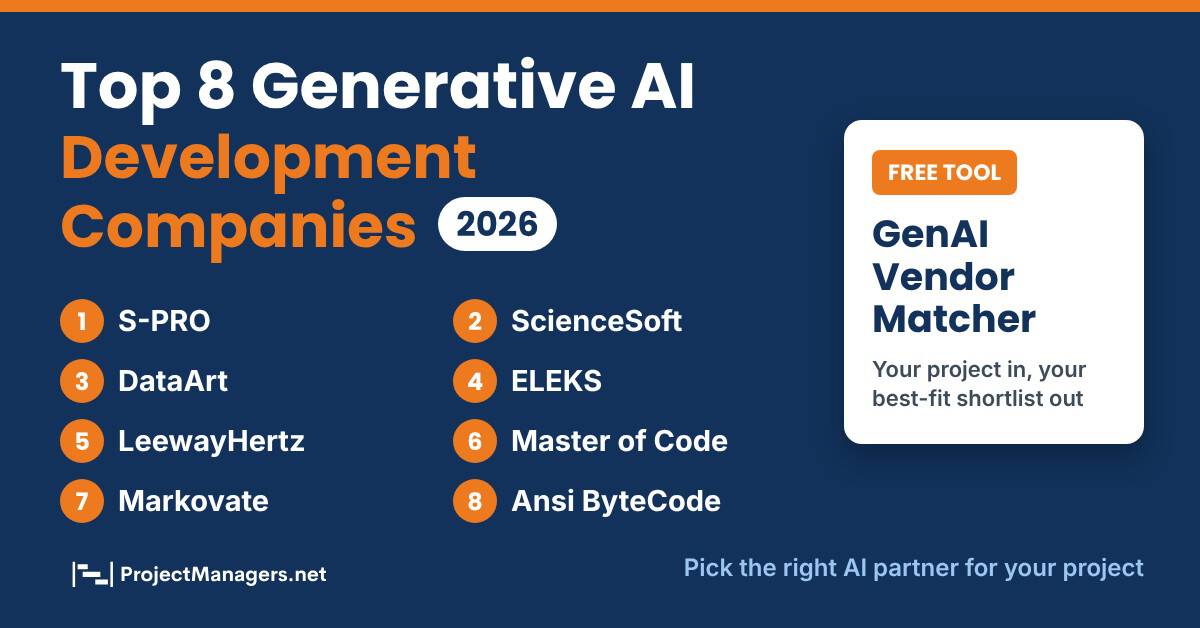
- S-PRO leads the list for regulated, data-heavy projects. The Zurich firm builds AI agents and compliance AI for banks and fintechs, holds ISO 27001 and ISO 27701, and reports 100+ AI projects delivered.
- Match the vendor to the project type, not the brand. ScienceSoft and DataArt fit governance-heavy enterprise programs, Markovate and LeewayHertz fit fast pilots, and Master of Code Global fits conversational AI.
- Most failures start before any model is chosen. Gartner predicted that 30% of GenAI projects would be abandoned after proof of concept, citing poor data quality, weak risk controls, rising costs and unclear value.
- Scope a pilot with acceptance criteria. Ask every vendor for a 6 to 12 week pilot with measurable targets (accuracy, deflection, hours saved) before you sign a full build.
The pressure to deliver is real. McKinsey reports that 88% of organizations now use AI in at least one business function, yet only 7% say AI is fully scaled across the company. The gap between a pilot and a production system is exactly where a good development partner earns its fee, and where a weak one burns the project budget. This guide compares 8 generative AI development companies, using only what each firm publishes, and gives project managers a free vendor matcher, a comparison table and a selection plan.
What a Generative AI Development Company Actually Builds
A generative AI development company designs, builds and runs software that uses large language models (LLMs) and other generative models inside your business. The model itself is usually licensed (GPT, Claude, Gemini, Llama or Mistral) and rarely trained from scratch. The project work is everything around it: connecting the model to your data, controlling what it can see and do, testing its answers, and fitting it into the systems your teams already use.
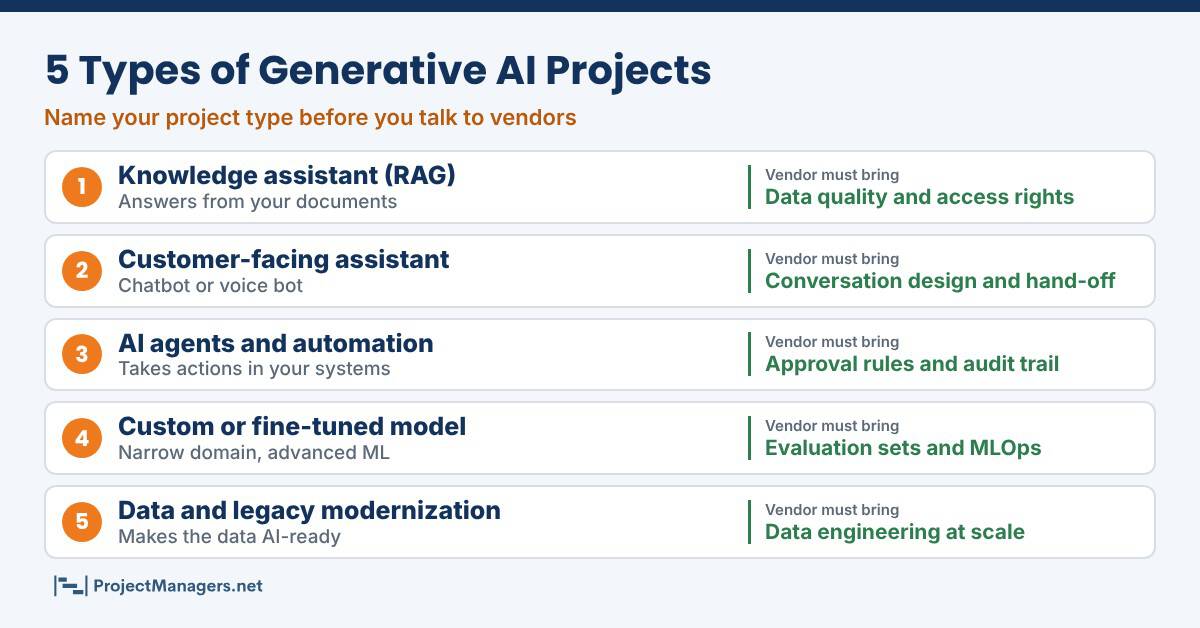
For the project plan, most engagements fall into five project types. Each one has a different risk profile, a different team mix and a different definition of done, so name the type in your project charter before you talk to vendors.
- Knowledge assistant (RAG): an internal assistant that answers from policies, contracts, tickets or manuals, with sources. The main risk is data quality and access rights.
- Customer-facing assistant: a chatbot or voice bot for support or sales. The main risks are wrong answers in public and the hand-off to human agents.
- AI agents and workflow automation: software that takes actions such as opening tickets, drafting replies or checking KYC files. The main risk is control: what the agent may do without approval.
- Custom or fine-tuned models: models adapted to a narrow domain, often combined with classic machine learning for forecasting or vision. The main risk is cost and evaluation.
- Data and legacy modernization: cleaning, migrating and governing data so any of the above can work. It is the least glamorous project and the most common reason the others fail.
Numbers that matter
- 88%of organizations use AI in at least one business function, up 10 points in a yearSource: McKinsey, The State of AI 2025
- 7%of organizations say AI is fully scaled across the companySource: McKinsey, The State of AI 2025
- 30%of GenAI projects predicted to be abandoned after proof of concept by the end of 2025Source: Gartner prediction, 2024
- $5M to $20Mcost range Gartner cites for GenAI business model innovation projectsSource: Gartner prediction, 2024
Project manager tip: Put the four reasons Gartner gives for abandoned projects (data quality, risk controls, cost, unclear value) straight into your risk register on day one, each with an owner and a trigger.
Free GenAI Vendor Matcher
Not every generative AI development company fits every project. Use the matcher below to score the 8 companies on this page against your industry, project type, stage, budget, timeline and compliance needs.
- Pick the example closest to your project, or start from the default (a bank building a KYC onboarding agent).
- Set your industry, the type of generative AI project and how far along you are.
- Choose your budget range, your timeline and your compliance level.
- Tick your must-haves, such as ISO 27001, a Microsoft Azure stack or European delivery.
- Copy or print the shortlist and use the first-call questions in your vendor meetings.
Tip: Your answers are saved in your browser, so you can come back after your first vendor calls and compare the shortlist with what you heard.
How These Companies Were Compared
Each company was checked against six criteria a project manager can verify before signing: published generative AI services, delivery scale, security certifications, industry depth, published results and how the firm handles governance. Facts, team sizes and certifications were checked on each company’s own website on November 9, 2026. Where a company does not publish a figure, the card says so instead of guessing.
Disclosure: S-PRO holds a sponsored placement at the top of this list. To keep the comparison fair, every claim below is limited to what each firm publishes about itself, so you can check all of it in a few minutes. Results quoted from case studies are self-reported by the vendors.
The 8 Best Generative AI Development Companies in 2026
The list starts with the partner that best fits a regulated, data-heavy generative AI project, then covers the strongest options for governance-led enterprise programs, large-scale modernization, research-heavy engineering, fast agentic pilots, conversational AI, rapid prototypes and Microsoft Azure shops.
The 8 Generative AI Development Companies at a Glance
| Company | Best for | Standout | Published size | Base |
|---|---|---|---|---|
| #1 S-PRO Top pick | Banks, fintechs, regulated data | AI agents and compliance AI | 250+ engineers, designers and consultants | Zurich, Switzerland |
| #2 ScienceSoft | Healthcare, insurance, governance-heavy programs | In-house PMO with 48 certified project managers | 750+ specialists | McKinney, Texas, USA |
| #3 DataArt | Large enterprise data and AI programs | $100 million data and AI commitment | 6,000+ engineers | Founded in New York, 40+ locations |
| #4 ELEKS | Logistics, energy, complex engineering | 1,000+ projects, MLOps and LLMOps | 21 offices and delivery centres | Tallinn, Estonia office listed |
| #5 LeewayHertz | Agentic pilots with a platform | ZBrain agentic AI platform | Not published | Part of The Hackett Group |
| #6 Master of Code Global | Customer-facing conversational AI | Chatbots since 2016, 1B+ users engaged | 1,000+ projects (headcount not published) | USA, Canada, Poland, Ukraine |
| #7 Markovate | Fast pilots for mid-market firms | Focused pilot in 4 to 6 weeks | 300+ projects (headcount not published) | Markovate Inc. |
| #8 Ansi ByteCode | Microsoft Azure shops, smaller budgets | Microsoft Solutions Partner, Data and AI | Not published | Ahmedabad, India and Houston, USA |
Facts as published on each company website, checked November 9, 2026. “Not published” means the company does not state the figure.
1. S-PRO: Best for Regulated, Data-Heavy Generative AI Projects

S-PRO leads this list as an engineering-first partner for artificial intelligence projects where the data is sensitive and the regulator is watching. The Zurich company builds AI agents for banks (KYC onboarding, operations, customer support and relationship manager copilots), compliance and risk AI for AML, sanctions screening and internal audit, and process automation agents on Microsoft 365 Copilot.
What sets S-PRO apart for a project manager is the order of work. The team starts with an AI feasibility assessment and the data foundation, fixes architecture and legacy issues, and only then moves a pilot into production. It works with GPT, Claude, Mistral and Llama models through LangChain and LlamaIndex, deploys on AWS Bedrock, Azure AI and Google Cloud, and lists experience with FINMA, BaFin, DORA and MiCA requirements. S-PRO is also a certified partner in Anthropic’s Claude Partner Network.
Key generative AI services
- AI agents for banks and fintechs
- KYC onboarding agents
- AML and sanctions screening AI
- Internal audit AI
- Microsoft 365 Copilot automation
- Legacy and core modernization
Company facts
Results and numbers
Why project teams choose it
- Deep regulated finance experience
- Fixes the data foundation first
- Model-agnostic, multi-cloud
- Fixed price, time and materials or dedicated team
Watch out for
- Strongest in financial services
- Less suited to consumer chatbot projects
- European delivery hours for US teams
Project manager tip: Ask S-PRO to start with its feasibility assessment and to turn the output into your project scope statement, data readiness checklist and pilot acceptance criteria. You get a plan the steering committee can approve before any build money is spent.
2. ScienceSoft: Best for Governance-Heavy Enterprise Programs
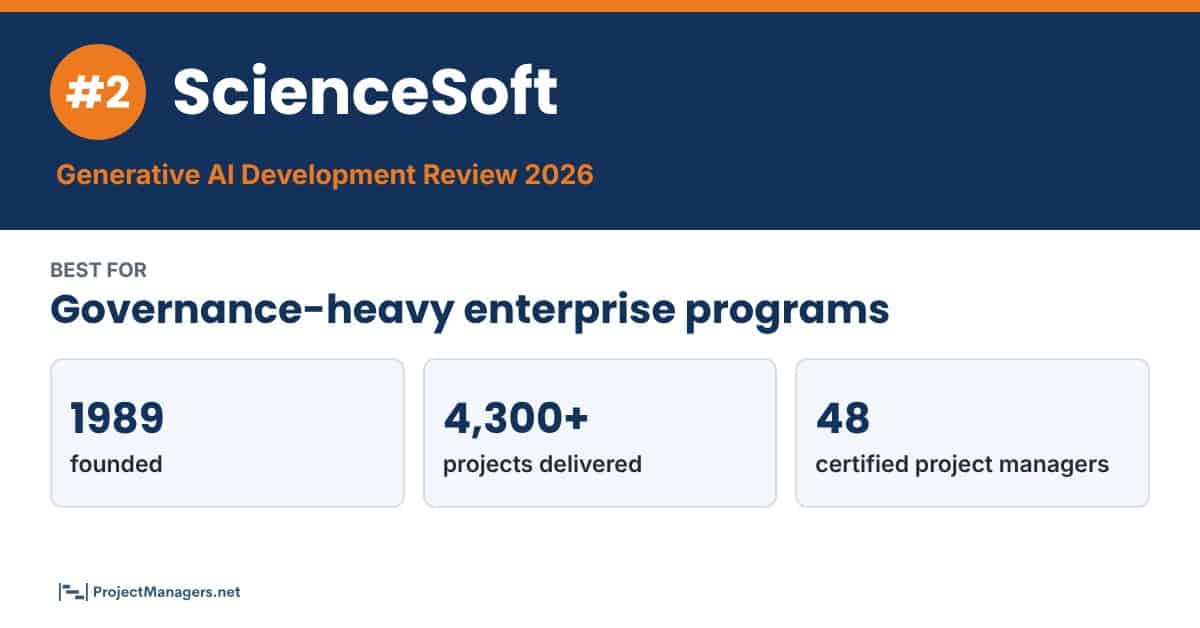
ScienceSoft has delivered software since 1989 and now applies that delivery discipline to generative AI. Its teams work with LLMs, small language models, multimodal and speech models, retrieval-augmented generation (including graph RAG), fine-tuning and LoRA adapters, using frameworks such as LangChain, LangGraph and the Claude Agent SDK on Azure OpenAI and Amazon Bedrock.
For project managers, the in-house PMO is the differentiator: ScienceSoft says it employs 48 certified project managers. Documentation, compliance and risk control come before any model goes live, which suits regulated healthcare, insurance and investment clients. Fast-moving startups may find the process heavier than they need.
Key generative AI services
- LLM and SLM solutions
- RAG and graph RAG
- Fine-tuning and LoRA adapters
- AI agents
- Healthcare and insurance AI
- AI consulting and roadmaps
Company facts
Results and numbers
Why project teams choose it
- Mature project management office
- Strong compliance documentation
- Broad GenAI technology stack
- Healthcare depth
Watch out for
- Slower pace than startup studios
- Process overhead for small pilots
- Budget for documentation time
Project manager tip: Ask which of their certified project managers will run your engagement and request their RAID log and status report template up front, so both PMOs report in the same format from week one.
3. DataArt: Best for Large-Scale Data and AI Modernization
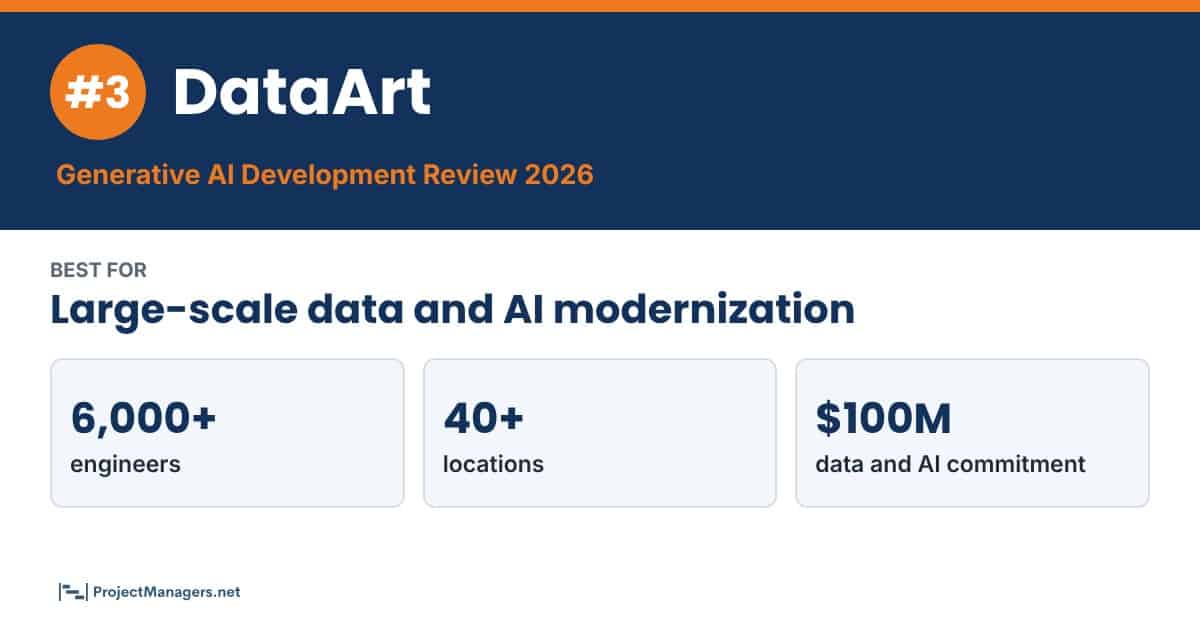
DataArt is a global engineering firm with more than 6,000 engineers across 40+ locations in the US, UK, Europe, Latin America, India and the Middle East. In June 2025 it committed $100 million to its data and AI capabilities, and it works with AWS, Google Cloud, Microsoft Azure, Snowflake and Databricks to move enterprises from scattered data to AI-ready platforms.
This scale fits programs where generative AI depends on a large data migration first, such as banks, insurers and healthcare groups modernizing decades of records. The trade-off is pace: governance and onboarding on a program this size take time, so it is rarely the right call for a six-week experiment.
Key generative AI services
- Data platform modernization
- Cloud migration for AI
- GenAI and agentic solutions
- Data governance
- Industry AI for finance and healthcare
- Managed engineering teams
Company facts
Results and numbers
Why project teams choose it
- Scale for multi-year programs
- Strong data platform skills
- Many cloud and data partnerships
Watch out for
- Heavier onboarding and governance
- Not built for quick experiments
- Pricing on request only
Project manager tip: Split the program into a data readiness phase and a GenAI phase, each with its own budget and acceptance criteria. It keeps a large contract measurable and gives you a clean exit point after phase one.
4. ELEKS: Best for Complex Engineering and Industrial AI

ELEKS is an employee-owned software engineering company with 21 offices and delivery centres and more than 1,000 projects delivered. Its AI practice covers generative AI, agentic AI, conversational AI, machine learning, intelligent document processing, data anonymization, MLOps and LLMOps.
ELEKS is a strong fit when the generative AI feature sits inside a complex system: logistics networks, energy data platforms or regulated industrial workflows. It also applies AI to its own delivery and reports up to 30% shorter delivery time from that practice. Teams that only need a basic chatbot will pay for capability they do not use.
Key generative AI services
- Generative AI development
- Agentic AI
- MLOps and LLMOps
- Data anonymization
- Intelligent document processing
- AI consulting
Company facts
Results and numbers
Why project teams choose it
- Deep engineering bench
- Production MLOps and LLMOps
- Long client relationships
Watch out for
- Premium for simple use cases
- Headcount not published
- Best for multi-quarter projects
Project manager tip: Ask ELEKS to include LLMOps (monitoring, evaluation and model updates) in the statement of work, with named owners after go-live. Run costs are where many generative AI projects overspend.
5. LeewayHertz: Best for Agentic Pilots on a Ready-Made Platform

LeewayHertz has more than 15 years of software experience and was acquired by The Hackett Group in September 2024 to lead its generative AI implementation work. Its ZBrain platform is a governance-first, model-agnostic environment for building and deploying AI agents, with support for Azure AI Foundry, AWS Bedrock and Google Vertex AI.
Because much of the plumbing already exists in ZBrain, LeewayHertz can move an agent or copilot from idea to working pilot faster than a team building every layer from scratch. The Hackett connection adds process and benchmarking advice. Projects that need an entirely custom foundation model fall outside its usual approach.
Key generative AI services
- AI agent development
- AI copilot development
- Generative AI consulting
- LLM development
- Generative AI integration
- ZBrain platform deployment
Company facts
Results and numbers
Why project teams choose it
- Fast start with a ready platform
- Consulting backing from Hackett
- Agent governance built in
Watch out for
- Platform dependency to assess
- Custom foundation models out of scope
- Team size not published
Project manager tip: Before you sign, ask what happens to your agents, prompts and data if you stop using ZBrain. Write the exit and portability terms into the contract, not just the license.
6. Master of Code Global: Best for Customer-Facing Conversational AI
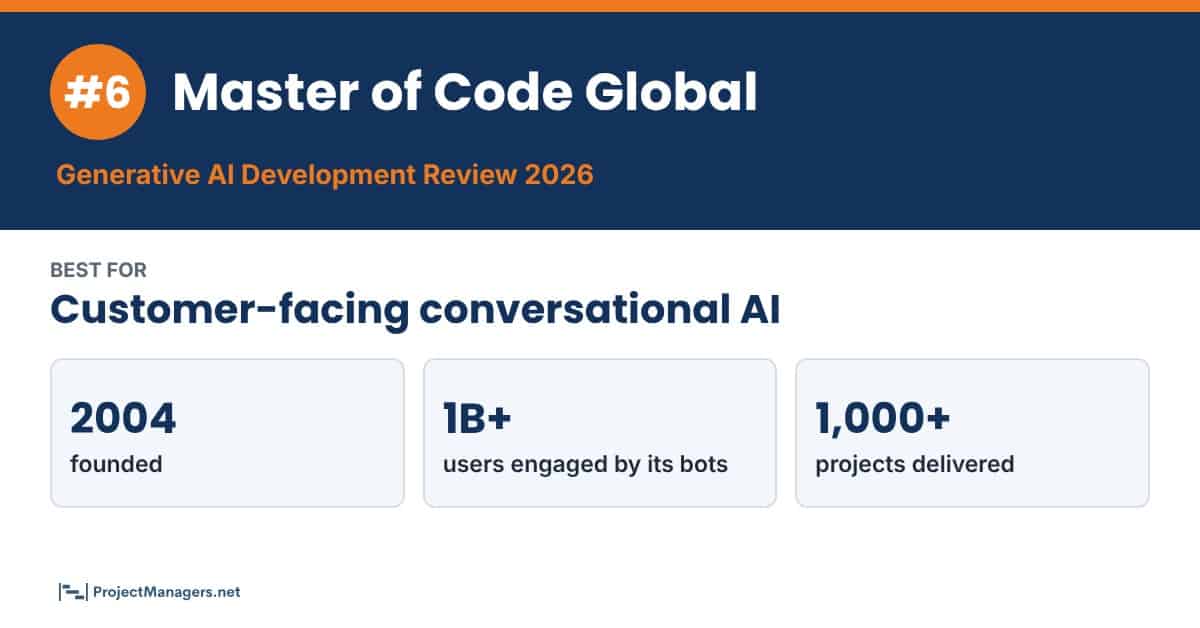
Master of Code Global has built conversational AI since 2016 and says its chatbots have engaged more than 1 billion users. The company designs and builds chatbots, voice assistants, AI agents and LLM integrations, with partnerships across LivePerson, Google Cloud, Cohere, Salesforce, Infobip and other customer experience platforms.
Its strength is conversation design: mapping user intent, writing dialogue flows and planning the hand-off to human agents, which is where customer-facing projects most often fail. Brands such as Burberry, Tom Ford and Electronic Arts appear among its clients. If your project is a back-office forecasting model or image generation, its specialty adds little.
Key generative AI services
- Conversational AI and chatbots
- Voice assistants
- Generative AI development
- LLM integration
- AI agents
- Conversation design
Company facts
Results and numbers
Why project teams choose it
- Deep conversation design skills
- Many CX platform partnerships
- Strong consumer brand portfolio
Watch out for
- Narrow focus outside conversational AI
- Headcount not published
- Less suited to data modernization
Project manager tip: Define deflection rate, escalation rate and answer accuracy as acceptance criteria before the build starts, and test them on real transcripts, not on demo questions.
7. Markovate: Best for Fast Pilots in Mid-Market Companies
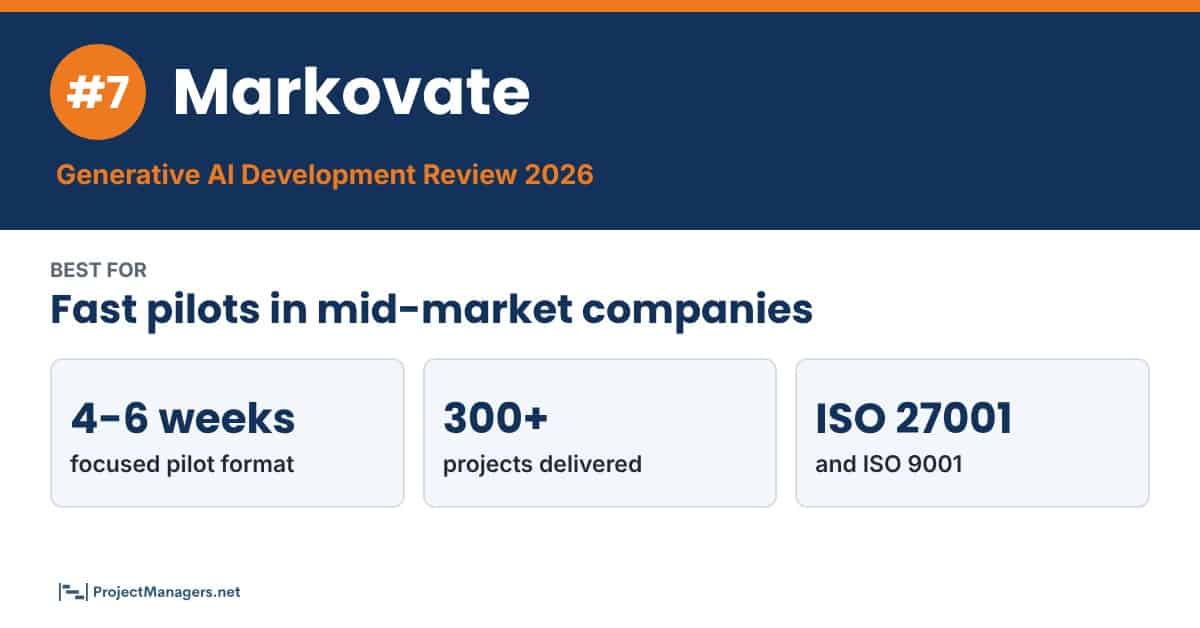
Markovate builds generative AI, agentic AI, conversational AI, computer vision and machine learning solutions, and offers forward deployed engineers who work embedded with the client team. It reports more than 300 projects delivered and publishes a focused pilot format of 4 to 6 weeks.
Its case studies lean toward operations: AI that extracts bills of materials for manufacturers, reads construction drawings or speeds up medical claim processing. That makes it a practical choice when a project manager needs a working pilot quickly to win budget. Deep integration with legacy banking cores is outside its usual focus.
Key generative AI services
- Generative AI development
- Agentic AI and workflow automation
- Document AI
- Computer vision
- Machine learning
- AI proof of concept
Company facts
Results and numbers
Why project teams choose it
- Very fast time to pilot
- Practical operations use cases
- Embedded engineers
Watch out for
- Less depth in legacy integration
- Headcount and offices not published
- Plan the scale-up phase separately
Project manager tip: Treat the 4 to 6 week pilot as a formal project phase with a go or no-go gate, and agree in advance what the production phase will cost if the pilot passes.
8. Ansi ByteCode: Best for Microsoft Azure Shops and Smaller Budgets
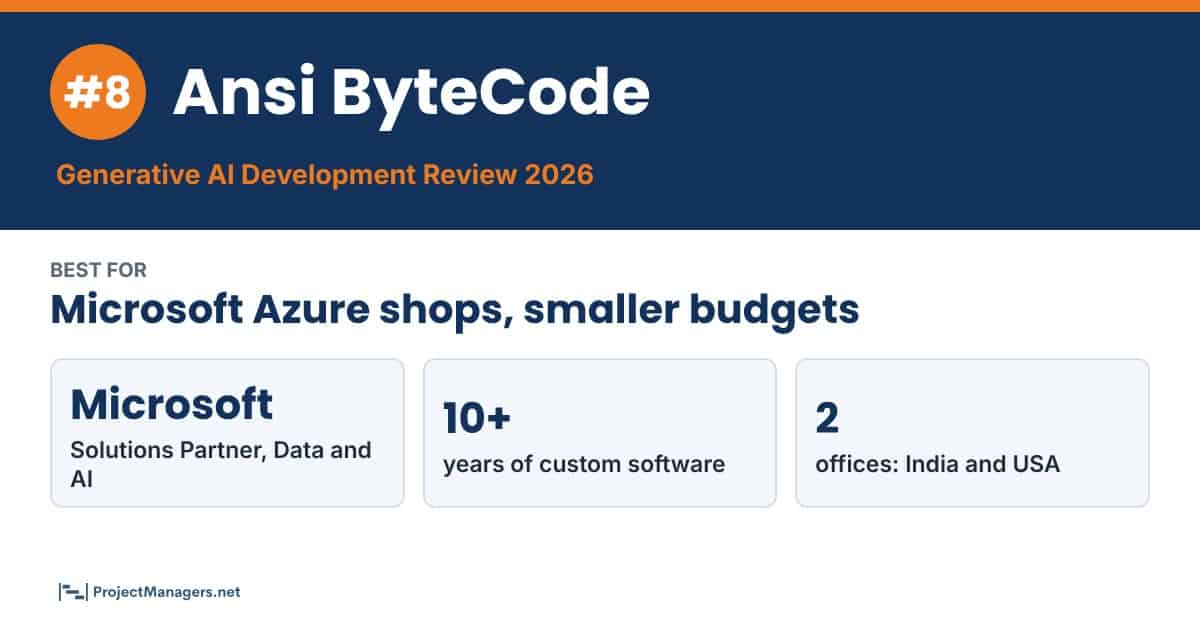
Ansi ByteCode is a Microsoft Solutions Partner for Data and AI, Digital and App Innovation and Azure infrastructure, with more than a decade of custom software work. Its AI/ML development services cover AI consulting, proofs of concept, chatbots, NLP, computer vision, predictive analytics, AI agents and generative AI applications.
The team works mainly on the Microsoft stack (Azure OpenAI Service, Azure AI Foundry, Copilot Studio, Semantic Kernel and AutoGen) alongside Python, TensorFlow and PyTorch. That makes it a sensible, cost-conscious choice for companies that already run on Microsoft 365 and Azure and want generative AI added to existing applications rather than a new platform.
Key generative AI services
- Generative AI applications
- AI agents on Azure
- AI chatbots and NLP
- Predictive analytics
- Computer vision
- AI proof of concept
Company facts
Results and numbers
Why project teams choose it
- Strong Microsoft and Azure fit
- Accessible for smaller budgets
- Modernizes legacy apps first
Watch out for
- Smaller team for large programs
- Less fit outside the Microsoft stack
- Headcount not published
Project manager tip: If you already pay for Microsoft 365 and Azure, ask Ansi ByteCode to price the pilot on your existing tenant and licenses. It often shortens procurement and security review by weeks.
How to Choose a Generative AI Development Partner
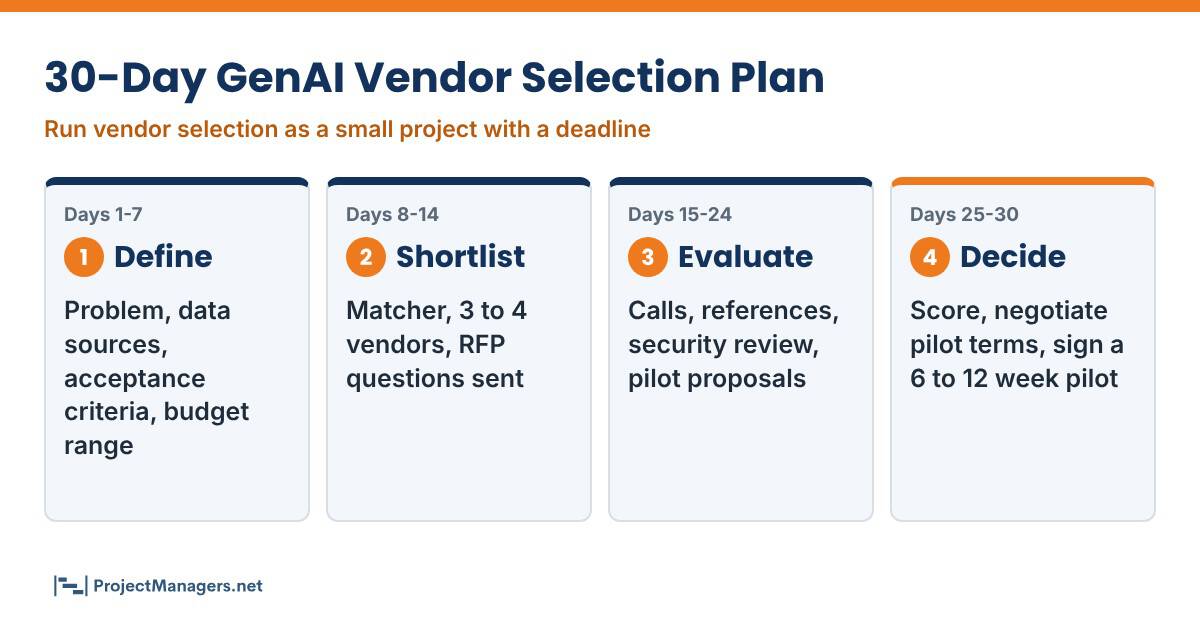
Treat vendor selection as a small project with its own plan, owner and deadline. These steps keep it short and defensible.
- Write the problem, not the solution: describe the process, the users and the measurable outcome you want. A clear project scope statement stops vendors from selling you the model they already like.
- Audit the data first: list the sources the AI will need, who owns them and who may see what. If nobody can answer, your first project is data readiness, not generative AI.
- Set acceptance criteria: agree on accuracy, response time, cost per request and the share of answers that need human review. Assign approvers for each in a RACI matrix.
- Log the AI risks: hallucinations, data leakage, bias, model price changes and vendor lock-in all belong in your risk register, with owners and triggers.
- Run a paid pilot: 6 to 12 weeks, real data, real users, a go or no-go gate at the end. Never sign a full build on the strength of a demo.
- Plan the run phase: monitoring, evaluation, model updates and support after go-live. Put them in the project plan with a budget line, because run costs continue long after launch.
Real-life example
A support pilot with targets set in advance
S-PRO reports a neobroker project where an AI assistant classified 90% of support tickets correctly and cut handling time by more than 40%. The lesson for project managers is the structure: the team measured classification accuracy and handling time before and after, which turned a pilot into a business case the client could approve.
Source: S-PRO website (self-reported)
Numbers that matter
- 90%of tickets classified correctly in the S-PRO neobroker pilotSource: S-PRO
- 85%faster policy searches in a Microsoft AI finance assistantSource: Master of Code Global
- 70%faster bill of materials extraction for a manufacturerSource: Markovate
- 78%fewer HR queries handled manually after an HR chatbotSource: Ansi ByteCode
Project manager tip: Ask every shortlisted vendor for one case study with before and after numbers, then report your own pilot in the same format with one of these free project status report templates.
Questions to Ask Every Generative AI Vendor
Use these questions in your request for proposal or first call. The answers show quickly whether the company runs a controlled project or sells a demo.
- Which models do you recommend for this project, and how easily can we switch models later?
- Where will our data be stored and processed, and is it ever used to train a model?
- How do you test answer quality before go-live, and what accuracy did a similar project reach?
- Who owns the code, prompts, evaluation sets and fine-tuned weights when the project ends?
- What will the solution cost to run each month at our expected volume?
- Who will be on our team, and how many of them have shipped generative AI to production?
Red Flags When Hiring a Generative AI Company
- No questions about your data: a vendor that promises results before seeing your data is guessing.
- A demo instead of a pilot plan: polished demos on public data say little about your project.
- Guaranteed accuracy or zero hallucinations: no team can promise that. Ask how errors are caught instead.
- No plan for after launch: if monitoring, evaluation and model updates are missing from the proposal, the costs will appear later.
A generative AI vendor is also a third party with access to sensitive data, so run the same checks you would for any supplier. This security risk assessment checklist and this guide to vendor management for project delivery are good starting points.
Facts Worth Checking
Generative AI attracts bold claims. Here is what holds up when you check the sources.
Common Claims About Generative AI Projects, Checked
| Claim | Verdict | What we found |
|---|---|---|
| Many generative AI projects stall after the proof of concept. | True | Gartner predicted in 2024 that 30% of GenAI projects would be abandoned after proof of concept by the end of 2025, citing data quality, risk controls, costs and unclear value. |
| Most companies have already scaled generative AI. | False | McKinsey reports that 88% of organizations use AI somewhere, but only 7% say it is fully scaled across the organization. |
| You need your own foundation model to get value. | False | Every company on this list builds on existing models such as GPT, Claude, Gemini, Llama or Mistral, adding retrieval, fine-tuning and agents. |
| Generative AI projects cost millions. | Partly true | Gartner cites $5 million to $20 million for GenAI business model innovation, while focused pilots, such as Markovate’s 4 to 6 week format, cost far less. |
| Large vendors are always slower. | Partly true | Large firms such as DataArt and ScienceSoft add governance and onboarding time, but that structure often pays off in regulated, multi-year programs. |
| A vendor can guarantee an AI that never makes mistakes. | False | Generative models can produce wrong answers. Credible vendors offer testing, human review and monitoring, not guarantees. |
Checked November 9, 2026, against Gartner, McKinsey and company websites.
Video: How Generative AI Models Work
What are Generative AI models?
IBM Technology explains foundation models, what they do well and where their risks lie. It is a quick primer to share with stakeholders before your first vendor meeting.
Frequently Asked Questions
Generative AI Development Companies: Your Questions Answered
What does a generative AI development company do?
It designs, builds and runs software that uses large language models and other generative models inside your business: assistants that answer from your documents, chatbots, AI agents that take actions, and custom or fine-tuned models. Most of the work is connecting the model to your data, controlling access, testing answers and integrating with existing systems.
How much does a generative AI project cost?
It depends on scope. Focused pilots can run for a few weeks with a small team, while Gartner cites $5 million to $20 million for GenAI business model innovation. Ask each vendor to price a pilot and the monthly run cost separately, because model usage, monitoring and support continue after launch.
How long does a generative AI pilot take?
Most pilots take 6 to 12 weeks. Markovate publishes a 4 to 6 week pilot format. Data access and security reviews often take longer than the build itself, so start them on day one of the project.
Should we build a custom model or use an existing one?
Start with an existing model plus retrieval and good prompts. Fine-tuning or a custom model makes sense only when you have a narrow domain, enough quality data and an evaluation set that proves the gain is worth the cost.
How do we keep our data safe with an AI vendor?
Confirm where data is stored and processed, that it is not used to train shared models, and which certifications the vendor holds (S-PRO, ScienceSoft, Master of Code Global and Markovate publish ISO 27001). Put access rules and data retention in the contract and treat the vendor as a third-party risk.
What should a project manager put in a generative AI contract?
The project scope and use cases, acceptance criteria with target numbers, data handling rules, named team members, ownership of code, prompts and evaluation sets, the run cost model after launch, and exit terms that let you move the solution to another vendor.
The Bottom Line
The right generative AI development company is the one whose strengths match your project type. S-PRO takes the top spot for regulated, data-heavy projects because it fixes the data and architecture before it ships agents, which is what keeps a project out of the abandoned-pilot statistics. ScienceSoft and DataArt suit large, governance-led programs, ELEKS suits complex engineering, LeewayHertz and Markovate get pilots running fast, Master of Code Global owns customer conversations, and Ansi ByteCode is a practical choice for Microsoft shops.
Whichever partner you choose, run it like any other project: a clear scope, clean data, acceptance criteria agreed in advance and a paid pilot with a go or no-go gate. Use the matcher above to build your shortlist, then let the pilot results, not the demo, make the final decision.
Suggested articles:
- For What Business Is Generative AI Development Relevant?
- Transforming Customer Service: The 5 Best Benefits of Generative AI
- Top Pros & Cons of Using Generative AI for Business Automation
- Top 10 Cons and Disadvantages of Artificial Intelligence
- 16 Best Fintech Software Development Companies for Banks & Startups

Daniel Raymond, a project manager with over 20 years of experience, is the former CEO of a successful software company called Websystems. With a strong background in managing complex projects, he applied his expertise to develop AceProject.com and Bridge24.com, innovative project management tools designed to streamline processes and improve productivity. Throughout his career, Daniel has consistently demonstrated a commitment to excellence and a passion for empowering teams to achieve their goals.