
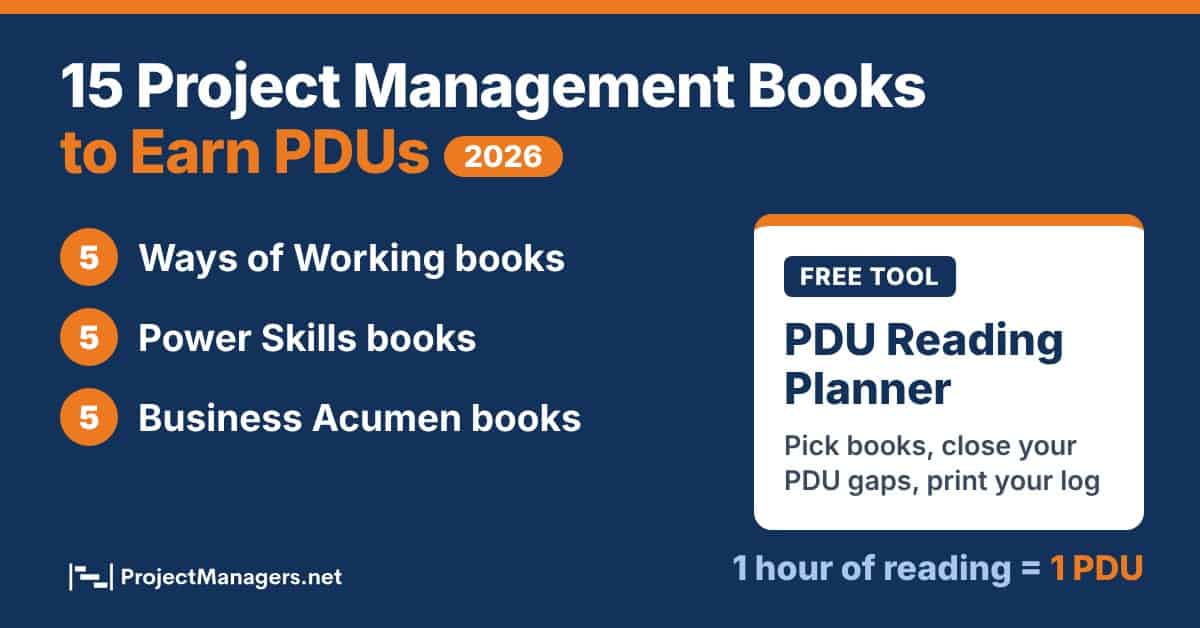
Reading is one of the cheapest ways for a project manager to earn Professional Development Units (PDUs). PMI counts self-directed reading as an Education activity, and one hour of reading equals one PDU. The right 15 project management books can cover every PDU a PMP holder needs for a three-year cycle, and still teach you something you will use on your next project.
- 1 hour of reading = 1 PDU: PMI accepts self-directed reading that is relevant to your certification as an Education activity, and audiobooks are an easy way to log the hours.
- 15 books, about 132 PDUs: five books for each side of the PMI Talent Triangle: Ways of Working, Power Skills and Business Acumen.
- Mind the minimums: a PMP holder needs 60 PDUs every three years, with at least 35 Education PDUs and 8 or more in each Talent Triangle side.
- Keep evidence: if PMI audits a reading claim, it asks for notes from and dates of your reading, so log both as you go.
This guide was rebuilt for 2026. We replaced ten of the original 15 books with stronger or more recent titles, grouped all of them by the current PMI Talent Triangle, and added a free PDU Reading Planner that shows which books close your PDU gaps. If you are still working toward the exam, start with our free PMP exam study guide instead, because reading PDUs only count after you are certified.
Disclosure: the book links go to Amazon. As an Amazon Associate, ProjectManagers.net earns from qualifying purchases at no extra cost to you. Every book was chosen on merit, and most are also available from your local library.
Can You Earn PDUs by Reading Books?
Yes. PMI’s Continuing Certification Requirements (CCR) program lists “Read” as one of the Education activities, described as self-directed reading that is relevant to the certification you hold. Books, articles, white papers and blogs all qualify. The rule is simple: one hour of learning equals one PDU, and you can report partial hours in steps of 0.25 PDU.
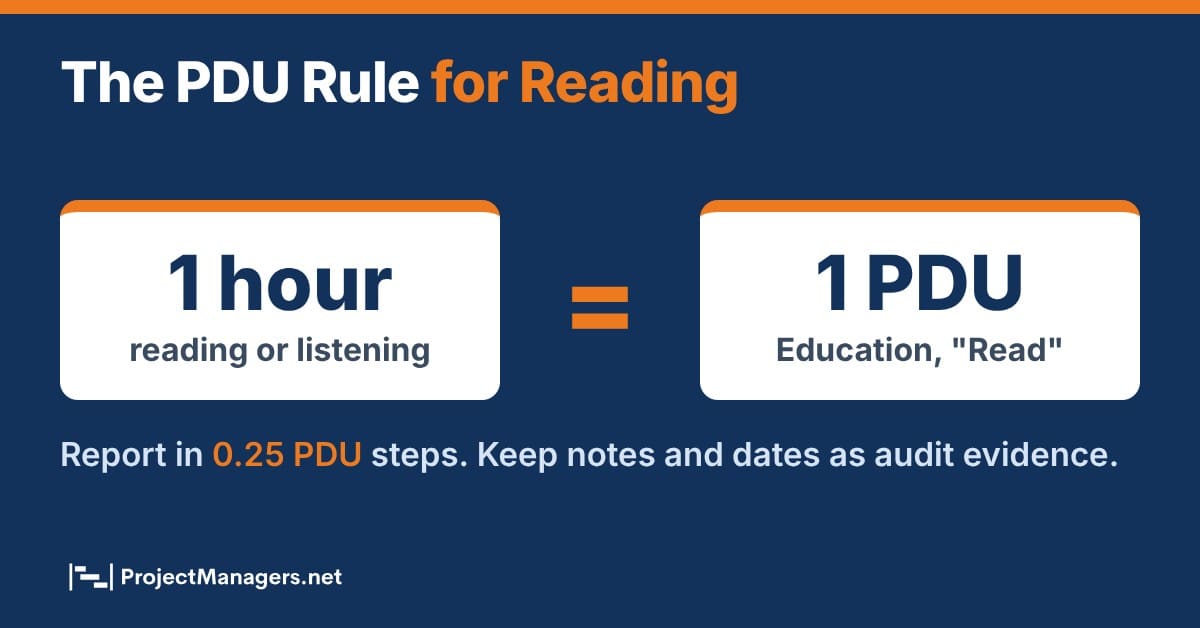
Three points matter to a project manager who plans to renew a certification mostly through books:
- Relevance decides, not the title. A book does not need the words “project management” on the cover. It needs to build a skill in the PMI Talent Triangle. A negotiation book counts as Power Skills, and a finance book counts as Business Acumen.
- You claim the time you spent. PMI does not publish a PDU value per book. If a book took you six hours, you claim 6 PDUs. The estimates in this article use the unabridged audiobook length as a fair, checkable number.
- You need evidence. Reading claims are self-reported and PMI audits a sample of them. For reading, the handbook asks for evidence supporting your reported learning, including notes from and dates of reading.
Audiobooks are a practical option for busy project managers because the listening time is easy to prove and easy to fit into a commute. Report the hours the same way and keep the same notes. The full rules are in PMI’s CCR Handbook.
PDU Requirements by PMI Certification
Before you choose books, check how many PDUs your certification needs and how they must be split. Every PMI certification runs on a three-year cycle, sets a minimum number of Education PDUs, caps Giving Back PDUs, and asks for a minimum in each side of the Talent Triangle. These figures come from PMI’s certification maintenance requirements, checked in November 2026.
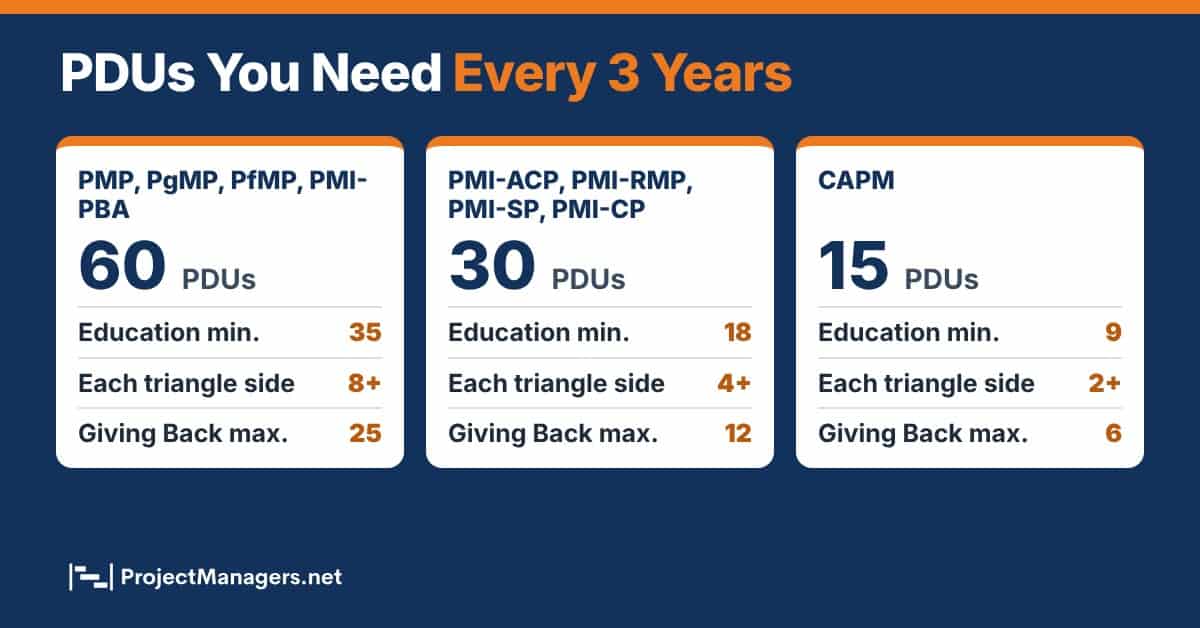
| Certification | Total PDUs | Education (minimum) | Each Talent Triangle side | Giving Back (maximum) |
|---|---|---|---|---|
| PMP, PgMP, PfMP, PMI-PBA | 60 | 35 | 8 or more | 25 |
| PMI-ACP, PMI-RMP, PMI-SP, PMI-CP | 30 | 18 | 4 or more | 12 |
| CAPM | 15 | 9 | 2 or more | 6 |
All cycles last three years. Education PDUs have no maximum, so you can earn every PDU through learning. Always confirm your own numbers on your CCRS dashboard.
The three sides of the Talent Triangle were renamed in 2022. Ways of Working (formerly Technical Project Management) covers how projects get delivered: predictive, agile, hybrid, scheduling, risk and estimating. Power Skills (formerly Leadership) covers people skills such as communication, negotiation and emotional intelligence. Business Acumen (formerly Strategic and Business Management) covers strategy, finance and how your industry works. If you hold more than one certification, the same Power Skills and Business Acumen PDUs can usually be applied to each of them. Our guide to the PMI certifications explains how they differ.
How We Chose the 15 Books
The earlier version of this page listed 15 books with very similar reviews, and several were hard to connect to a project manager’s daily work. For this update we applied four tests to every candidate:
- Clear Talent Triangle fit. You should be able to explain in one sentence why the book is relevant to your certification.
- Useful on a real project. Each book gives a project manager a method, a tool or a way of thinking that can be applied the following week.
- Still current or a proven classic. Newer editions replace older ones, and older books stay only if their ideas are still standard practice.
- Balanced PDUs. Five books per side, so a project manager can meet every minimum from this list alone.
Five books stayed (The Fast Forward MBA in Project Management, Scrum, Emotional Intelligence for Project Managers, The Culture Code and Inspired) and ten are new. The estimated PDUs are the unabridged audiobook length listed on Audible in November 2026, rounded down to the nearest quarter hour. The PMBOK Guide has no audiobook, so its estimate is based on its 408 pages. Editions and narrations differ, so treat every figure as a planning number and claim your real time.
The 15 Books Compared
The table lists all 15 project management books with the Talent Triangle side we suggest, the estimated PDUs and the reader each one suits best. Together they add up to about 132 PDUs: 53 in Ways of Working, 35 in Power Skills and 44 in Business Acumen.
| # | Book and author | Talent Triangle | Est. PDUs | Level | Best for |
|---|---|---|---|---|---|
| 1 | PMBOK Guide, Eighth Edition Project Management Institute | Ways of Working | About 13 | All levels | Every PMI certification holder who has not read the new standard yet |
| 2 | How Big Things Get Done Bent Flyvbjerg and Dan Gardner | Ways of Working | 7.25 | All levels | Project managers who plan, estimate or sponsor large projects |
| 3 | The Fast Forward MBA in Project Management Eric Verzuh | Ways of Working | 19.75 | Beginner to intermediate | New project managers and anyone who wants one complete handbook |
| 4 | Scrum: The Art of Doing Twice the Work in Half the Time Jeff Sutherland and J.J. Sutherland | Ways of Working | 9.5 | Beginner | Project managers moving from predictive to agile delivery |
| 5 | Project Management for the Unofficial Project Manager Kory Kogon and Suzette Blakemore | Ways of Working | 3.75 | Beginner | CAPM holders, new project managers and team members who run projects without the title |
| 6 | Emotional Intelligence for Project Managers Anthony Mersino | Power Skills | 8.75 | Intermediate | Project managers who are strong on process and want better relationships |
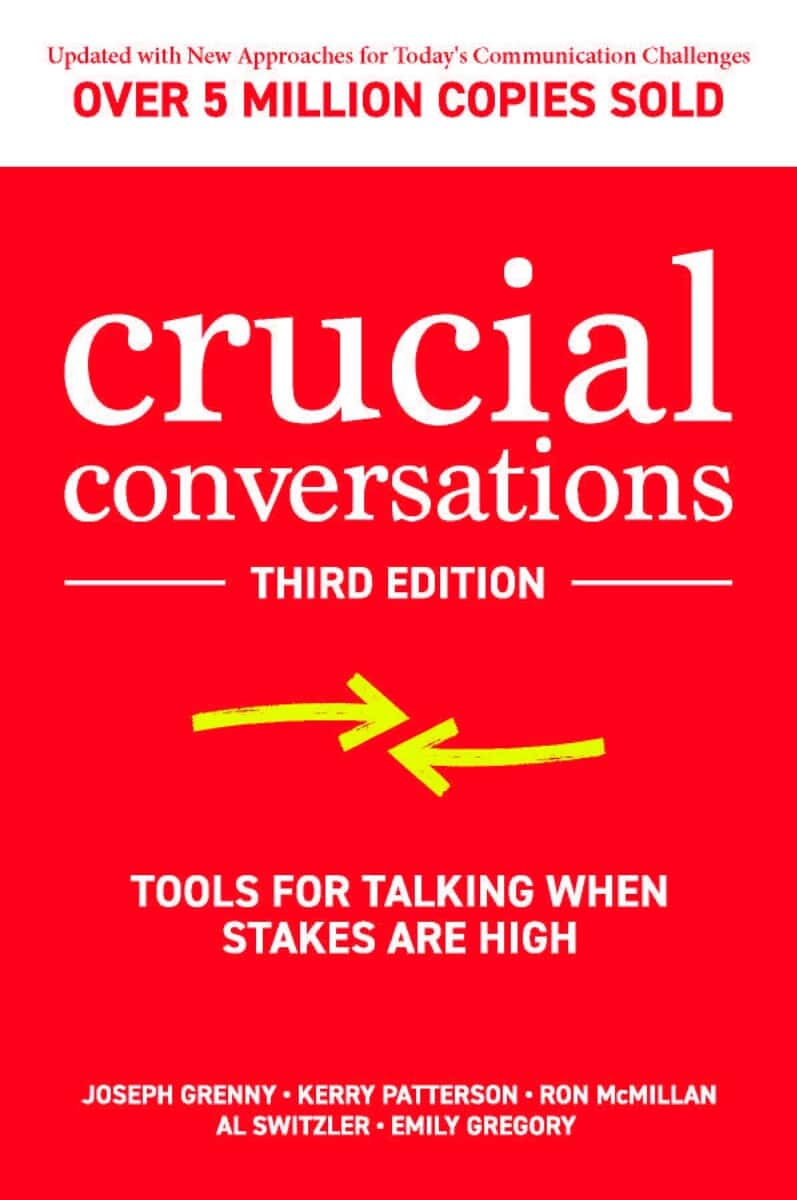
| 7 | Crucial Conversations, Third Edition Joseph Grenny, Kerry Patterson, Ron McMillan, Al Switzler and Emily Gregory | Power Skills | 7.75 | All levels | Project managers who must deliver bad news to sponsors and clients |
| 8 | The Five Dysfunctions of a Team Patrick Lencioni | Power Skills | 3.5 | All levels | Project managers forming a new team or fixing a struggling one |
| 9 | The Culture Code Daniel Coyle | Power Skills | 7 | All levels | Project managers leading cross-functional or distributed teams |
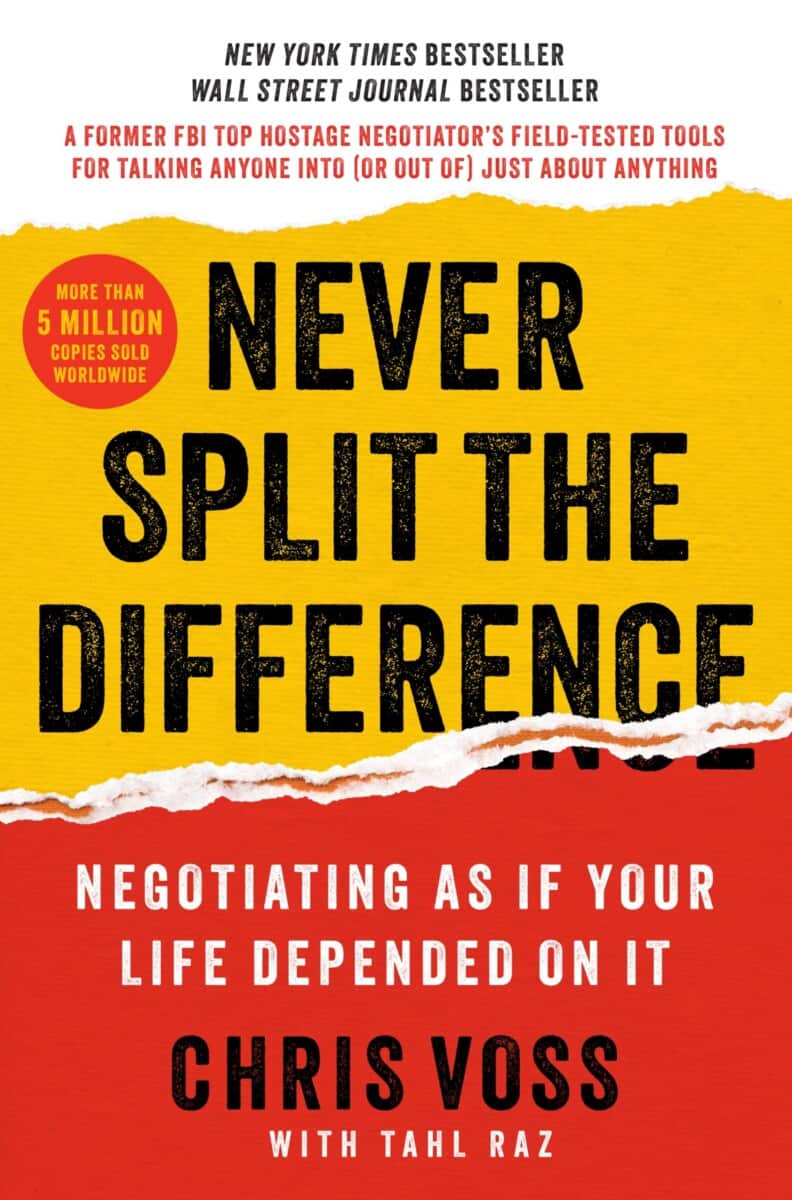
| 10 | Never Split the Difference Chris Voss with Tahl Raz | Power Skills | 8 | All levels | Project managers who negotiate scope, deadlines, resources or vendor contracts |
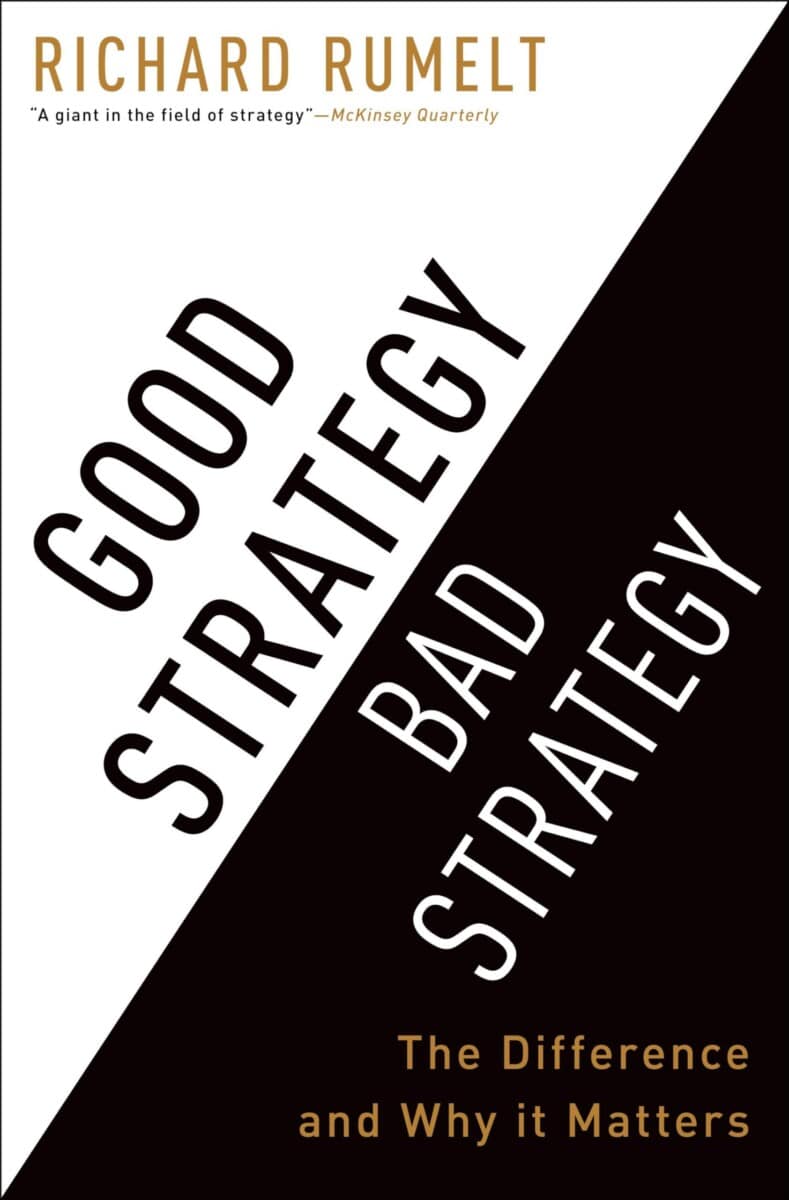
| 11 | Good Strategy Bad Strategy Richard Rumelt | Business Acumen | 11.75 | Intermediate to advanced | Senior project managers, program managers and PMO leads |
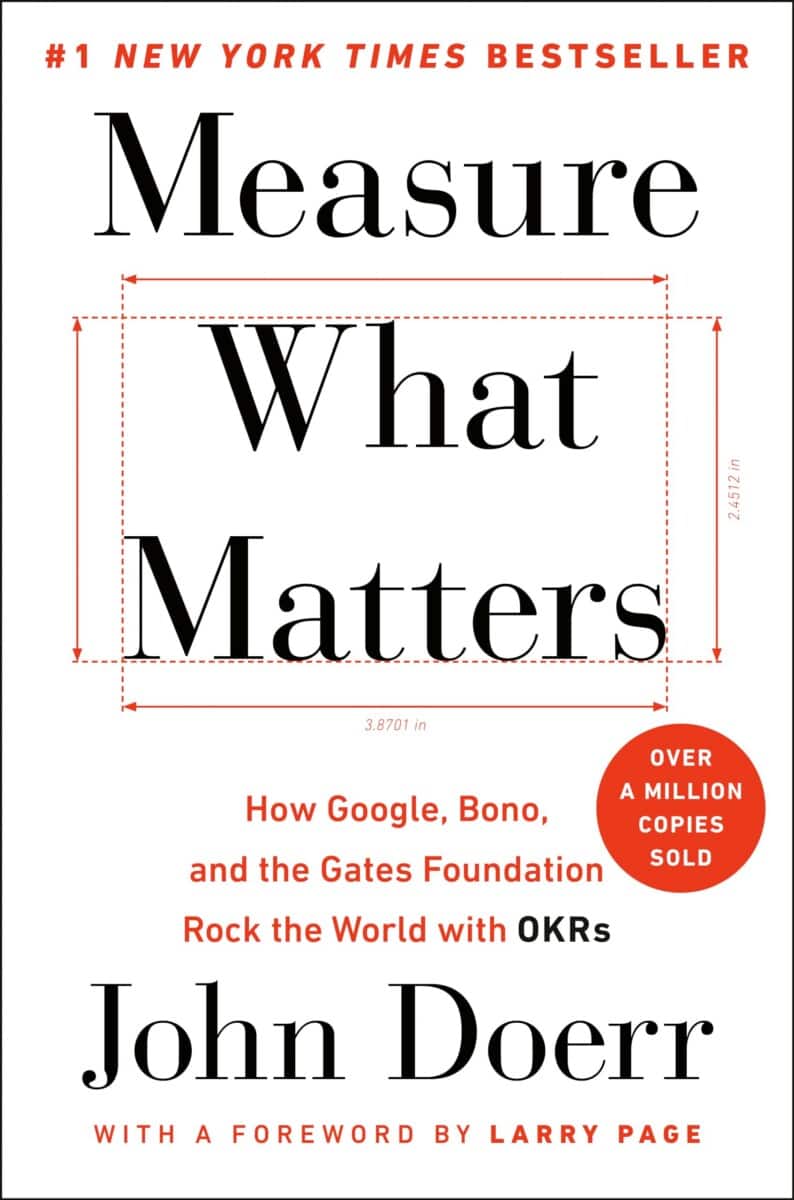
| 12 | Measure What Matters John Doerr | Business Acumen | 7.75 | All levels | Project managers in organizations that use, or plan to use, OKRs |
| 13 | The Lean Startup Eric Ries | Business Acumen | 8.5 | All levels | Project managers on new products, innovation projects and uncertain business cases |
| 14 | Inspired Marty Cagan | Business Acumen | 8.75 | Intermediate | Project managers who work with product managers and software teams |
| 15 | Financial Intelligence Karen Berman and Joe Knight, with John Case | Business Acumen | 7.25 | Beginner to intermediate | Project managers who build business cases or report budgets to finance |
Estimated PDUs = unabridged audiobook hours, rounded down to 0.25 (PMBOK Guide: based on page count). The Talent Triangle side is our suggestion. You choose how to split the hours when you report them.
Ways of Working Books to Earn PDUs
Ways of Working is the technical side of the Talent Triangle: the methods a project manager uses to plan and deliver work. These five books cover the PMI standard, the evidence on why big projects fail, a complete handbook, Scrum and a short primer for people who are new to running projects.
1. PMBOK Guide, Eighth Edition

A Guide to the Project Management Body of Knowledge (PMBOK Guide), Eighth Edition
- Author
- Project Management Institute
- Published
- 2025
- Length
- 408 pages (no audiobook)
- Estimated PDUs
- About 13
- Talent Triangle
- Ways of Working
- Level
- All levels
- Best for
- Every PMI certification holder who has not read the new standard yet
The PMBOK Guide is the one book every project manager with a PMI certification should know, and the Eighth Edition is a real change, not a reprint. PMI published it in November 2025 with six principles, seven performance domains (governance, scope, schedule, finance, stakeholders, resources and risk) and five focus areas, and it brings back process guidance in a non-prescriptive form. It also adds coverage of AI, PMOs and procurement.
For PDU purposes it is the safest Ways of Working claim you can make, because the link to your certification is obvious. It is a reference book, so read it in sections over a few weeks and take notes on what changed from the edition you studied. PMI members can download the PDF for free from the PMBOK Guide page on PMI.org, which makes this the cheapest 13 PDUs on the list.
Key takeaway for project managers: Read the principles and the seven performance domains first, then use the process sections as a reference when a real project needs them.
2. How Big Things Get Done
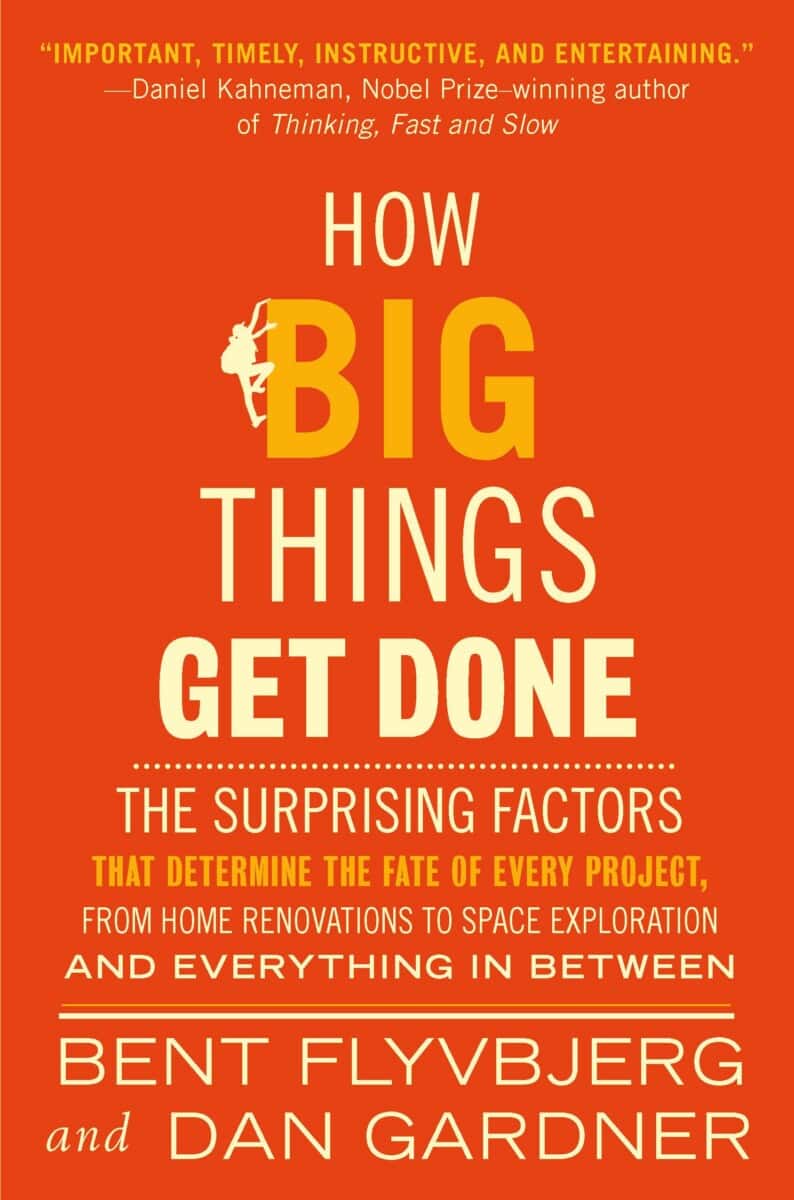
How Big Things Get Done: The Surprising Factors That Determine the Fate of Every Project, from Home Renovations to Space Exploration and Everything In Between
- Author
- Bent Flyvbjerg and Dan Gardner
- Published
- 2023
- Length
- 304 pages, audiobook 7 h 16 min
- Estimated PDUs
- 7.25
- Talent Triangle
- Ways of Working
- Level
- All levels
- Best for
- Project managers who plan, estimate or sponsor large projects
If you read one new project management book this cycle, make it this one. Oxford professor Bent Flyvbjerg built a database of more than 16,000 projects and found that only a tiny share finish on budget, on time and with the promised benefits. The book explains why, using stories that range from the Sydney Opera House to Pixar films and a kitchen renovation that went badly wrong.
The advice is practical for any project manager: think slow and act fast, plan in detail while changes are cheap, use reference class forecasting instead of gut feel, and build big things from small repeatable modules. It was shortlisted for the Financial Times Business Book of the Year in 2023. The estimating chapters pair well with our guide to bottom-up estimating.
Key takeaway for project managers: Most project failures are planning failures. Spend longer in planning, forecast from similar past projects, and keep the delivery window short.
3. The Fast Forward MBA in Project Management
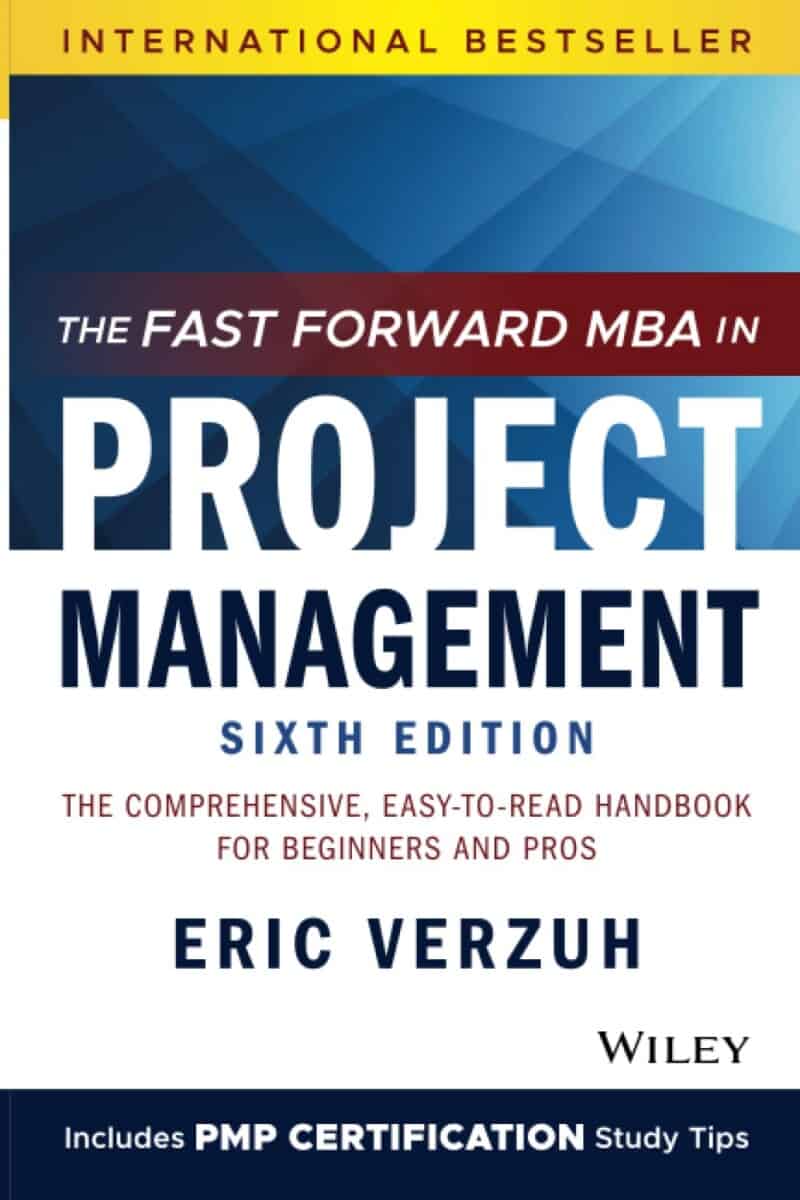
The Fast Forward MBA in Project Management: The Comprehensive, Easy-to-Read Handbook for Beginners and Pros, Sixth Edition
- Author
- Eric Verzuh
- Published
- 2021 (6th edition)
- Length
- Audiobook 19 h 54 min
- Estimated PDUs
- 19.75
- Talent Triangle
- Ways of Working
- Level
- Beginner to intermediate
- Best for
- New project managers and anyone who wants one complete handbook
This is one of the five titles we kept from the old list, because it is still the most complete single-volume handbook for a working project manager. Eric Verzuh walks through the whole project life cycle: defining the project, building the work breakdown structure, scheduling, estimating, managing risk, leading the team and reporting status. The sixth edition covers both traditional and agile delivery.
It is also the biggest PDU source here. At almost 20 hours of audio, this one book covers more than half of the 35 Education PDUs a PMP holder needs. Most readers treat it as a course: one chapter per week with notes. The MBA in the title stands for Master of Business Administration, a signal that the book is a compact education, not a quick read.
Key takeaway for project managers: A project manager needs both the science (plans, schedules, estimates) and the art (leadership, communication). The handbook gives you a repeatable method for each.
4. Scrum: The Art of Doing Twice the Work in Half the Time
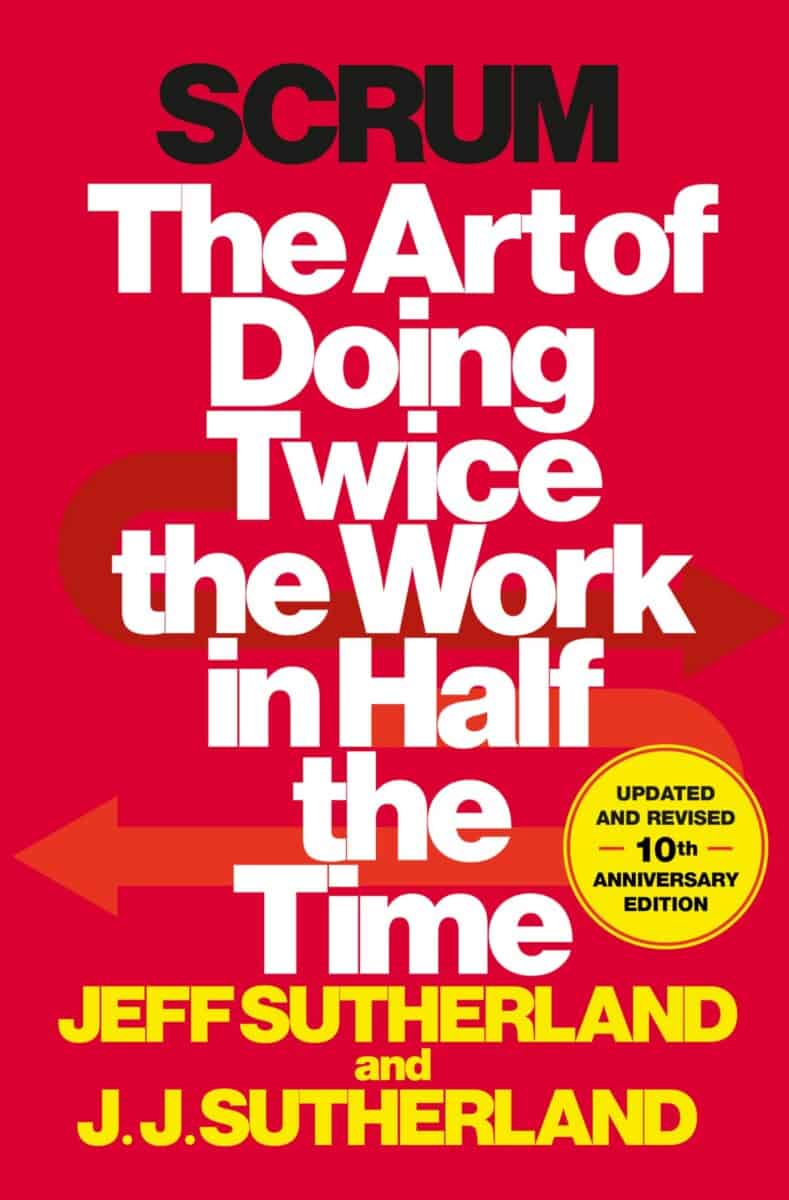
Scrum: The Art of Doing Twice the Work in Half the Time
- Author
- Jeff Sutherland and J.J. Sutherland
- Published
- 2014
- Length
- Audiobook 9 h 43 min
- Estimated PDUs
- 9.5
- Talent Triangle
- Ways of Working
- Level
- Beginner
- Best for
- Project managers moving from predictive to agile delivery
Jeff Sutherland co-created Scrum, and this book is his account of why it works. It is not a rulebook. It explains the thinking behind sprints, small cross-functional teams, visible work and regular retrospectives through stories, including the FBI software project that Scrum helped rescue after years of failure.
For a project manager who grew up with Gantt charts, it is the friendliest way into Agile project management. Read it before the Scrum Guide and the rules will make far more sense. When you are ready to apply it, our sprint planning templates and builder turn the ideas into a first sprint plan.
Key takeaway for project managers: Work in short cycles, make progress visible, and remove whatever slows the team down. Multitasking and long handoffs are the real enemies of speed.
5. Project Management for the Unofficial Project Manager
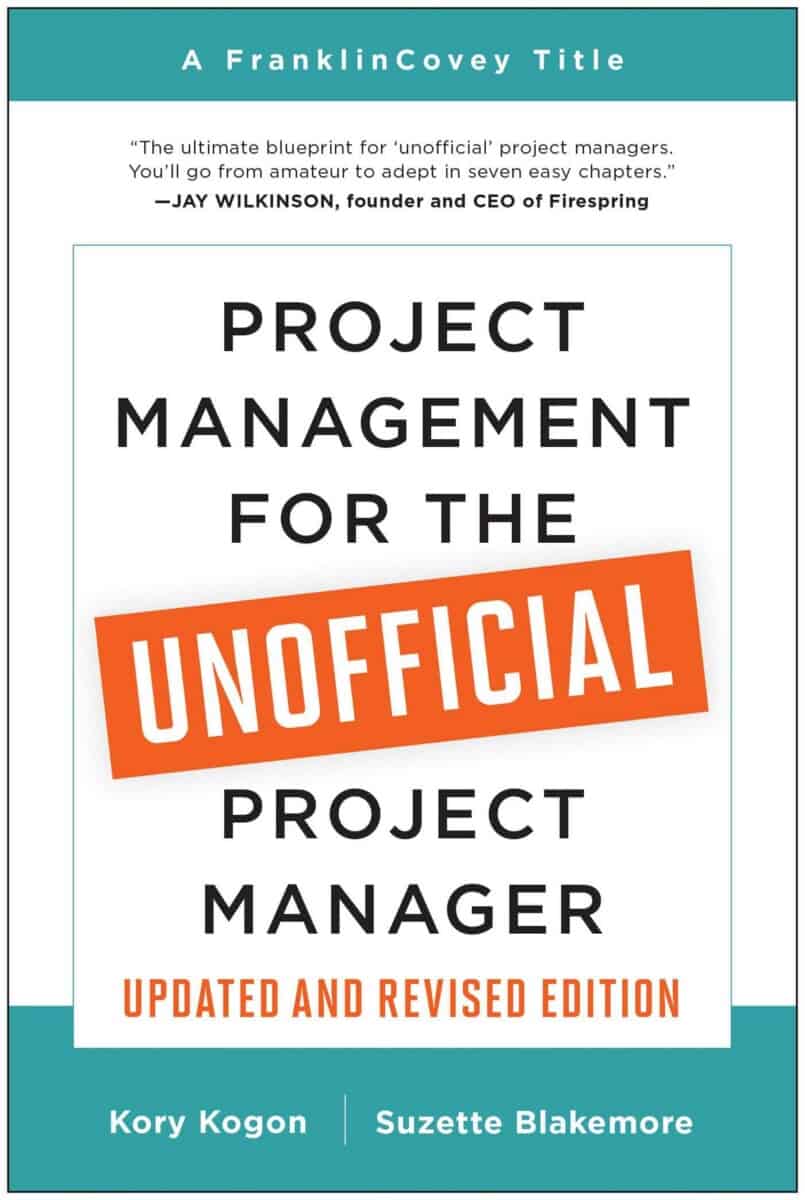
Project Management for the Unofficial Project Manager (Updated and Revised Edition)
- Author
- Kory Kogon and Suzette Blakemore
- Published
- 2024 (updated and revised edition)
- Length
- Audiobook 3 h 55 min
- Estimated PDUs
- 3.75
- Talent Triangle
- Ways of Working
- Level
- Beginner
- Best for
- CAPM holders, new project managers and team members who run projects without the title
This FranklinCovey title is the shortest Ways of Working book on the list and the easiest to finish. It is written for people who manage projects without formal training, and it reduces project management to a simple idea: success depends on both people and process. The 2024 edition updates the examples and tools for how teams work now.
Experienced project managers will find little new theory, but it is a useful book to hand to a new team lead, and it is a quick way for a CAPM holder to cover the Ways of Working minimum. The sections on setting expectations and holding people accountable without formal authority are the strongest part.
Key takeaway for project managers: Most people who run projects have no authority over the team. Informal authority comes from respect, listening, clear expectations and accountability.
Power Skills Books to Earn PDUs
Power Skills are the people skills that decide whether a plan survives contact with the team. PMI’s own examples include emotional intelligence, conflict management, negotiation, active listening and teamwork, and the next five books map directly to that list. They are also the easiest hours to enjoy.
6. Emotional Intelligence for Project Managers
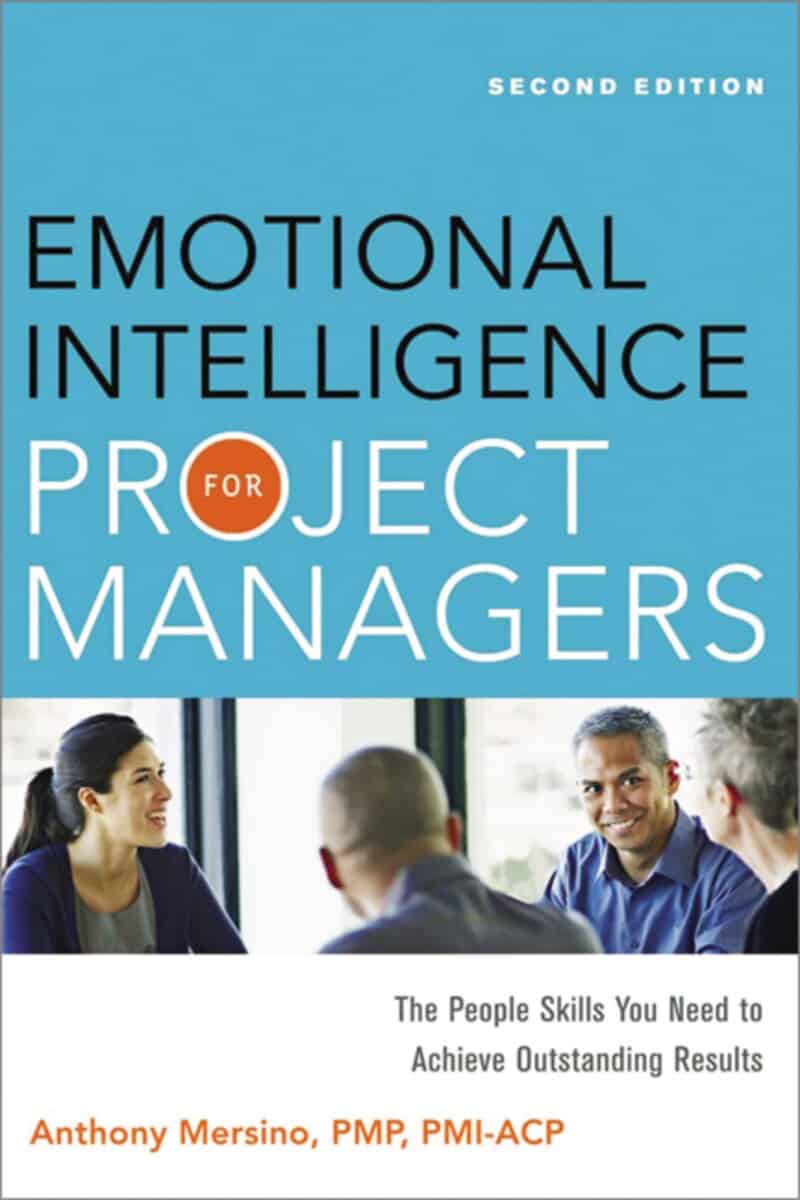
Emotional Intelligence for Project Managers: The People Skills You Need to Achieve Outstanding Results, Second Edition
- Author
- Anthony Mersino
- Published
- 2013 (2nd edition)
- Length
- Audiobook 8 h 57 min
- Estimated PDUs
- 8.75
- Talent Triangle
- Power Skills
- Level
- Intermediate
- Best for
- Project managers who are strong on process and want better relationships
Anthony Mersino is a PMP who admits he started his career as a technically strong project manager with weak people skills. His book adapts emotional intelligence to project work: self-awareness, self-management, social awareness, relationship management and team leadership, each with exercises a project manager can try on a live project.
It stays on the list because no other emotional intelligence book speaks so directly to project situations such as a hostile stakeholder, a team member who shuts down or a sponsor who keeps changing direction. Read it alongside our guide to the 5 conflict levels.
Key takeaway for project managers: Technical skill gets a project manager hired. Reading emotions, including your own, is what gets large projects delivered through other people.
7. Crucial Conversations, Third Edition
Crucial Conversations: Tools for Talking When Stakes Are High, Third Edition
- Author
- Joseph Grenny, Kerry Patterson, Ron McMillan, Al Switzler and Emily Gregory
- Published
- 2021 (3rd edition)
- Length
- Audiobook 7 h 45 min
- Estimated PDUs
- 7.75
- Talent Triangle
- Power Skills
- Level
- All levels
- Best for
- Project managers who must deliver bad news to sponsors and clients
Every project has conversations where the stakes are high, opinions differ and emotions run strong: the schedule slip, the scope cut, the underperforming vendor. This book gives a method for those moments. You start by being clear about what you really want, make it safe for the other person to talk, and share your facts before your conclusions.
It replaces a little-known communication title on the old list because it is the standard text on the subject and the third edition adds advice for conversations held by video, email and chat. Project managers who practice it escalate less and get honest status reports sooner.
Key takeaway for project managers: When people feel safe they will tell you the truth about the project. Protect safety first, then talk about the hard facts.
8. The Five Dysfunctions of a Team

The Five Dysfunctions of a Team: A Leadership Fable
- Author
- Patrick Lencioni
- Published
- 2002
- Length
- Audiobook 3 h 42 min
- Estimated PDUs
- 3.5
- Talent Triangle
- Power Skills
- Level
- All levels
- Best for
- Project managers forming a new team or fixing a struggling one
Patrick Lencioni tells the story of a new chief executive who inherits a talented leadership team that cannot work together. Through the story he builds a simple pyramid of five problems: absence of trust, fear of conflict, lack of commitment, avoidance of accountability and inattention to results. Each one makes the next one worse.
It is the shortest book on the list, under four hours of audio, and one of the most useful for project kickoffs. Many project managers run the short team assessment at the back of the book in their first month with a new project team.
Key takeaway for project managers: Teams that do not trust each other avoid honest debate, so decisions never get real commitment. Build trust first and the other four problems become fixable.
9. The Culture Code

The Culture Code: The Secrets of Highly Successful Groups
- Author
- Daniel Coyle
- Published
- 2018
- Length
- Audiobook 7 h 13 min
- Estimated PDUs
- 7
- Talent Triangle
- Power Skills
- Level
- All levels
- Best for
- Project managers leading cross-functional or distributed teams
Daniel Coyle spent years studying groups that perform far above the sum of their parts, including Pixar, the San Antonio Spurs and the Navy SEALs. He found three skills behind all of them: they build safety, they share vulnerability and they establish purpose. The book shows what each one looks like in small daily behaviors.
We kept it from the old list. Project teams are temporary, so a project manager has weeks, not years, to build a working culture. Coyle gives concrete actions for that short window, such as overdoing thank-yous, admitting your own mistakes first and repeating priorities until they feel obvious.
Key takeaway for project managers: Culture is a set of small signals that say “you are safe here and we share a goal”. A project manager sends those signals in every meeting.
10. Never Split the Difference
Never Split the Difference: Negotiating As If Your Life Depended On It
- Author
- Chris Voss with Tahl Raz
- Published
- 2016
- Length
- Audiobook 8 h 7 min
- Estimated PDUs
- 8
- Talent Triangle
- Power Skills
- Level
- All levels
- Best for
- Project managers who negotiate scope, deadlines, resources or vendor contracts
Chris Voss was the lead international kidnapping negotiator for the FBI. His book turns hostage negotiation into tools for everyday business: mirroring the last few words someone said, labeling their emotions, and asking calibrated questions that start with how or what.
Negotiation is listed by PMI as a power skill, and project managers negotiate constantly, usually without thinking of it as negotiation. The next time a sponsor asks for more scope in the same time, Voss would have you ask a calm question that makes the other side solve the problem with you. It is also the most entertaining book on this list.
Key takeaway for project managers: Do not rush to a compromise. Listen until the other side feels understood, then use open questions to let them find a solution you can accept.
Business Acumen Books to Earn PDUs
Business Acumen is where many project managers come up short at renewal time, because most project training focuses on delivery. These five books explain strategy, goal setting, product thinking and finance, so you can connect your project to the reason the organization is paying for it.
11. Good Strategy Bad Strategy
Good Strategy Bad Strategy: The Difference and Why It Matters
- Author
- Richard Rumelt
- Published
- 2011
- Length
- Audiobook 11 h 49 min
- Estimated PDUs
- 11.75
- Talent Triangle
- Business Acumen
- Level
- Intermediate to advanced
- Best for
- Senior project managers, program managers and PMO leads
Projects exist to carry out strategy, so a project manager who can tell a good strategy from a bad one is far more useful to sponsors. Richard Rumelt says good strategy has a kernel of three parts: a diagnosis of the challenge, a guiding policy and a set of coherent actions. Bad strategy is a list of goals dressed up in buzzwords.
This replaces Good to Great from the old list. Rumelt gives you a test you can apply to your own business case next week. If your project cannot be traced back to a diagnosis and a guiding policy, you have found the reason priorities keep shifting.
Key takeaway for project managers: A goal is not a strategy. Ask what problem the project solves and how its work fits the other actions the organization is taking.
12. Measure What Matters
Measure What Matters: How Google, Bono, and the Gates Foundation Rock the World with OKRs
- Author
- John Doerr
- Published
- 2018
- Length
- Audiobook 7 h 56 min
- Estimated PDUs
- 7.75
- Talent Triangle
- Business Acumen
- Level
- All levels
- Best for
- Project managers in organizations that use, or plan to use, OKRs
Venture capitalist John Doerr learned objectives and key results (OKRs) from Andy Grove at Intel and took the method to Google when it had about 40 employees. The book explains the system and then shows it at work in very different organizations, from Google to the Gates Foundation.
OKRs matter to project managers because they change the question from “did we deliver the scope” to “did the result move”. If your company sets OKRs, this book helps you tie each project to a key result and explain its value in the language executives already use.
Key takeaway for project managers: Deliverables are outputs. Sponsors pay for outcomes. Link every project to a measurable key result and report against it.
13. The Lean Startup

The Lean Startup: How Today's Entrepreneurs Use Continuous Innovation to Create Radically Successful Businesses
- Author
- Eric Ries
- Published
- 2011
- Length
- Audiobook 8 h 38 min
- Estimated PDUs
- 8.5
- Talent Triangle
- Business Acumen
- Level
- All levels
- Best for
- Project managers on new products, innovation projects and uncertain business cases
Eric Ries argues that a new product is an experiment, and that the job is to learn what customers want before the money runs out. He introduces the build-measure-learn loop, the minimum viable product, validated learning and the decision to pivot or persevere.
It replaces two company-growth books on the old list that were written for founders, not for project managers. The Lean Startup is different because its ideas apply inside any project with an uncertain business case. Testing the riskiest assumption first is simply good risk management, and it sits well beside a prioritization method such as the RICE framework.
Key takeaway for project managers: When requirements are uncertain, the cheapest progress is learning. Plan the smallest test that proves or kills the biggest assumption.
14. Inspired
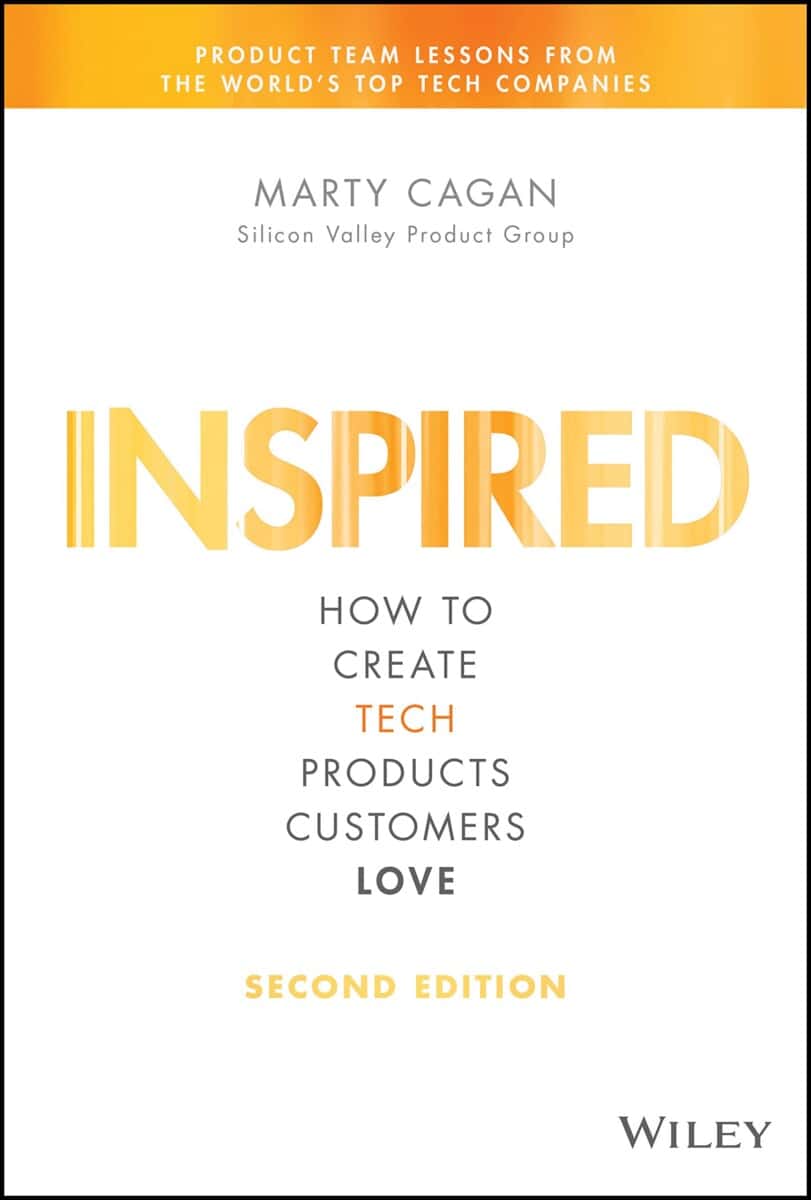
Inspired: How to Create Tech Products Customers Love, Second Edition
- Author
- Marty Cagan
- Published
- 2017 (2nd edition)
- Length
- Audiobook 8 h 46 min
- Estimated PDUs
- 8.75
- Talent Triangle
- Business Acumen
- Level
- Intermediate
- Best for
- Project managers who work with product managers and software teams
Marty Cagan explains how the best technology companies decide what to build. He separates product discovery (finding a solution customers want that the business can support) from product delivery (building it well), and he describes the four risks every product idea carries: value, usability, feasibility and business viability.
We kept it from the old list because it clears up a common source of friction. Project managers and product managers often clash when nobody has agreed who owns the outcome. After this book you will know what a strong product manager should bring to your project, and what to ask for when it is missing.
Key takeaway for project managers: Delivering on time is not success if nobody wants the product. Make sure discovery has tested value and feasibility before the project commits to a plan.
15. Financial Intelligence
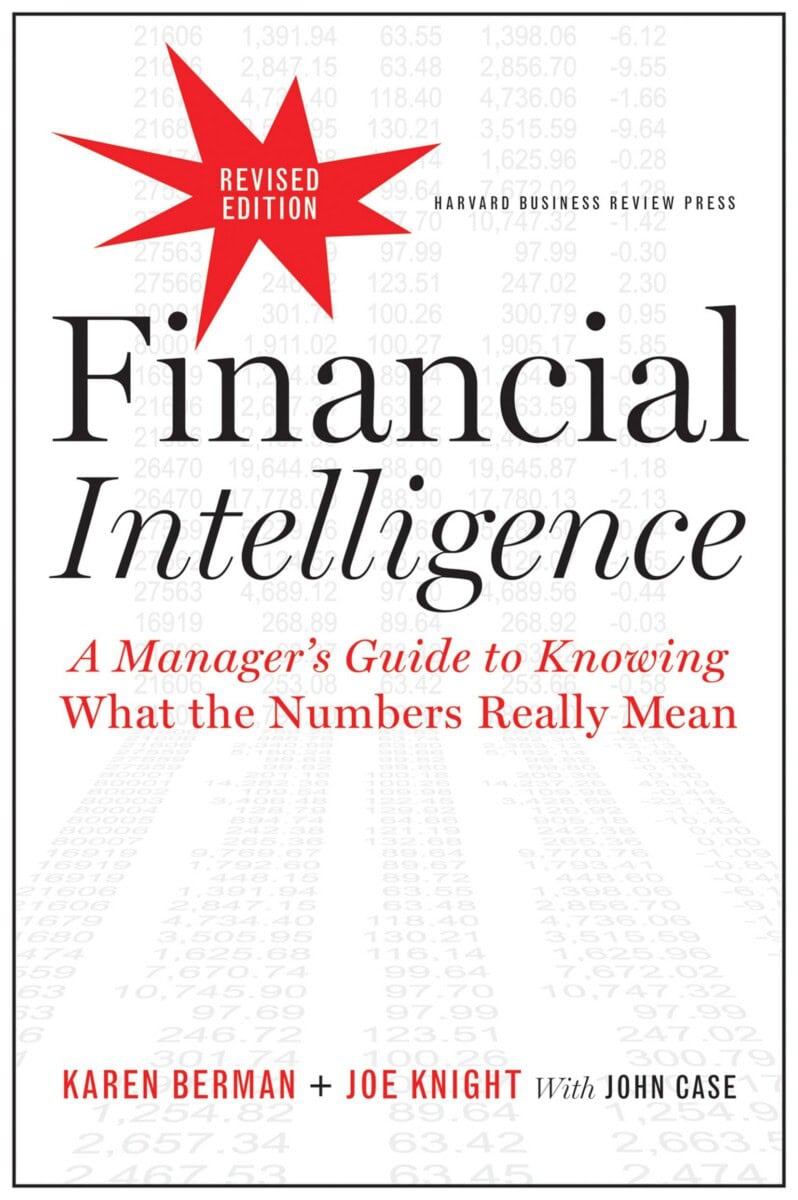
Financial Intelligence, Revised Edition: A Manager's Guide to Knowing What the Numbers Really Mean
- Author
- Karen Berman and Joe Knight, with John Case
- Published
- 2013 (revised edition)
- Length
- Audiobook 7 h 20 min
- Estimated PDUs
- 7.25
- Talent Triangle
- Business Acumen
- Level
- Beginner to intermediate
- Best for
- Project managers who build business cases or report budgets to finance
Business Acumen is the Talent Triangle side where most project managers fall short, and finance is usually the reason. This book teaches the income statement, the balance sheet and the cash flow statement in plain language, then covers ratios and the return on investment methods used to approve projects: payback, net present value and internal rate of return.
It is new to this list and it fills a real gap, because none of the old 15 books explained how money works. After reading it, a project manager can read the company results, see why finance treats capital and operating costs differently, and defend a project budget with the right numbers.
Key takeaway for project managers: Finance is partly judgment, built on estimates and assumptions. Knowing which numbers are soft makes you a stronger voice in budget and business case reviews.
Free PDU Reading Planner
Use the planner to turn this list into a renewal plan. It opens with an example for a PMP holder so you can see how it works, and nothing you enter leaves your browser.
- Your certification: choose your certification, enter your cycle end date and the PDUs you have already reported in each category.
- Pick books: tick the books you want to read, or press Fill my gaps and the planner selects the shortest books that close your missing PDUs. You can add your own books too.
- Reading plan: see your progress against each requirement and a finish date for every book at your weekly reading pace.
- Reading log and export: record the date you finished and your key takeaways, then print the plan or download it as a CSV file to keep as audit evidence.
How to Claim PDUs for Reading a Book
Reporting a book takes about five minutes in PMI’s Continuing Certification Requirements System (CCRS). The labels on the screens change from time to time, but the steps stay the same.
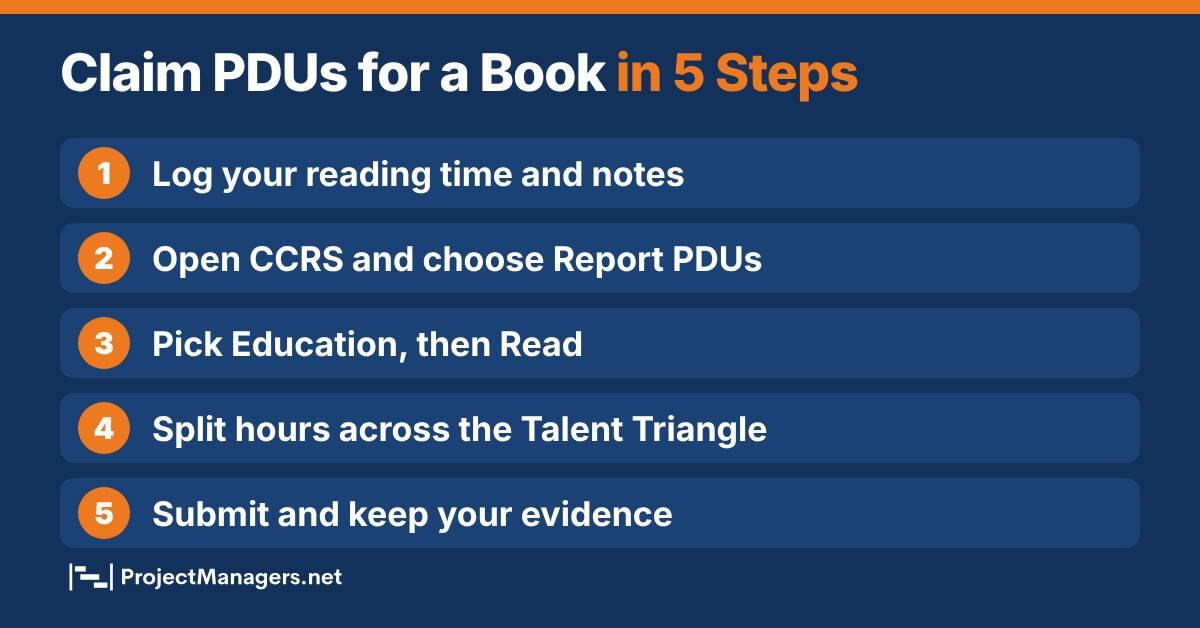
- Log your time and notes while you read. Write down the dates you started and finished, the hours you spent, and two or three things you learned. The reading log in the planner above does this for you.
- Sign in to CCRS and choose Report PDUs. Use the same account as your PMI.org profile.
- Select Education, then Read. This is the category for self-directed reading.
- Describe the book. Enter the title, the author, the dates you started and completed it, and a short description of what it covers.
- Split your hours across the Talent Triangle. Enter the PDUs for Ways of Working, Power Skills and Business Acumen. Most books fit one side, but you can split a book that covers two. The total cannot be more than the hours you spent.
- Confirm and submit. You declare that the claim is accurate. Keep your notes after you submit, in case the claim is audited.
What counts as evidence if a project manager is audited? Keep these four things for every book:
- The title, author and edition of the book.
- The dates you started and finished reading or listening.
- The number of hours you spent, which is the number of PDUs you claimed.
- Your own notes: key points, and how you used them on a project. A receipt, library loan record or audiobook history is useful extra proof.
Two renewal details are worth knowing. First, if you earn more PDUs than you need, a PMP holder can carry up to 20 PDUs into the next cycle, but only PDUs earned in the final year of the current cycle qualify. Second, renewal has a fee: for the PMP it is $60 for PMI members and $150 for non-members. If you plan to add another credential, see our ranking of the best project management certifications.
PDU Reading Quiz
Test what you have learned about earning PDUs with books. Choose one answer for each of the 10 questions, then check your score.
1. How many PDUs does one hour of relevant reading earn?
2. How many PDUs does a PMP holder need in each three-year cycle?
3. Which CCRS category covers reading a book?
4. What is the minimum number of PDUs a PMP holder needs in each Talent Triangle side?
5. Which evidence does PMI ask for if a reading claim is audited?
6. A negotiation book such as Never Split the Difference fits which Talent Triangle side best?
7. What is the current name of the side once called Technical Project Management?
8. How many PDUs does a PMI-ACP holder need every three years?
9. What is the maximum number of Giving Back PDUs a PMP holder can count?
10. How many principles and performance domains does the PMBOK Guide, Eighth Edition have?
Video: More Ways to Earn PDUs
Books work best as part of a mix. In this video, project management trainer David McLachlan walks through 10 ways to earn PDUs quickly, including courses, webinars and working as a practitioner. It is a good companion to a reading plan if your cycle ends soon.
Video: 10 Ways to Get PDUs FAST, David McLachlan on YouTube.
Facts Worth Checking
PDU rules are often quoted from memory, and many pages still repeat rules that PMI retired years ago. We checked the main claims in this article against their sources.
| Claim | Verdict | Source or correction |
|---|---|---|
| One hour of reading earns 1 PDU. | Confirmed | One hour of learning equals 1 PDU. PMI CCR Handbook |
| PMP holders need 60 PDUs every three years: at least 35 Education, at most 25 Giving Back, and 8 or more per Talent Triangle side. | Confirmed | PMI maintenance requirements |
| PMI-ACP, PMI-RMP, PMI-SP and PMI-CP holders need 30 PDUs (18 Education minimum, 12 Giving Back maximum, 4 per side). | Confirmed | PMI maintenance requirements |
| CAPM holders need 15 PDUs (9 Education minimum, 6 Giving Back maximum, 2 per side). | Confirmed | PMI maintenance requirements |
| Reading is limited to 30 PDUs per cycle. | Out of date | That cap belonged to the old “Category C: Self-Directed Learning” rules. Today Education PDUs have no maximum. PMI maintenance requirements |
| Old page: the Talent Triangle sides are Technical Project Management, People Management and Strategic and Business Management. | Corrected | The sides are now Ways of Working, Power Skills and Business Acumen. PMI maintenance requirements |
| Old page: The Fast Forward MBA in Project Management “alludes to sports”. | Corrected | MBA stands for Master of Business Administration. The book is a project management handbook and has no sports theme. |
| The PMBOK Guide, Eighth Edition was published in November 2025 and has 408 pages, six principles and seven performance domains. | Confirmed | PMI, PMBOK Guide |
| How Big Things Get Done was shortlisted for the Financial Times Business Book of the Year 2023. | Confirmed | University of Oxford, Said Business School |
| Up to 20 PDUs earned in the final year of a PMP cycle can be carried into the next cycle. | Confirmed | CCR Handbook text quoted on ProjectManagement.com |
| PMP renewal costs $60 for PMI members and $150 for non-members. | Confirmed | 4PMTI renewal guide. Confirm the fee in CCRS before you pay. |
Checked in November 2026. PMI can change its requirements, so confirm them in CCRS before you renew.
Conclusion
Books will not replace every course or conference, but they are the most flexible way for a project manager to keep a certification active. One hour of reading is one PDU, the cost is low, and the learning goes deeper than a one-hour webinar. The 15 books on this list cover all three sides of the PMI Talent Triangle, so you can meet every minimum without leaving your reading chair.
Start with the side where you are shortest, which for most project managers is Business Acumen. Pick two or three books, set a weekly reading pace in the PDU Reading Planner, and write your notes as you finish each one. By the time your renewal date arrives, the PDUs will already be reported and the evidence will be in your files.
FAQs About Earning PDUs With Books
Can I really earn PDUs by reading books?
Yes. PMI lists Read as an Education activity in its Continuing Certification Requirements program. Self-directed reading that is relevant to your certification earns 1 PDU for each hour, and you report it yourself in CCRS.
How many PDUs can I claim for one book?
You claim the hours you spent reading or listening, in steps of 0.25 PDU. PMI does not assign a fixed value to a book. A fair estimate is the length of the unabridged audiobook, which is between 3.5 and 20 hours for the books on this list.
Do audiobooks count for PDUs?
Yes. Listening to a relevant book is self-directed learning, and one hour still equals one PDU. Report the hours you listened and keep the same evidence: dates and your own notes on what you learned.
Is there a limit on PDUs from reading?
There is no maximum for Education PDUs today, so a project manager could earn every required PDU from learning activities. Older PMI rules capped self-directed learning at 30 PDUs for PMP holders, which is why that number is still quoted. In practice, mix reading with other activities and make sure you meet the minimum in each Talent Triangle side.
Does the book have to be about project management?
No. It must be relevant to the certification you hold and fit one side of the Talent Triangle. Leadership, negotiation, strategy and finance books all qualify when they build skills a project manager uses.
What proof do I need if PMI audits my reading PDUs?
PMI asks for evidence supporting your reported learning, including notes from and dates of reading. Keep the book title and author, your start and finish dates, the hours you spent and a short summary of what you learned for each claim.
Can one book count toward more than one PMI certification?
Often, yes. PDUs in Power Skills and Business Acumen can generally be applied to every PMI certification you hold, while Ways of Working PDUs must be relevant to each specific certification. CCRS lets you apply one claim to several certifications when you report it.
Suggested articles:
- Top 5 PMP Certification Preparation Books
- Free PMP Exam Study Guide: 8 Tips to Pass on Your First Try
- Guide to Becoming a Successful Project Manager

Shane Drumm, holding certifications in PMP®, PMI-ACP®, CSM, and LPM, is the author behind numerous articles featured here. Hailing from County Cork, Ireland, his expertise lies in implementing Agile methodologies with geographically dispersed teams for software development projects. In his leisure, he dedicates time to web development and Ironman triathlon training. Find out more about Shane on shanedrumm.com and please reach out and connect with Shane on LinkedIn.