
Every project runs on messages. A sponsor approves a change, a developer picks up a task, a client signs off on a deliverable. Each of those moments depends on one person getting an idea into someone else’s head without losing anything on the way. When that fails, project managers pay for it in rework, missed dates and tense meetings.
The communication process diagram is the simplest map of how that transfer works and where it breaks. This guide walks project managers through each element of the diagram, shows real cases where a single weak step changed the outcome, and gives you a free tool to test your own project messages before you hit send.
- The communication process diagram has seven elements: sender, encoding, message, channel, decoding, receiver and feedback. Noise and context surround every message.
- Most project messages fail at one weak step, usually a vague purpose, the wrong channel or no feedback loop, not because the whole message is bad.
- PMI found that 56% of the project budget at risk is at risk because of ineffective communication, and highly effective communicators are more than five times as likely to be high performers.
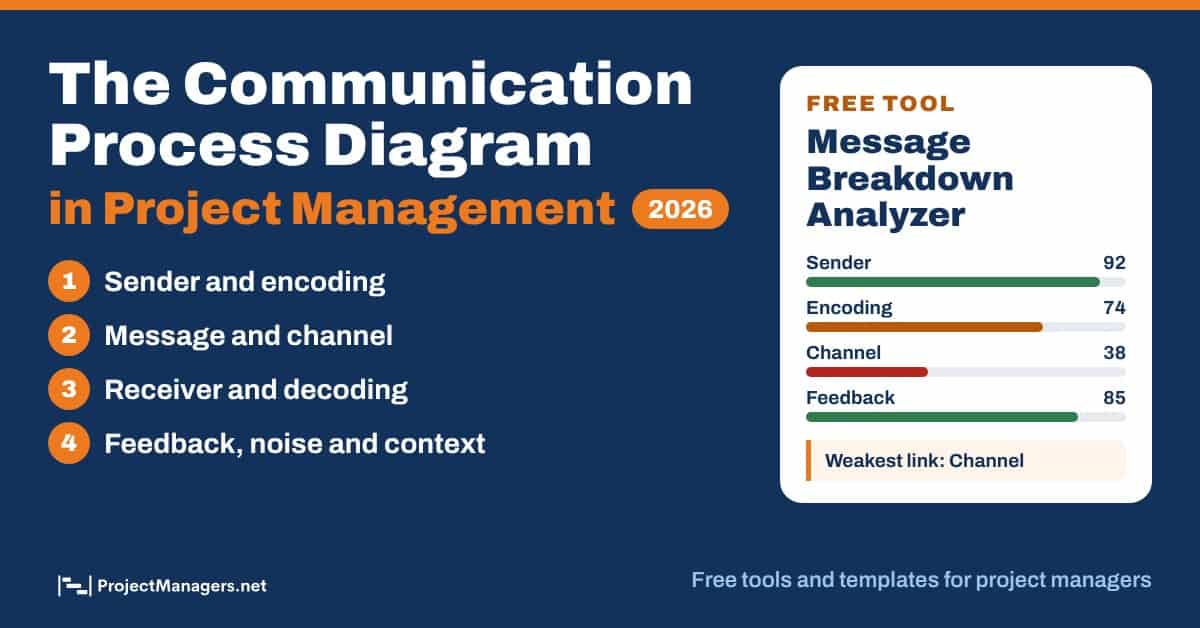
- Paste any status update, change request or task hand-off into the free analyzer below to see which step of the diagram is most likely to break.
Below you will find a plain definition, the seven elements with a project example for each, the noise and context that sit around every message, the main communication models, a step-by-step way to apply the diagram on your project, a worked example, a 10-question quiz, a short video and a fact check of claims you will often see repeated.
What Is the Communication Process?
The communication process is the series of steps that moves an idea from a sender to a receiver through a chosen channel, and back again as feedback. It is not only about sending. A message can be sent perfectly and still fail if the receiver reads it differently, never sees it, or has no easy way to say “I am not sure what you mean.”
The idea of drawing communication as a diagram goes back to 1948, when Claude Shannon at Bell Labs published a model of how a signal travels from a source to a destination and how noise can distort it on the way. Later researchers added the human parts a telephone engineer did not need: how people turn thoughts into words, how their experience shapes what they understand, and how replies close the loop.
For a project manager, the value of the diagram is practical. It turns a fuzzy problem (“the team did not get it”) into a specific question: did the breakdown happen when I chose my words, when I picked the channel, when they read it, or because nobody checked that it landed?
Real-life example
The paper that started it all was written for telephone engineers
Shannon’s 1948 paper in the Bell System Technical Journal described a source, a transmitter, a channel, a receiver and a destination, with noise able to distort the signal in between. It was about telegraph and telephone signals, not meetings. Warren Weaver later explained how the same ideas apply to human communication, and the diagram project managers use today grew out of that work.
From the field
The fundamental problem of communication is “…reproducing at one point either exactly or approximately a message selected at another point.”
Claude Shannon, A Mathematical Theory of Communication, 1948
By the numbers
- 88%of the workweek is spent communicating across channels, according to knowledge workers in the 2024 survey.Grammarly and Harris Poll, 2024
- 100%of knowledge workers surveyed said they run into miscommunication at least once a week.Grammarly and Harris Poll, 2024
The Communication Process Diagram: 7 Elements Explained
Most textbooks and project management courses use a seven-element version of the diagram. The sender encodes an idea into a message, sends it through a channel, and the receiver decodes it. Feedback travels back so the sender knows whether the message landed. Noise can distort any step, and context shapes how everything is understood.
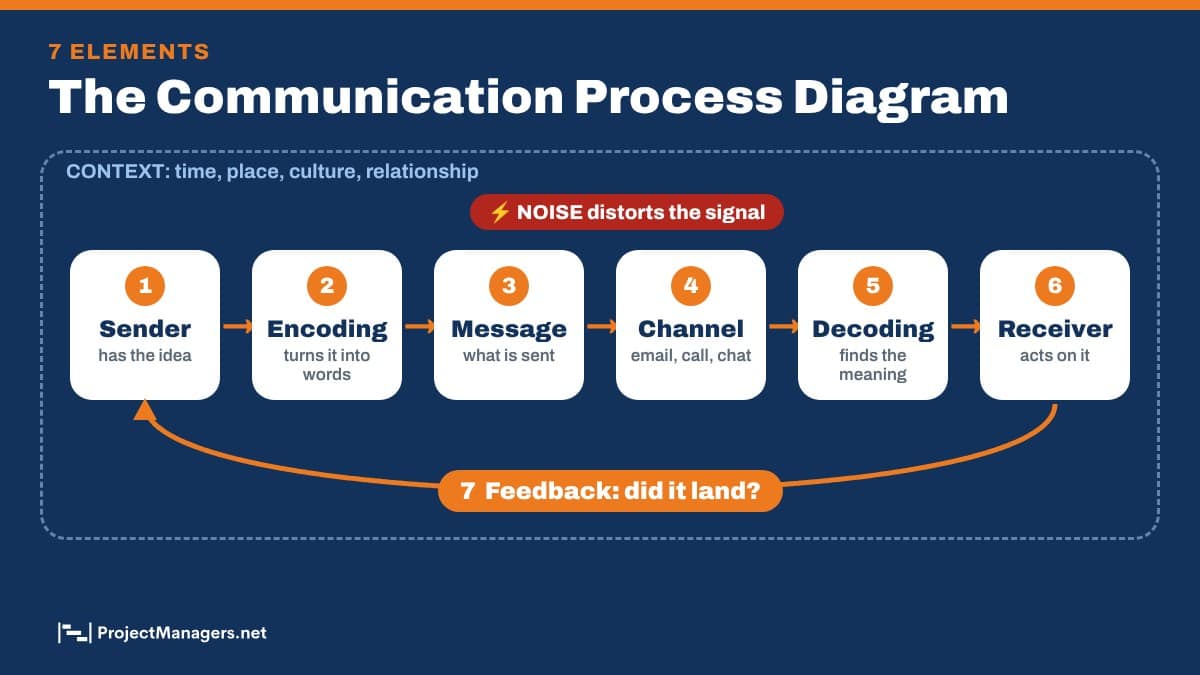
The 7 elements at a glance
Use the last column as a pre-send checklist for any important project message.
| Element | What it means | Question for the project manager |
|---|---|---|
| 1. Sender | The person who starts the message and owns its purpose. | What do I want the receiver to know, decide or do? |
| 2. Encoding | Turning the idea into words, numbers, visuals or tone. | Will this reader understand my terms, acronyms and numbers? |
| 3. Message | The content that is actually sent. | Does it include the date, owner, impact and request? |
| 4. Channel | The medium: email, meeting, call, chat, report or ticket. | Does the channel fit the urgency, complexity and sensitivity? |
| 5. Decoding | The receiver working out what the message means. | Is there any word that could be read two ways? |
| 6. Receiver | The person or group the message is for. | Did I write for their role, knowledge and language? |
| 7. Feedback | The response that shows whether the message landed. | How and by when will I know they understood? |
1. Sender
The sender is the person who starts the communication and is responsible for its purpose. On a project that is often the project manager, but it can be a team lead, a business analyst, a vendor or the sponsor. The sender’s first job happens before any words are written: deciding what the message is for. An update, a decision request, a task assignment and a risk escalation each need a different shape.
Credibility also travels with the sender. A message from a project manager who has been accurate in the past is read with more trust than one from someone whose last three “on track” updates turned out to be late. That is why honest, consistent reporting is part of the communication process, not a separate soft skill.
2. Encoding
Encoding is translating your thoughts into a form someone else can receive: words, numbers, a chart, a demo, tone of voice or body language. Project managers encode constantly, and most breakdowns start here. Acronyms that are obvious to the delivery team (“UAT slips because the SIT env is down”) mean nothing to a sponsor. Long sentences hide the one fact that matters. Idioms like “circle back” or “ballpark” trip up readers who use English as a second language.
Good encoding matches the receiver. For executives, lead with the decision and the impact in plain words. For the delivery team, technical terms are fine, but dates and owners still need to be exact. For mixed or global audiences, shorter sentences and spelled-out terms remove most of the risk.
3. Message
The message is the content itself: facts, requests, options, opinions and feelings. Its clarity and structure decide how much work the receiver has to do. A useful test is to ask what the receiver must know to act without coming back with a question. For a decision request, that means the deadline, the options, the impact of each option and your recommendation. For a task, it means the exact work, a named owner, a due date and where to find the inputs.
Structure helps too. Put the point in the first line, group details under short labels such as “Why” and “Options”, and link to the project plan or tracker for anything else. The 5 C’s of communication (clarity, conciseness, correctness, completeness and cohesiveness) are a good checklist for this step.
4. Channel
The channel, or medium, is how the message travels: a face-to-face conversation, a video call, a phone call, an email, a chat message, a report, a dashboard or a comment on a task. The same words can work in one channel and fail in another. Bad news sent by chat feels careless. A complex trade-off explained only in a meeting is forgotten by Friday. A routine update booked as a one-hour meeting wastes a dozen people’s time.
A simple rule covers most project situations: the more complex, urgent or sensitive the message, the richer the channel should be. Rich channels (in person, video, phone) carry tone and allow instant questions. Lean channels (email, documents, tickets) leave a record people can reread. For important decisions, many project managers use both: a short written summary, then a 15-minute call.
5. Decoding
Decoding is the receiver turning the message back into meaning. Two people can read the same sentence and decode it differently, because they bring different knowledge, priorities and assumptions. “We are slightly behind” means two days to the project manager and two weeks to a nervous client. “End of week” means Friday 5 p.m. in Toronto and Saturday morning in Sydney.
Bias matters as well. A receiver who already doubts the project will read a neutral update as bad news. One who is overloaded will skim the first line and miss the request at the bottom. The fix sits back at the sender’s side: remove words that can be read two ways, and use calendar dates, numbers and named owners instead.
Real-life example
One word that did not mean “emergency”
In January 1990, Avianca Flight 52 circled New York for over an hour while running low on fuel. The crew told air traffic control they needed “priority” and that they were running out of fuel, but never used the word “emergency”. Controllers did not decode “priority” as an emergency, and the Boeing 707 crashed after its engines flamed out. The investigation pointed to the crew’s failure to state the emergency clearly and to the lack of standard terms for fuel states.
Source: Avianca Flight 052 (Wikipedia summary of the NTSB report)
From the field
A total breakdown in communications by the flight crew.
US National Transportation Safety Board, finding on Avianca Flight 52
By the numbers
- 73 of 158people on board died when the aircraft ran out of fuel near the airport.NTSB via Wikipedia
- 1 wordseparated a routine request from an emergency the receiver would have acted on at once.NTSB via Wikipedia
6. Receiver
The receiver is the individual or group the message is for. On a project there are usually several receivers with different needs: the sponsor wants impact and decisions, the team wants tasks and dates, the client wants progress against what was promised, and vendors want clear scope. One message rarely serves them all. A stakeholder analysis, such as one built with the free stakeholder analysis templates on this site, tells you who needs what and how much detail each group can absorb.
The receiver’s situation also counts. A field engineer reading on a phone between site visits needs a three-line message, not a two-page attachment. A new team member needs a sentence of background that a veteran would skip.
7. Feedback
Feedback is the response from the receiver back to the sender. It is the step that turns one-way broadcasting into communication, because it is the only way the sender learns whether the message was understood. Feedback can be a reply, a question, a read-back of the key points, a facial expression in a meeting or, too often, silence that the sender mistakes for agreement.
Project managers can design feedback into every important message. Ask for a specific reply (“Please confirm Option 1 or 2 by November 19”) rather than “let me know your thoughts”. In meetings, close each decision by saying it back and naming the owner. For critical instructions, ask the receiver to summarize the next steps in their own words. Aviation made this a rule after Tenerife, and healthcare uses the same idea, called teach-back, with patients.
Real-life example
The read-back rule that came out of Tenerife
In March 1977, two Boeing 747s collided on a fog-covered runway at Tenerife. The KLM crew read back their route clearance and ended with a non-standard phrase about being at takeoff. The tower answered “OK”, and a simultaneous radio call blocked the rest of the message and the Pan Am crew’s warning that they were still on the runway. Afterwards, standard phrases became mandatory, “OK” stopped counting as an acknowledgment, and the word “takeoff” was kept only for the clearance itself.
By the numbers
- 583people died in the deadliest accident in aviation history, which reshaped radio phraseology worldwide.Wikipedia
- 40 to 80%of medical information given to patients is forgotten immediately, which is why clinicians check understanding with teach-back.Kessels, J R Soc Med, 2003
Noise and Context: What Surrounds Every Message
The seven elements describe the path a message takes. Noise and context describe the conditions along that path. Both explain why a message that looks fine on paper can still fail in practice.
Noise
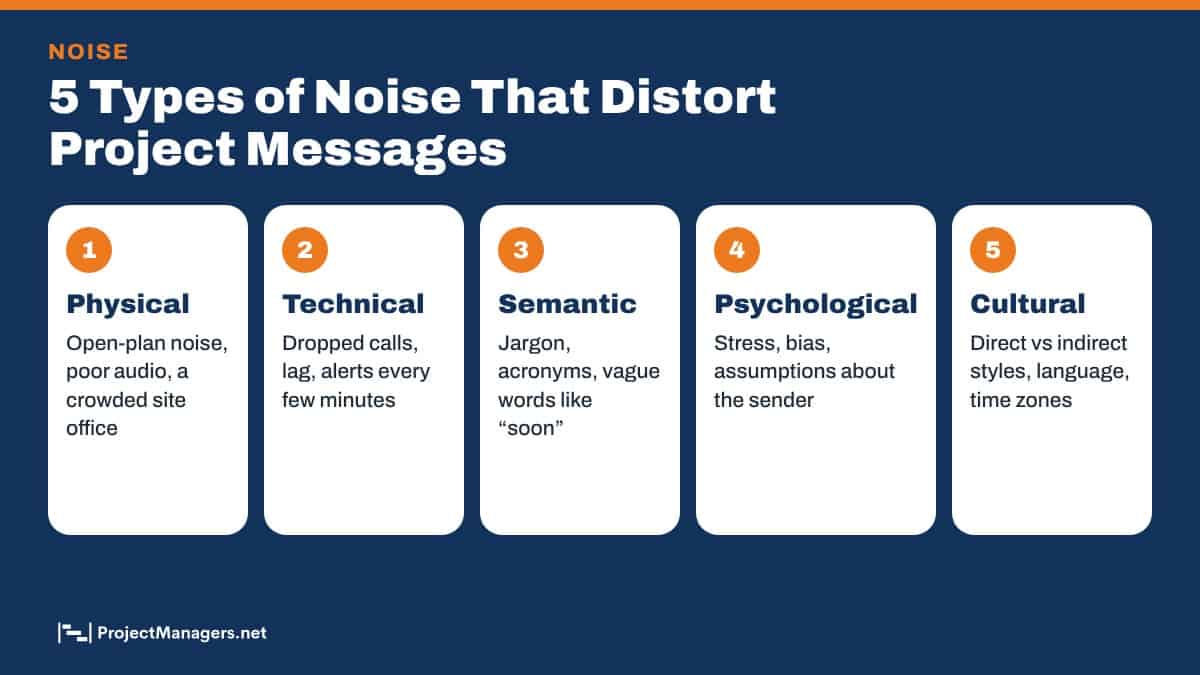
Noise is anything that distorts or blocks the message between the sender and the receiver. It is not only sound. Project managers deal with five common types:
- Physical noise: an open-plan office, a loud construction site or a bad microphone on a call.
- Technical noise: dropped calls, video lag, overflowing inboxes and constant notifications.
- Semantic noise: jargon, acronyms and vague words such as “soon”, “minor” or “a bit”.
- Psychological noise: stress, fatigue, defensiveness or assumptions about the sender’s motives.
- Cultural noise: differences in directness, language, hierarchy and time zones.
You cannot remove all noise, but you can plan around it. Send important messages when receivers can focus, keep one source of truth so side conversations do not create competing versions, and repeat key decisions in more than one channel.
Context
Context is everything around the communication: the time, the place, the relationship between the people, the history of the project and the culture of the team. The same sentence lands differently in a calm planning session and in the week before go-live. Anthropologist Edward T. Hall described how some cultures rely heavily on shared context and indirect messages (high-context), while others expect meaning to be stated plainly (low-context). On a global project, both styles often sit in the same meeting.
Context also explains why some topics should never be pushed into a meeting at all. Exploring what high-performing ops teams never outsource to meetings helps project managers understand how context-aware communication reduces misalignment and keeps teams focused on outcomes. Routine status, approvals and requests can flow through shared tools, which frees live time for the conversations that need it. For cross-cultural teams, the strategies in cross-cultural management are a good next read.
Real-life example
The “infinite workday” is a noise problem
Microsoft’s 2025 Work Trend Index looked at Microsoft 365 activity and found that a typical worker is interrupted roughly every two minutes during core hours by a meeting, email or chat message. The average worker also gets more than 50 messages outside core hours, and meetings that start after 8 p.m. rose 16% year over year. For a project manager, every one of those pings competes with your message for the receiver’s attention.
By the numbers
- Every 2 mina worker is interrupted during core hours, about 275 times a day on a 24-hour basis.Microsoft, 2025
- 117 and 153emails and Teams messages the average worker receives per day, most emails skimmed in under a minute.Microsoft, 2025
Why the Communication Process Matters for Project Managers
Project managers spend a large share of their day communicating: running meetings, writing updates, negotiating scope and clearing blockers. When that communication works, the project moves. When it fails, the cost shows up everywhere else.
- Fewer misunderstandings: clear messages reduce rework and the “that is not what I asked for” moments that eat into the schedule.
- Faster decisions: sponsors decide quickly when they get the options, the impact and a recommendation in one place.
- More trust: consistent, honest updates make the project manager a reliable source, so people act on what they read.
- Earlier warnings: a working feedback loop surfaces risks while there is still time to respond.
- Better collaboration: teams that share information openly solve problems together instead of in silos.
Informal, overheard communication matters too. Osmotic communication, where team members pick up useful information simply by working near each other, keeps feedback fast and spreads knowledge cheaply. Remote and hybrid teams lose much of it, which is why they need more deliberate updates, written decisions and a single place where the latest version lives.
Real-life example
High performers communicate differently
PMI’s Pulse of the Profession research on communications compared organizations by how effectively they communicate. Those rated highly effective communicators were far more likely to be high performers, and ineffective communication accounted for more than half of the money at risk on projects. Communication was not a side issue in the study. It was one of the clearest dividing lines between organizations that deliver and those that do not.
Source: PMI Pulse of the Profession: The Essential Role of Communications, 2013
By the numbers
Free Message Breakdown Analyzer
Use this free tool to run one of your own project messages through the communication process diagram. It scores each step from 0 to 100, shows your weakest link and suggests specific fixes.
- Pick an example to see how it works, or choose Blank to start fresh.
- Describe the sender’s purpose, the receiver and the channel you plan to use.
- Paste your subject line and message (or your talking points for a call).
- Tick the feedback and context checks that apply, then read the score, the channel check and the marked-up message.
The analyzer runs entirely in your browser and nothing you type is sent anywhere. It checks structure and wording, so you still need to confirm that the facts and numbers in your message are correct.
Message Breakdown Analyzer
Run one project message through the communication process diagram and see which step is most likely to break down.
Everything runs in your browser. Nothing you type is sent anywhere. Your last message is kept in this browser only.
Linear, Interactive and Transactional Communication Models
The seven-element diagram is one of several models. Some textbooks shorten the communication process to five processes (sender, transmission, noise, receiver and feedback). Others use six elements and fold decoding into the receiver. None of them is the “official” version. They are different zoom levels on the same idea, and each one fits different project situations.
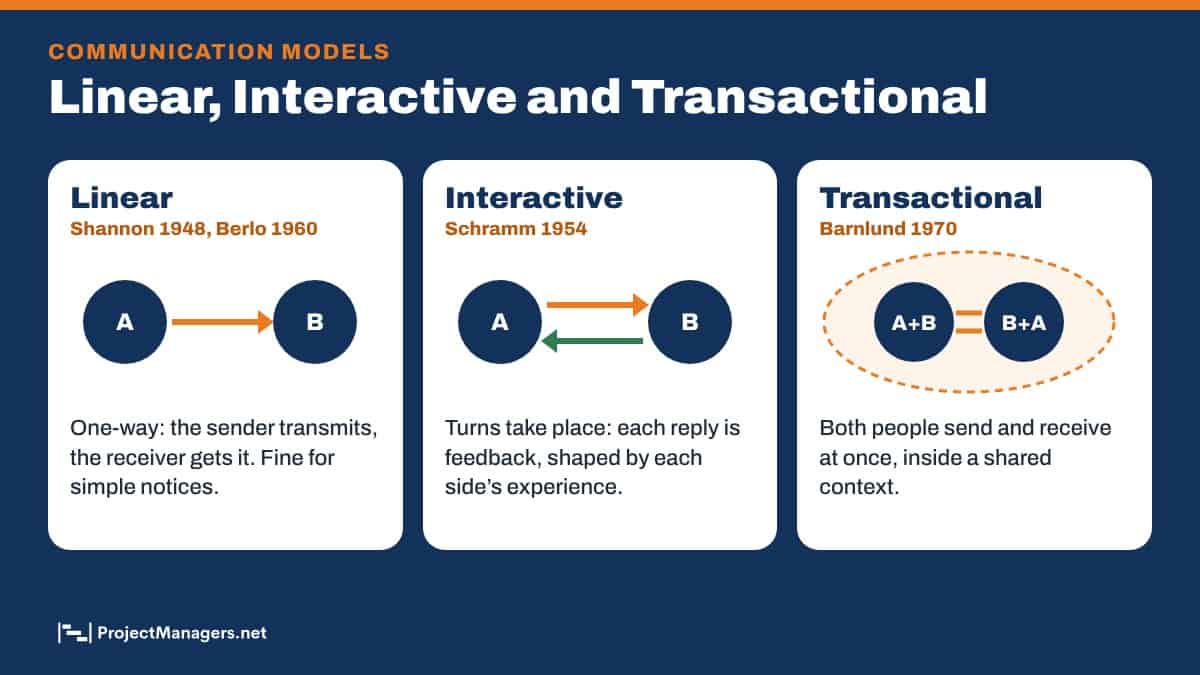
Main communication models compared
Years refer to first publication. All are still taught in communication and project management courses.
| Model | Type | What it adds | Where it helps on a project |
|---|---|---|---|
| Lasswell (1948) | Linear | Five questions: who says what, in which channel, to whom, with what effect. | Planning a communication plan row for each stakeholder group. |
| Shannon and Weaver (1948 to 1949) | Linear | Source, transmitter, channel, receiver, destination, with noise distorting the signal. | Spotting technical noise in tools and channels. |
| Schramm (1954) | Interactive | Feedback, and a “field of experience” that shapes encoding and decoding. | Writing for receivers with different knowledge and background. |
| Berlo SMCR (1960) | Linear | Source, message, channel and receiver, each shaped by skills, attitudes and knowledge. | Checking that sender and receiver share enough skills and knowledge. |
| Barnlund (1970) | Transactional | Both people send and receive at the same time, and meaning is built together in context. | Workshops, negotiations and sensitive conversations. |
Sources: Models of communication (Wikipedia), A Mathematical Theory of Communication.
In practice, project managers mix them. A status email is close to the linear model, so you add a feedback request to make it interactive. A conflict conversation is transactional, so you plan for listening as much as talking.
How to Apply the Communication Process Diagram on Your Project
Communication on a project is not a one-off message. It is a repeating cycle of planning, sending, confirming and adjusting. The PMBOK Guide Sixth Edition split this work into three processes: Plan Communications Management, Manage Communications and Monitor Communications. Later editions organize the guide around principles and performance domains, but those three activities still describe the job well.

Step 1. Identify who needs what. Start by identifying the stakeholders and what each group needs to know, decide or do. Note their influence, their preferred channel and how much detail they want. The project stakeholder management guide covers this step in depth.
Step 2. Plan the message and the channel. Write a communication plan that lists each message, its audience, owner, frequency and channel. A free communication plan template saves time here. Choose from the main types of communication used on projects, such as meetings, emails, phone calls, presentations, memos and the project plan itself, and match each one to the situation using the table below.
Step 3. Send and confirm. Encode for the receiver, send through the planned channel and build in feedback: a reply-by date, a read-back in the meeting, or a quick poll after an announcement.
Step 4. Monitor and adjust. Watch for signs that messages are not landing: repeated questions, missed actions, surprised stakeholders. Log key communications and decisions in a communication register, and update the plan when stakeholders, risks or phases change.
Which channel fits which project message?
Start here, then adjust for your team’s habits and time zones.
| Situation | Best channel | Feedback check |
|---|---|---|
| Routine weekly status | Email or a dashboard link | Ask readers to flag anything that is wrong by a set day. |
| Decision with trade-offs | Short written summary, then a 15-minute call | Ask for the chosen option in writing. |
| Urgent blocker today | Phone or video call, then a chat recap | Confirm the owner and the next check-in time. |
| Bad news or sensitive change | Face-to-face or video, then a written follow-up | Ask what questions people have and answer them in writing. |
| Task assignment | The task in the project tool, with a named owner | Owner accepts the task and confirms the due date. |
| Announcement to 20+ people | Email or project page, repeated in the next meeting | Short Q&A slot or a feedback form. |
Common Breakdowns at Each Step and How to Fix Them
When a project message fails, it usually fails at one step. Knowing the warning signs makes the fix quick.
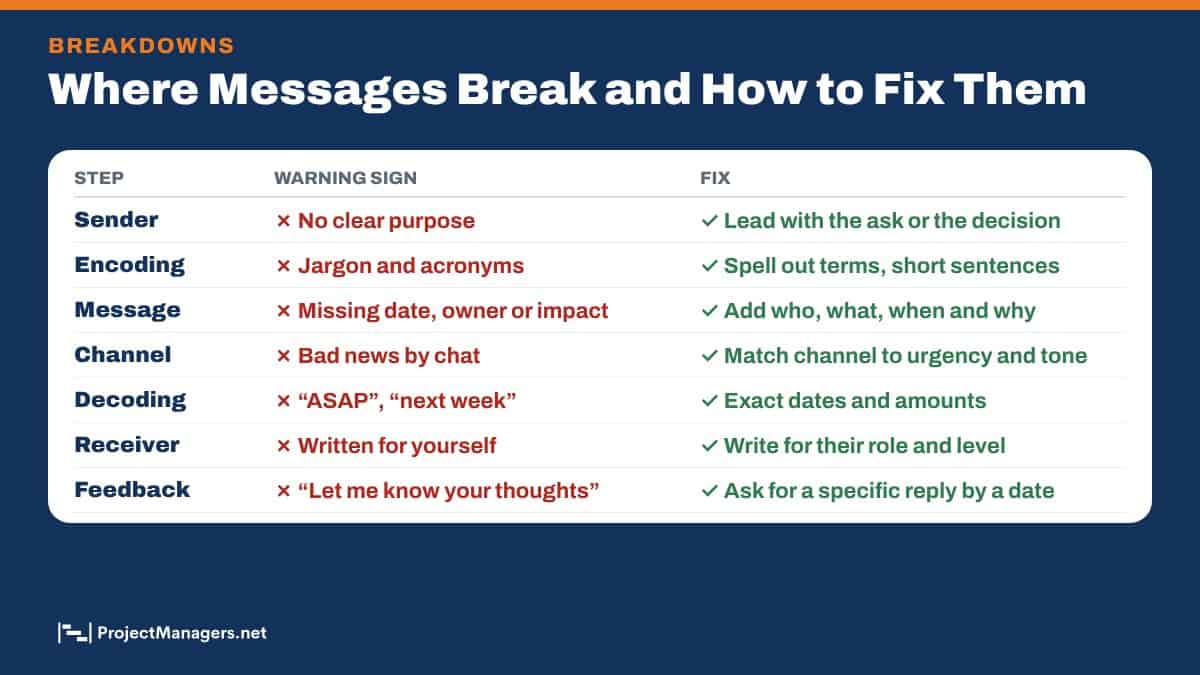
- Sender: the message has no clear purpose, so readers cannot tell whether to act. Lead with the request or decision in the first line.
- Encoding: acronyms and insider terms. Spell out terms the first time and keep sentences to around 15 to 20 words.
- Message: missing date, owner or impact. Add who, what, when and why before you send.
- Channel: sensitive news by chat, or a one-line update booked as a meeting. Match the channel to urgency, complexity and tone.
- Decoding: words like “ASAP”, “minor” and “next week”. Replace them with exact dates, amounts and time zones.
- Receiver: one message sent to everyone at the same level of detail. Tailor the version for each stakeholder group.
- Feedback: “let me know your thoughts”. Ask for a specific reply by a specific date, and treat silence as a question, not agreement.
Communication breakdowns are also a leading cause of friction. If a misunderstanding has already turned into tension, the guide to the 5 conflict levels in the workplace helps you judge how serious it is and how to respond.
Example: One Change Request Through the Diagram
Here is the same change request written two ways. The project has a vendor delay that pushes user acceptance testing, and the project manager needs the sponsor to approve a new date.
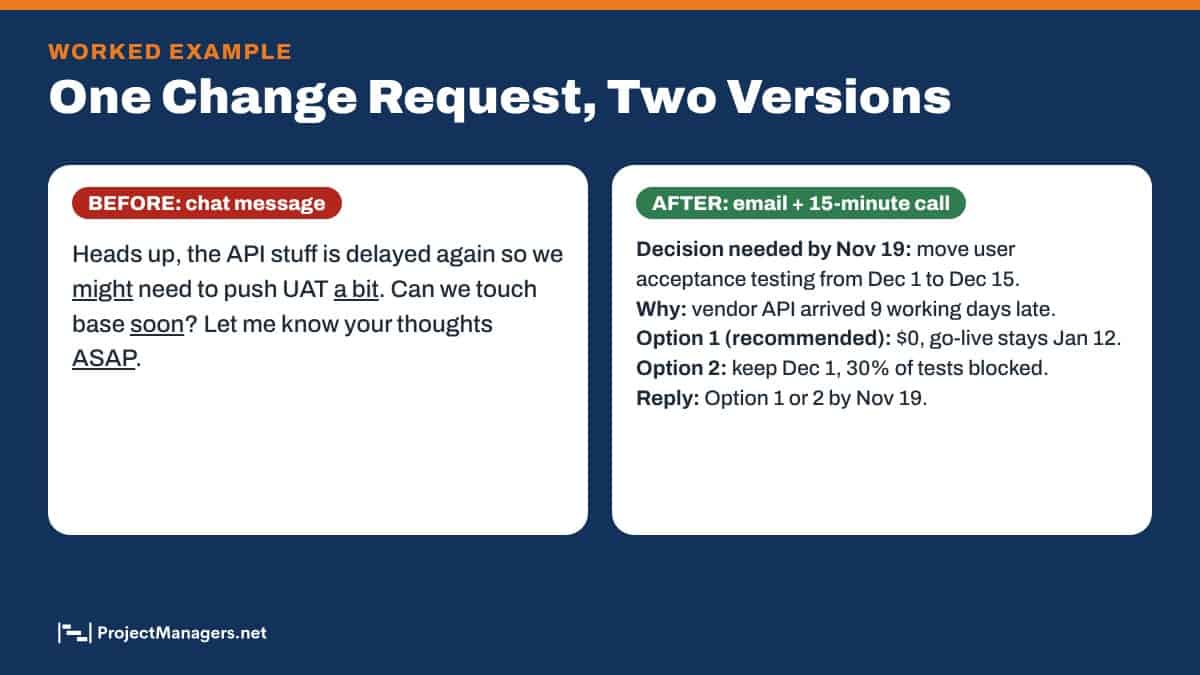
The change request, step by step
Load the “Vague change request” and “Clear change request” examples in the analyzer to see the scores side by side.
| Step | Before | After |
|---|---|---|
| Sender | Purpose buried: “might need to push UAT a bit”. | First line states the decision needed and the deadline. |
| Encoding | Acronyms and idioms: “API stuff”, “UAT”, “touch base”. | Plain terms, with user acceptance testing spelled out once. |
| Message | No dates, options or impact. | Cause, two options, cost and schedule impact, recommendation. |
| Channel | Chat message for a complex, sensitive decision. | Email the sponsor can reread, plus a booked 15-minute call. |
| Decoding | “Soon”, “a bit”, “ASAP” can mean anything. | Calendar dates and a time zone. |
| Receiver | Subject line “Quick question”. | Subject names the decision and the date. |
| Feedback | “Let me know your thoughts.” | “Please reply with Option 1 or 2 by November 19.” |
Nothing in the “after” version is long or formal. It simply covers each step of the diagram, so the sponsor can decide in two minutes and the project manager knows exactly when to expect an answer.
Test Your Knowledge: 10 Questions on the Communication Process
10 questions on the communication process diagram
Check what you learned. Pick an answer, then open the explanation.
Which element of the diagram turns an idea into words, numbers or visuals?
- ADecoding
- BEncoding
- CFeedback
- DChannel
Show answer
Answer B. Encoding is the sender translating thoughts into a form the receiver can take in.
In the Avianca Flight 52 case, which word did controllers not treat as an emergency?
- AMayday
- BUrgent
- CPriority
- DFuel
Show answer
Answer C. The crew asked for “priority” but never declared an emergency, so controllers did not act on it as one.
Who published the 1948 model that introduced noise distorting a signal between source and destination?
- AWilbur Schramm
- BDavid Berlo
- CClaude Shannon
- DDean Barnlund
Show answer
Answer C. Claude Shannon described the model in A Mathematical Theory of Communication at Bell Labs.
Which model added the “field of experience” and feedback?
- ASchramm (1954)
- BLasswell (1948)
- CBerlo (1960)
- DShannon (1948)
Show answer
Answer A. Schramm’s interactive model shows that shared experience shapes how messages are encoded and decoded.
Jargon, acronyms and vague words are examples of which type of noise?
- APhysical
- BTechnical
- CPsychological
- DSemantic
Show answer
Answer D. Semantic noise comes from the meaning of words, not from sound or technology.
What share of the project budget at risk did PMI link to ineffective communication?
- A12%
- B33%
- C56%
- D90%
Show answer
Answer C. PMI’s 2013 Pulse research put 56% of the money at risk down to ineffective communication.
Which is the best feedback request in a decision email?
- ALet me know your thoughts
- BPlease reply with Option 1 or 2 by November 19
- CAny questions?
- DThanks in advance
Show answer
Answer B. A specific reply and a date tell the receiver exactly what to send and when.
What is the best channel for bad news or a sensitive change?
- AA chat message
- BA ticket comment
- CA face-to-face or video conversation, then a written follow-up
- DA line in the monthly report
Show answer
Answer C. Rich channels carry tone and allow questions; the written follow-up keeps a record.
In a transactional model, how do sender and receiver interact?
- AThey take strict turns
- BOnly the sender speaks
- CBoth send and receive at the same time
- DThey communicate only in writing
Show answer
Answer C. Barnlund’s transactional model treats communication as simultaneous and shaped by shared context.
According to Mehrabian himself, when does the 7-38-55 rule apply?
- ATo all workplace communication
- BOnly when people talk about feelings or attitudes
- COnly to written messages
- DOnly to presentations
Show answer
Answer B. Mehrabian said the ratios do not apply unless the speaker is talking about feelings or attitudes.
Video: How the Communication Process Works
How the Communication Process Works
This short lesson from Alanis Business Academy walks through each step of the communication process with simple examples. Watch it as a quick refresher before you run a message through the analyzer above.
Video by Alanis Business Academy on YouTube: How the Communication Process Works.
Facts Worth Checking
Facts worth checking
Each claim is checked against the original source where one exists.
| Claim | Verdict | What the source says |
|---|---|---|
| Project managers spend 90% of their time communicating. | Partly true | The figure is widely repeated, including in a 2010 PMI conference paper, but that paper states it without citing a study or data. Treat it as a rule of thumb. PMI library |
| 93% of communication is nonverbal (the 7-38-55 rule). | False | Mehrabian’s small lab studies were about feelings and attitudes, and he said the ratios do not apply otherwise. Big Think |
| There is one official communication process with exactly seven steps. | False | Models range from Lasswell’s five questions to Berlo’s four SMCR parts and Barnlund’s transactional model. Wikipedia |
| Shannon’s original model was designed for human conversation. | False | It was a model of signals in telegraph and telephone systems; Weaver later applied it to human communication. Wikipedia |
| Ineffective communication puts 56% of project budgets at risk. | Partly true | PMI found 56% of the budget at risk is at risk because of communication, not 56% of the whole budget. PMI |
| Poor communication costs US businesses $1.2 trillion a year. | Partly true | This is an estimate from a 2022 survey of business leaders and knowledge workers, not an audited figure. Business Wire |
| Workers are interrupted about every two minutes. | True | Microsoft measured this from Microsoft 365 activity during core work hours. Microsoft |
| Saying “priority” to air traffic control declares an emergency. | False | On Avianca Flight 52, controllers did not treat “priority” as an emergency declaration. Wikipedia |
| The high-context and low-context idea comes from Edward T. Hall. | True | The anthropologist introduced the terms to describe how much meaning cultures leave unsaid. Wikipedia |
Frequently Asked Questions
What is the communication process diagram?
It is a visual model of how a message moves from a sender to a receiver. The sender encodes an idea into a message, sends it through a channel, the receiver decodes it, and feedback travels back. Noise and context surround the whole process.
What are the 7 elements of the communication process?
Sender, encoding, message, channel, decoding, receiver and feedback. Many versions also show noise, which distorts the message, and context, which shapes how it is understood.
What is noise in the communication process?
Noise is anything that distorts or blocks a message. It can be physical (a loud room), technical (a dropped call), semantic (jargon or vague words), psychological (stress or bias) or cultural (different communication styles).
Why is feedback important in project communication?
Feedback is the only way a project manager knows whether a message was understood. Without it, silence is easily mistaken for agreement, and misunderstandings surface late, when they cost more to fix.
What is the difference between the 6-step and 7-step communication models?
They describe the same process at different levels of detail. The 7-step version shows decoding as its own step; shorter versions fold it into the receiver. Some also list noise or context as separate steps.
How do project managers use the communication process in a communication plan?
For each stakeholder group, the plan names the sender, the message, the channel, the frequency and how feedback will be collected. Thinking through each element of the diagram ensures no step is left to chance.
Conclusion
The communication process diagram is simple on purpose. Sender, encoding, message, channel, decoding, receiver and feedback, wrapped in noise and context: seven boxes and a loop. Yet almost every project communication failure can be traced to one of them. When project managers know which step is weak, the fix is usually small: a clearer first line, a better channel, a calendar date instead of “soon”, or a direct request for a reply.
Used consistently, the diagram keeps stakeholders informed, gives them a real chance to provide input and helps avoid confusion and conflict among stakeholders. Run your next important message through the free analyzer above, and browse the Free PM Toolkit for more tools that help your project succeed.
Suggested articles:
- A Quick Overview of the Basic Communication Model For Project Managers
- Communication Channels in Project Management: Formula & Examples
- What Are The 5 C’s Of Communication In Project Management?
- Communication Plan Template for Project Managers

Shane Drumm, holding certifications in PMP®, PMI-ACP®, CSM, and LPM, is the author behind numerous articles featured here. Hailing from County Cork, Ireland, his expertise lies in implementing Agile methodologies with geographically dispersed teams for software development projects. In his leisure, he dedicates time to web development and Ironman triathlon training. Find out more about Shane on shanedrumm.com and please reach out and connect with Shane on LinkedIn.